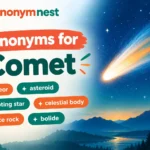
Have you ever looked at the night sky and noticed a bright object with a long, glowing tail? That beautiful sight might remind you of a comet. Comets have fascinated people for centuries because of their unusual appearance, long journeys through space, and connection to the early history of our solar system.
If you are looking for synonyms for comet, the right word depends on your purpose. In science writing, the word comet is the most accurate term. In creative writing, expressions such as celestial wanderer, cosmic visitor, and icy traveler can help describe a comet in a more imaginative way.
Some related terms, including meteor, fireball, and asteroid, describe different astronomical objects or phenomena. They are useful for understanding space vocabulary, but they are not exact synonyms for comet.
This guide explores 50 comet-related words and descriptive expressions, with simple meanings and example sentences. Whether you are a student, teacher, blogger, writer, or English learner, you will learn how to choose the right expression for science projects, essays, stories, and everyday communication.
What Is a Comet?
A comet is a small celestial body made mainly of ice, dust, rock, and frozen gases that orbits the Sun. When a comet approaches the Sun, its surface heats up, releasing gas and dust. This process can create a glowing cloud called a coma and one or more tails.
A comet’s tail generally points away from the Sun because of solar radiation and the solar wind. Although a comet may look like a bright star in the sky, it is a different type of object.
Comets are scientifically important because they preserve material from the early solar system. Studying them helps astronomers investigate how the planets and other celestial bodies formed.
50 Comet Synonyms and Related Words
The following list includes scientific descriptions, common related terms, and creative expressions. Each entry explains how the word or phrase can be used without suggesting that every expression is an exact synonym.
1. Icy Celestial Body
Meaning: A natural object in space that contains substantial amounts of ice.
Examples:
- The icy celestial body developed a bright tail as it approached the Sun.
- Scientists studied the icy celestial body to understand its composition.
Usage: A useful descriptive expression for explaining the physical nature of a comet.
2. Cometary Body
Meaning: A body associated with a comet or having comet-like characteristics.
Examples:
- The researchers examined the cometary body through a powerful telescope.
- The cometary body released dust as it moved closer to the Sun.
Usage: Suitable for scientific or educational writing.
3. Celestial Wanderer
Meaning: A poetic description of a celestial object traveling through space.
Examples:
- The comet appeared like a celestial wanderer in the dark sky.
- The poet described the celestial wanderer as a visitor from distant space.
Usage: Best for stories, poetry, and imaginative descriptions.
4. Cosmic Visitor
Meaning: A descriptive expression for an object that appears in a particular region of space.
Examples:
- The cosmic visitor attracted the attention of amateur astronomers.
- Children watched the cosmic visitor through a backyard telescope.
Usage: A creative alternative, not a formal astronomical synonym.
5. Icy Traveler
Meaning: A poetic description of an icy object moving through space.
Examples:
- The icy traveler began to glow as it approached the Sun.
- Astronomers followed the icy traveler across the night sky.
Usage: Useful for simple explanations and creative writing.
6. Solar System Body
Meaning: A natural object that belongs to the solar system.
Examples:
- The comet is a solar system body with an elongated orbit.
- Scientists calculated the path of the solar system body.
Usage: A broad scientific description that also applies to many non-comet objects.
7. Celestial Body
Meaning: A natural physical object in space.
Examples:
- The celestial body traveled around the Sun.
- Researchers measured the movement of the celestial body.
Usage: A general astronomical term, not a comet-specific synonym.
8. Astronomical Object
Meaning: An object studied by astronomers.
Examples:
- The astronomical object became brighter as it approached the Sun.
- The telescope captured detailed images of the astronomical object.
Usage: Appropriate for educational and scientific writing.
9. Icy Solar System Object
Meaning: An object in the solar system that contains significant ice.
Examples:
- The icy solar system object released gas near the Sun.
- Scientists compared the icy solar system object with other comets.
Usage: A descriptive phrase that emphasizes a comet’s icy composition.
10. Dust-and-Ice Body
Meaning: A body composed of frozen material and dust.
Examples:
- The dust-and-ice body developed a coma during its solar approach.
- Researchers investigated the dust-and-ice body to learn about ancient solar material.
Usage: Useful for explaining comet composition in simple English.
11. Cosmic Traveler
Meaning: A poetic expression for an object journeying through space.
Examples:
- The cosmic traveler crossed the region near the inner planets.
- The writer imagined the comet as a cosmic traveler on a long journey.
Usage: Suitable for creative and descriptive writing.
12. Space Wanderer
Meaning: An informal expression for an object moving through space.
Examples:
- The space wanderer returned to the region near the Sun.
- The story followed a space wanderer through the solar system.
Usage: A figurative description rather than a formal scientific term.
13. Heavenly Wanderer
Meaning: A poetic phrase describing an object traveling through the heavens.
Examples:
- The heavenly wanderer appeared above the distant hills.
- Ancient observers recorded the heavenly wanderer in their writings.
Usage: Appropriate for historical narratives and poetry.
14. Astral Wanderer
Meaning: A literary expression for a celestial object traveling through space.
Examples:
- The astral wanderer inspired a poem about the universe.
- The author compared the comet to an astral wanderer.
Usage: Best suited to imaginative writing.
15. Celestial Traveler
Meaning: A descriptive expression for an object journeying through space.
Examples:
- The celestial traveler followed a long orbit around the Sun.
- The celestial traveler became visible through a telescope.
Usage: A useful poetic alternative to repeating the word comet.
16. Solar Visitor
Meaning: A descriptive expression for an object approaching or appearing in the Sun’s vicinity.
Examples:
- The solar visitor grew brighter as it approached the Sun.
- Astronomers observed the solar visitor during its closest approach.
Usage: A creative phrase, not an established name for comets.
17. Celestial Visitor
Meaning: A poetic expression for a celestial object appearing in the sky.
Examples:
- The celestial visitor became a topic of discussion among local stargazers.
- The story described the comet as a mysterious celestial visitor.
Usage: Works well in storytelling and general descriptions.
18. Cosmic Drifter
Meaning: A literary expression for an object moving through space.
Examples:
- The cosmic drifter continued along its orbital path.
- The author portrayed the comet as a cosmic drifter.
Usage: A figurative expression; a comet follows an orbit rather than drifting without direction.
19. Space Traveler
Meaning: A general expression for an object moving through space.
Examples:
- The space traveler followed an elliptical path around the Sun.
- The children’s book introduced a comet as a space traveler.
Usage: Useful in educational stories and beginner-friendly explanations.
20. Frozen Space Body
Meaning: A descriptive expression for a cold object in space containing frozen material.
Examples:
- The frozen space body released gas when sunlight warmed its surface.
- Researchers studied the frozen space body from a safe distance.
Usage: A broad description, not a standard astronomical name.
21. Dusty Snowball
Meaning: An informal description of a comet’s mixture of ice and dust.
Examples:
- The dusty snowball formed a coma near the Sun.
- The teacher used a dusty snowball analogy to explain comet composition.
Usage: Helpful for explaining comets to younger readers, although a comet is more complex than a simple snowball.
22. Cosmic Snowball
Meaning: A popular descriptive phrase for an icy comet containing dust and rocky material.
Examples:
- The cosmic snowball released dust as it warmed.
- The illustration showed a cosmic snowball traveling around the Sun.
Usage: Suitable for introductory science writing.
23. Icy Space Rock
Meaning: An informal description of a space object containing ice and rocky material.
Examples:
- The icy space rock developed a tail near the Sun.
- Students learned how an icy space rock differs from a typical asteroid.
Usage: Useful in simple explanations, but it is not a precise scientific classification.
24. Frozen Space Object
Meaning: A general expression for an object in space containing frozen substances.
Examples:
- The frozen space object released gas as it warmed.
- Scientists investigated the frozen space object using telescopic observations.
Usage: A descriptive phrase that can apply to objects other than comets.
25. Comet Nucleus
Meaning: The solid central part of a comet, composed mainly of ice, dust, and rocky material.
Examples:
- The comet nucleus contained ancient material from the solar system.
- Scientists studied the comet nucleus to understand its structure.
Usage: A genuine scientific term, but it refers specifically to the central part of a comet rather than the entire comet.
26. Coma-Bearing Body
Meaning: A descriptive phrase for a body surrounded by a coma, a cloud of gas and dust.
Examples:
- The coma-bearing body became easier to observe near the Sun.
- Images revealed the cloud around the coma-bearing body.
Usage: A descriptive expression rather than a standard synonym.
27. Long-Tailed Celestial Object
Meaning: A celestial object described by its prominent tail.
Examples:
- The long-tailed celestial object appeared in the evening sky.
- The photograph showed the long-tailed celestial object against a field of stars.
Usage: A descriptive phrase that can be useful when a comet’s tail is visible.
28. Tailed Celestial Body
Meaning: A celestial body observed with a visible tail.
Examples:
- The tailed celestial body became a popular target for photographers.
- Astronomers studied the tail of the celestial body.
Usage: Descriptive rather than a formal synonym.
29. Bright Celestial Object
Meaning: A celestial object that appears bright when observed.
Examples:
- The bright celestial object attracted attention from skywatchers.
- The comet appeared as a bright celestial object in the telescope.
Usage: A general expression that can describe stars, planets, comets, and other objects.
30. Night-Sky Visitor
Meaning: A poetic expression for an object that appears in the night sky.
Examples:
- The night-sky visitor inspired a group of students to study astronomy.
- Families gathered to observe the night-sky visitor.
Usage: Best for informal articles and creative descriptions.
31. Astral Visitor
Meaning: A literary expression for a visitor from the celestial realm.
Examples:
- The astral visitor appeared in the writer’s science-fiction story.
- The poem described the comet as an astral visitor.
Usage: A figurative phrase, not an official astronomical category.
32. Star-Like Object
Meaning: An object that appears similar to a star when viewed from a distance.
Examples:
- The comet initially looked like a star-like object through the telescope.
- Observers noticed that the star-like object developed a faint tail.
Usage: Describes appearance only; a comet is not a star.
33. Glowing Celestial Object
Meaning: A celestial object that appears to glow or reflect light.
Examples:
- The glowing celestial object became more visible after sunset.
- The telescope captured the glowing celestial object in detail.
Usage: A broad descriptive phrase.
34. Cometary Object
Meaning: An object associated with a comet or displaying comet-like characteristics.
Examples:
- The researchers examined the cometary object for signs of gas release.
- The report discussed the object’s cometary characteristics.
Usage: Suitable for technical contexts when the wording matches the scientific evidence.
35. Solar-Orbiting Icy Body
Meaning: An icy body that travels around the Sun.
Examples:
- The solar-orbiting icy body followed a long elliptical path.
- Researchers calculated the orbit of the solar-orbiting icy body.
Usage: A descriptive scientific phrase; other icy bodies can also orbit the Sun.
36. Periodic Comet
Meaning: A comet that returns to the inner solar system on a recurring orbital schedule.
Examples:
- Halley’s Comet is a well-known periodic comet.
- Astronomers calculated the next expected return of the periodic comet.
Usage: A specific category of comet, not a synonym for every comet.
37. Long-Period Comet
Meaning: A comet with an orbital period generally longer than 200 years.
Examples:
- The long-period comet took thousands of years to complete its orbit.
- Scientists studied the long-period comet to understand its origin.
Usage: A scientific classification for a particular type of comet.
38. Short-Period Comet
Meaning: A comet that completes an orbit around the Sun in 200 years or less.
Examples:
- The short-period comet returned to the inner solar system.
- Astronomers calculated the orbit of the short-period comet.
Usage: A specific scientific category rather than a general synonym.
39. Halley-Type Comet
Meaning: A comet belonging to a class of comets with orbital characteristics similar to Halley’s Comet.
Examples:
- Researchers classified the object as a Halley-type comet.
- The report compared the Halley-type comet with other periodic comets.
Usage: A specialized astronomical expression, not a general alternative for comet.
40. Oort Cloud Comet
Meaning: A comet originating from, or associated with, the distant Oort Cloud reservoir.
Examples:
- The astronomers investigated the possible origin of the Oort Cloud comet.
- The object may have entered the inner solar system from a distant reservoir.
Usage: Use when the object’s origin or classification supports the description.
41. Asteroid
Meaning: A rocky or metallic body that orbits the Sun.
Examples:
- The asteroid followed an orbit through the solar system.
- Scientists compared the asteroid’s composition with that of a comet.
Usage: A related space term, not a comet synonym. Asteroids and comets differ in composition and activity, although some objects show characteristics of both.
42. Meteor
Meaning: The visible streak of light produced when a meteoroid enters Earth’s atmosphere and heats the surrounding air.
Examples:
- A meteor flashed across the sky for a brief moment.
- The students watched a meteor shower during the astronomy event.
Usage: A related astronomical term, not a synonym for comet.
43. Fireball
Meaning: An exceptionally bright meteor.
Examples:
- A fireball illuminated the night sky.
- Observers reported seeing a fireball above the horizon.
Usage: Use for a bright meteor phenomenon, not as a direct substitute for comet.
44. Shooting Star
Meaning: A common name for a meteor’s streak of light in Earth’s atmosphere.
Examples:
- The child made a wish after seeing a shooting star.
- We watched several shooting stars during the meteor shower.
Usage: A familiar expression in everyday English, but scientifically different from a comet.
45. Meteoroid
Meaning: A small natural object traveling through space, generally smaller than an asteroid.
Examples:
- The meteoroid entered Earth’s atmosphere and produced a streak of light.
- Researchers studied the difference between a meteoroid and a comet.
Usage: A related scientific term, not a comet synonym.
46. Meteorite
Meaning: A piece of a space object that survives passage through the atmosphere and reaches the ground.
Examples:
- The museum displayed a meteorite discovered in a desert.
- Scientists analyzed the meteorite to determine its composition.
Usage: A distinct term that should not be used interchangeably with comet.
47. Interstellar Object
Meaning: An object that travels through interstellar space rather than remaining gravitationally bound to the Sun.
Examples:
- Astronomers investigated the interstellar object as it passed through the solar system.
- The unusual trajectory suggested that the interstellar object came from beyond our solar system.
Usage: A related astronomical category; some interstellar objects may display comet-like activity, but not all are comets.
48. Minor Planet
Meaning: A small solar system body that is neither a planet nor a dwarf planet; the term is commonly used for many asteroids and similar objects.
Examples:
- The astronomer recorded the orbit of the minor planet.
- Students compared the minor planet with other solar system bodies.
Usage: A related astronomical term, not a general synonym for comet.
49. Trans-Neptunian Object
Meaning: An object that orbits the Sun beyond Neptune’s orbit.
Examples:
- The trans-Neptunian object occupied a distant region of the solar system.
- Scientists studied the trans-Neptunian object’s orbit and composition.
Usage: A broad category that includes different kinds of objects, some of which can be related to comet populations.
50. Small Solar System Body
Meaning: A broad astronomical category for small objects orbiting the Sun, including comets and asteroids.
Examples:
- The comet is classified as a small solar system body.
- Researchers studied the small solar system body to learn more about the early solar system.
Usage: A useful scientific umbrella term, but it is not specific to comets.
Best Synonyms and Alternatives for Comet by Context
The best word depends on the type of writing you are doing. Here is a quick guide to choosing an appropriate alternative.
| Writing context | Recommended term or phrase |
|---|---|
| Scientific article | Comet, cometary body |
| School science project | Icy celestial body, comet |
| Children’s explanation | Cosmic snowball, icy traveler |
| Poetry | Celestial wanderer, astral visitor |
| Creative storytelling | Cosmic visitor, space wanderer |
| General astronomy article | Solar system body, celestial object |
| Technical classification | Periodic comet, long-period comet |
| Describing the solid center | Comet nucleus |
| Describing the surrounding cloud | Coma |
| Describing a visible streak in the atmosphere | Meteor or shooting star, where appropriate |
Remember that descriptive phrases can make writing more interesting, but scientific terms should be used whenever accuracy matters.
Comet vs. Meteor vs. Asteroid
Comets, meteors, and asteroids are often confused because they are all connected to space. However, they are not interchangeable words.
Comet: An icy body that orbits the Sun and may develop a coma and tail as it warms.
Asteroid: A rocky or metallic body that orbits the Sun. Most do not develop the characteristic coma and tail of an active comet.
Meteor: A visible streak of light produced when a meteoroid enters Earth’s atmosphere.
Meteorite: Material from a space object that survives its journey through the atmosphere and reaches the ground.
Understanding these differences helps you select accurate vocabulary for essays, educational content, and astronomy discussions.
How to Use Comet Synonyms in Sentences
When choosing an alternative to comet, consider whether you want to explain a scientific fact or create a particular mood.
Scientific example:
“The comet released gas and dust as it approached the Sun.”
Descriptive example:
“The icy celestial body developed a glowing tail against the dark sky.”
Poetic example:
“A celestial wanderer crossed the heavens, leaving a trail of light behind it.”
Educational example:
“The teacher described a comet as a cosmic snowball made of ice, dust, and rocky material.”
Creative writing example:
“In the old legend, a cosmic visitor appeared whenever the kingdom faced a great change.”
These examples show how different expressions can communicate similar imagery without changing the underlying scientific meaning.
Common Mistakes When Using Comet Synonyms
Avoiding a few common mistakes can make your writing more accurate and natural.
1. Calling a comet a shooting star
A comet and a shooting star are different phenomena. A shooting star is a meteor’s visible streak in Earth’s atmosphere.
2. Treating every descriptive phrase as an exact synonym
Phrases such as celestial wanderer and cosmic visitor are creative alternatives. They are not formal astronomical classifications.
3. Confusing a comet’s nucleus with the whole comet
The nucleus is the solid central part. The coma and tails are additional features that may develop as the comet becomes active.
4. Repeating similar phrases too often
Using cosmic traveler, space wanderer, astral wanderer, and celestial traveler in every paragraph can make an article sound repetitive. Choose the expression that best fits the sentence.
5. Using technical terms without explaining them
Words such as coma, meteoroid, and trans-Neptunian object may be unfamiliar to beginners. Provide a short explanation when introducing them.
Frequently Asked Questions
What is another word for comet?
The most accurate word is usually comet itself. Descriptive alternatives include icy celestial body, cometary body, and celestial wanderer. The last expression is poetic rather than scientific.
What are five words related to comets?
Five useful comet-related terms are comet nucleus, coma, asteroid, meteor, and meteoroid. These words have different meanings, so they should not all be treated as synonyms.
Is a shooting star another name for a comet?
No. A shooting star is the visible streak produced by a meteoroid entering Earth’s atmosphere. A comet is an icy body that orbits the Sun.
What is a poetic word for comet?
Celestial wanderer is a poetic expression that works well in stories and poems. Other creative options include cosmic visitor and icy traveler.
What is the scientific name for a comet?
Comet is already the standard scientific term. Depending on the context, astronomers may use more specific terms such as periodic comet, long-period comet, or comet nucleus.
Why do comets have tails?
When a comet approaches the Sun, its ice releases gas and dust. Sunlight and the solar wind help form tails that generally point away from the Sun.
Are comets stars?
No. Stars produce energy through processes such as nuclear fusion, while comets are comparatively small bodies made mainly of ice, dust, and rocky material that orbit the Sun.
Can I use cosmic visitor instead of comet in an essay?
Yes, if you are writing creatively or descriptively. For a scientific essay, use comet when precision is important, and introduce cosmic visitor only as a figurative expression.
Conclusion
Learning synonyms and related words for comet can make your writing more varied, descriptive, and engaging. Expressions such as celestial wanderer, cosmic visitor, and icy traveler are useful for creative writing, while terms such as cometary body, comet nucleus, and small solar system body serve more specific explanatory purposes.
However, not every space-related word is a synonym. A comet is different from a meteor, asteroid, shooting star, and meteorite. Understanding these distinctions will help you write more accurately and choose vocabulary that suits your audience.
Use scientific terminology for factual explanations and creative expressions for storytelling, poetry, and descriptive writing. With the right word choice, you can explain the wonders of comets clearly without sacrificing accuracy or style.