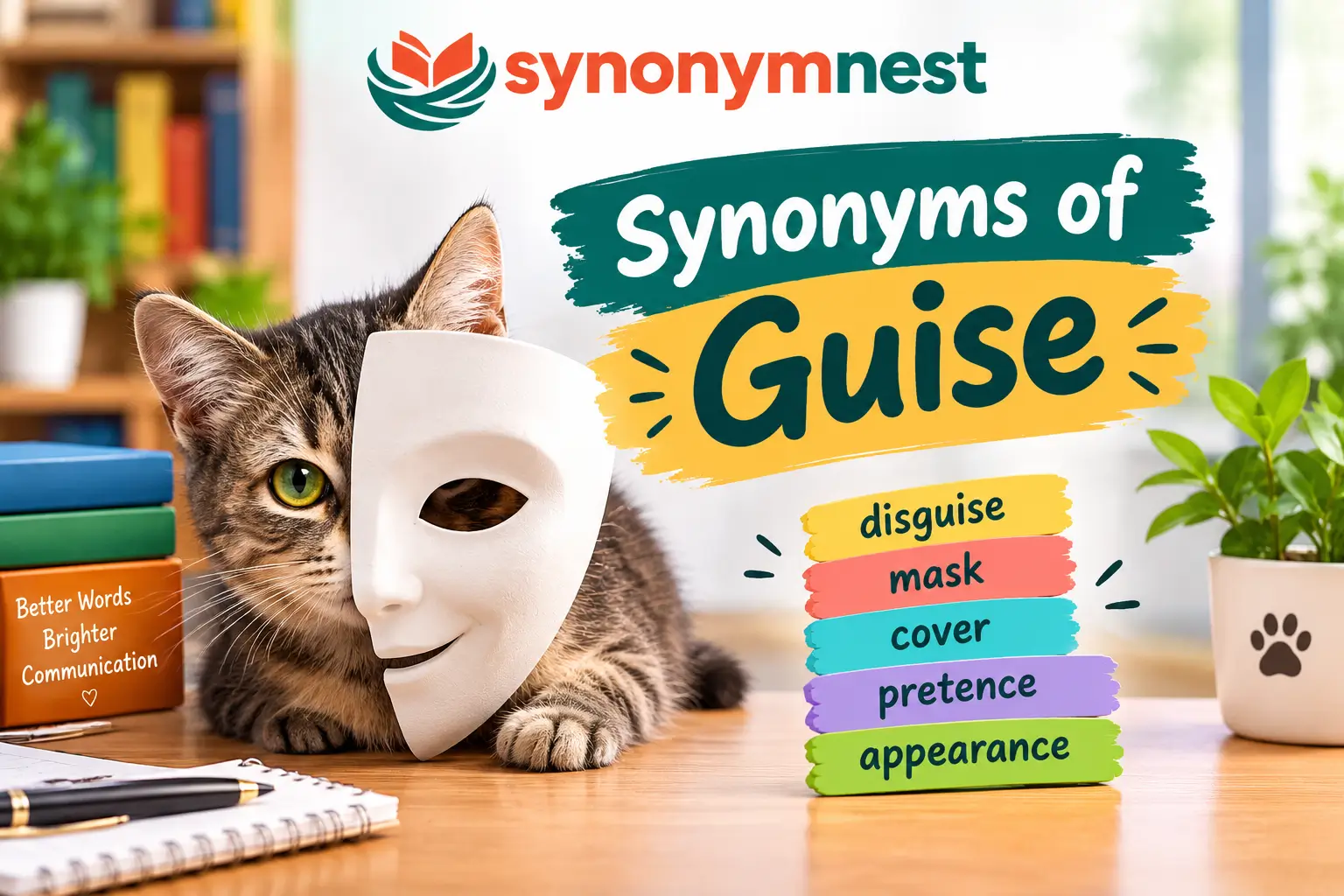
The word guise refers to an outward appearance, form, or manner that can hide someone’s true identity, intentions, or nature. It is commonly used when something appears to be one thing while its real purpose or character is different.
For example, if someone offers help while secretly trying to gain an advantage, their helpful behavior may be described as a guise.
Learning synonyms for guise can help you avoid repetition and choose a word that fits the exact context. Some alternatives emphasize deception, while others focus on appearance, concealment, identity, or a false impression.
This guide explains 30 useful synonyms and closely related alternatives to guise, with simple meanings and examples.
Meaning of Guise
Guise is a noun meaning an outward appearance, form, or manner that can conceal the real nature, identity, or purpose of something.
Examples
- He approached the company in the guise of a consultant.
- The proposal was presented under the guise of helping local businesses.
- The organization operated under the guise of a charity.
The word often suggests that the outward appearance does not completely reveal the truth.
Pronunciation of Guise
Guise: /ɡaɪz/
It rhymes with words such as size, wise, and rise.
Synonyms of Guise
The following words can replace guise in particular contexts. They are not all interchangeable in every sentence, so the examples show the situations where each alternative works naturally.
1. Disguise
Meaning: An appearance or covering used to hide identity or true appearance.
Examples:
- He wore a disguise to avoid being recognized.
- The thief changed his appearance as a disguise.
Usage: Disguise is one of the closest alternatives to guise, especially when hiding identity or appearance is involved.
2. Pretense
Meaning: A false claim, appearance, or behavior intended to make something seem true.
Examples:
- His friendliness was only a pretense.
- She visited the office under the pretense of asking for advice.
Usage: Pretense is especially useful when someone pretends that something is true.
3. Facade
Meaning: A false or misleading outward appearance.
Examples:
- His confidence was only a facade.
- The company’s success proved to be a facade.
Usage: Facade often describes a surface appearance that hides problems or reality.
4. Mask
Meaning: Something that hides a person’s real feelings, intentions, or identity.
Examples:
- His smile was a mask for his disappointment.
- She used confidence as a mask for her nervousness.
Usage: Mask can be literal or figurative and is common when discussing hidden emotions.
5. Cover
Meaning: Something used to hide the real purpose or truth.
Examples:
- The business was a cover for another operation.
- He used humor as a cover for his embarrassment.
Usage: Cover is often used when something is deliberately used to conceal another activity or purpose.
6. Cloak
Meaning: Something that conceals or hides something else.
Examples:
- The project was presented under a cloak of secrecy.
- The announcement was a cloak for the company’s real intentions.
Usage: Cloak is often figurative and has a more literary or formal tone.
7. Front
Meaning: A false appearance or organization that hides the real activity behind it.
Examples:
- The shop was used as a front for illegal activities.
- His cheerful attitude was merely a front.
Usage: Front is useful when an outward appearance hides a different reality.
8. Persona
Meaning: A public identity or personality that someone presents to others.
Examples:
- The actor created a confident public persona.
- His professional persona was very different from his private personality.
Usage: Persona is related to guise when the focus is on an identity or character presented to other people.
9. Pretext
Meaning: A reason given to hide the real reason for doing something.
Examples:
- He used illness as a pretext for leaving early.
- The meeting was a pretext for discussing a private business deal.
Usage: Pretext is not an exact synonym of guise. It refers specifically to a false or misleading reason.
10. Sham
Meaning: Something that is presented as genuine but is actually false.
Examples:
- Their agreement was a sham.
- The investigation was criticized as a sham.
Usage: Sham strongly suggests that something is fake or deliberately misleading.
11. Charade
Meaning: A situation or performance that is presented as genuine but is actually false.
Examples:
- Their friendly meeting was only a charade.
- Everyone knew that the argument was a charade.
Usage: Charade often describes a deceptive performance maintained for appearances.
12. Sham appearance
Meaning: A false outward appearance designed to create a particular impression.
Examples:
- The peaceful meeting was a sham appearance.
- His polite behavior created a sham appearance of agreement.
Usage: This phrase is useful when emphasizing that the appearance is deliberately false.
13. False front
Meaning: An outward appearance that hides the truth.
Examples:
- His cheerful attitude was a false front.
- The company maintained a false front of stability.
Usage: False front closely matches the idea of an appearance that conceals reality.
14. Semblance
Meaning: An appearance or outward impression of something.
Examples:
- The team maintained a semblance of order.
- She tried to maintain a semblance of confidence.
Usage: Semblance can describe an outward appearance that may not fully reflect reality.
15. Appearance
Meaning: The way someone or something looks or seems from the outside.
Examples:
- His calm appearance hid his concerns.
- The building had an impressive appearance.
Usage: Appearance is broader and more neutral than guise. It does not necessarily imply deception.
16. Outward appearance
Meaning: The visible or external way something seems.
Examples:
- His outward appearance suggested confidence.
- The company’s outward appearance was positive.
Usage: This is a useful neutral alternative when the focus is on what others can see rather than deliberate deception.
17. Show
Meaning: An outward display or presentation of something.
Examples:
- His concern was only a show.
- The apology seemed like a show for the audience.
Usage: Show can suggest that an outward display is not completely genuine.
18. Affectation
Meaning: Behavior or speech that is deliberately adopted to create a particular impression.
Examples:
- His formal accent was an affectation.
- Her exaggerated confidence seemed like an affectation.
Usage: Affectation is useful when someone deliberately adopts behavior that does not feel natural.
19. Act
Meaning: Pretended behavior or a performance that is not genuine.
Examples:
- His anger was just an act.
- She dropped her polite act when they were alone.
Usage: Act is an informal and common way to describe behavior that is being pretended.
20. Ruse
Meaning: A clever trick or deceptive plan used to achieve a purpose.
Examples:
- The friendly conversation was a ruse to obtain information.
- His question was merely a ruse.
Usage: Ruse emphasizes the deceptive method rather than the outward appearance itself.
21. Subterfuge
Meaning: Deception or a secret method used to achieve a goal.
Examples:
- The information was obtained through subterfuge.
- They used subterfuge to conceal their plans.
Usage: Subterfuge is formal and usually refers to deliberate deception.
22. Artifice
Meaning: A clever or skillful method used to deceive or create an effect.
Examples:
- His friendliness was an artifice designed to gain trust.
- The speech relied on clever rhetorical artifice.
Usage: Artifice is formal and often suggests cleverness or deliberate construction.
23. Deception
Meaning: The act of making someone believe something that is not true.
Examples:
- The entire scheme depended on deception.
- His smile was part of the larger deception.
Usage: Deception is broader than guise because it refers to the act or practice of misleading someone.
24. Concealment
Meaning: The act of hiding something from view or knowledge.
Examples:
- The concealment of the evidence caused further suspicion.
- His silence helped with the concealment of the truth.
Usage: Concealment focuses on hiding something rather than presenting a particular false appearance.
25. Camouflage
Meaning: Something that hides or makes something difficult to recognize.
Examples:
- The soldiers used camouflage to blend into their surroundings.
- Humor became a form of emotional camouflage.
Usage: Camouflage can be literal or figurative and is especially useful when something is hidden by blending in.
26. Veil
Meaning: Something that partially hides, covers, or obscures something.
Examples:
- The truth remained behind a veil of secrecy.
- His polite words created a veil over his real intentions.
Usage: Veil is often figurative and has a literary tone.
27. Screen
Meaning: Something that hides or protects something from being seen or known.
Examples:
- The public statement was a screen for the real issue.
- His jokes acted as a screen for his anxiety.
Usage: Screen works when something conceals another thing or prevents people from seeing the truth.
28. Cover-up
Meaning: An attempt to hide wrongdoing, information, or an embarrassing fact.
Examples:
- The officials were accused of a cover-up.
- The false report was part of a cover-up.
Usage: Cover-up is more specific than guise and normally relates to hiding an unwanted truth.
29. Assumed identity
Meaning: An identity adopted instead of one’s real identity.
Examples:
- The investigator traveled under an assumed identity.
- He used an assumed identity while working undercover.
Usage: This phrase is appropriate when guise specifically refers to hiding someone’s real identity.
30. False appearance
Meaning: An appearance that gives a misleading impression about reality.
Examples:
- His calm behavior created a false appearance of confidence.
- The website gave a false appearance of reliability.
Usage: False appearance is a clear and direct phrase when the main idea is that something looks different from what it really is.
How to Choose the Right Synonym for Guise
Not every synonym of guise has exactly the same meaning. The best word depends on the context.
- Use disguise when someone hides their identity or appearance.
- Use pretense when someone pretends something is true.
- Use facade when a surface appearance hides problems or reality.
- Use mask when feelings, intentions, or identity are being hidden.
- Use front when an outward appearance hides the real purpose of something.
- Use persona when someone presents a particular public identity.
- Use pretext when the focus is on a false reason.
- Use ruse when the focus is on a deceptive trick or plan.
- Use subterfuge when deliberate secret deception is involved.
- Use camouflage when something is hidden by blending in.
- Use veil when something is figuratively covered or obscured.
- Use cover-up when information or wrongdoing is deliberately hidden.
Guise vs. Disguise
Although guise and disguise are closely related, they are not always used in exactly the same way.
Guise generally emphasizes the form or appearance under which something is presented.
Disguise more strongly emphasizes hiding identity or changing appearance to avoid recognition.
Examples:
- The proposal was introduced under the guise of reform.
- The detective entered the building in disguise.
In the first sentence, the focus is on the apparent purpose of the proposal. In the second, the focus is on hiding identity.
Guise vs. Pretense
Guise refers to an outward form or appearance, while pretense refers to pretending that something is true or genuine.
Examples:
- The company acted under the guise of helping consumers.
- His kindness was merely a pretense.
Both words can involve deception, but they emphasize different aspects of it.
Guise vs. Facade
A facade is an outward appearance that can hide an unpleasant, different, or less impressive reality.
Guise is broader and can refer to the form or appearance under which something is presented.
Example:
- Her confidence was a facade hiding her uncertainty.
- The plan was introduced under the guise of improving efficiency.
Positive, Neutral, and Negative Uses
The word guise itself is generally neutral, but the surrounding context often gives it a negative or deceptive sense.
Neutral or less negative
- outward form
- appearance
- persona
- manner
Often negative or deceptive
- disguise
- pretense
- facade
- sham
- charade
- deception
- subterfuge
- ruse
The exact tone depends on the sentence and context.
Antonyms of Guise
Depending on the context, possible antonyms include:
- reality
- truth
- authenticity
- genuineness
- honesty
- openness
- transparency
For example:
- Guise: The friendliness was a guise.
- Authenticity: Her friendliness was genuine and sincere.
Frequently Asked Questions
What is the closest synonym for guise?
Disguise is one of the closest alternatives, especially when the meaning involves hiding identity or appearance. Pretense, facade, and mask can also work depending on the context.
What does guise mean in simple English?
Guise means the appearance or form in which someone or something is presented, especially when that appearance hides the real nature or purpose.
Is disguise the same as guise?
They are closely related but not identical. Disguise usually focuses on hiding identity or appearance, while guise often focuses on the form or appearance under which something is presented.
Is guise a positive or negative word?
Guise is generally neutral, but it often appears in contexts involving deception or hidden intentions, which can give it a negative tone.
What is a formal synonym for guise?
Depending on the context, facade, pretense, semblance, subterfuge, artifice, or concealment may work in formal writing.
What is the difference between guise and pretext?
A guise is an outward appearance or form, while a pretext is a false or misleading reason given for doing something.
Can guise be used for a person?
Yes. For example:
He approached the group in the guise of a journalist.
Here, guise describes the identity or appearance under which the person presented himself.
What is the plural of guise?
The plural of guise is guises.
Example:
The organization operated under several different guises.
Conclusion
The word guise describes an outward appearance, form, or identity that may hide the true nature, purpose, or intentions of someone or something. Common alternatives include disguise, pretense, facade, mask, cover, cloak, front, persona, semblance, sham, charade, ruse, subterfuge, artifice, and false appearance.
However, these words are not always interchangeable. Some focus on hiding identity, while others describe a false reason, deceptive behavior, concealed feelings, or an outward appearance.
Understanding these differences helps you choose the right word for essays, articles, professional writing, conversations, and everyday English. Instead of using the same word repeatedly, you can select a synonym that matches your exact meaning and tone.