Literacy is one of the most important skills for learning, communication, work, and everyday life. In its basic sense, literacy means having the ability to read and write. However, the word can also refer to a person’s ability to understand and use information effectively.
If you are writing an essay, blog post, academic assignment, or educational article, using the same word repeatedly can make your writing feel dull. Learning synonyms of literacy and related expressions can help you communicate your ideas more clearly and naturally.
In this guide, you will find 30 useful alternatives and related terms for literacy, along with their meanings and examples. We also explain which words are close synonyms and which ones are better used in specific contexts.
Meaning of Literacy
Literacy (noun) means the ability to read and write, especially at a basic or functional level.
Examples
- Literacy helps children succeed in school.
- Adult literacy programs provide important educational opportunities.
- Basic literacy is necessary for many everyday tasks.
The meaning of literacy can become broader depending on the context. For example, digital literacy means the ability to use digital technology effectively, while financial literacy refers to understanding money and financial decisions.
What Is Another Word for Literacy?
There is no single word that perfectly replaces literacy in every sentence. The best alternative depends on the context.
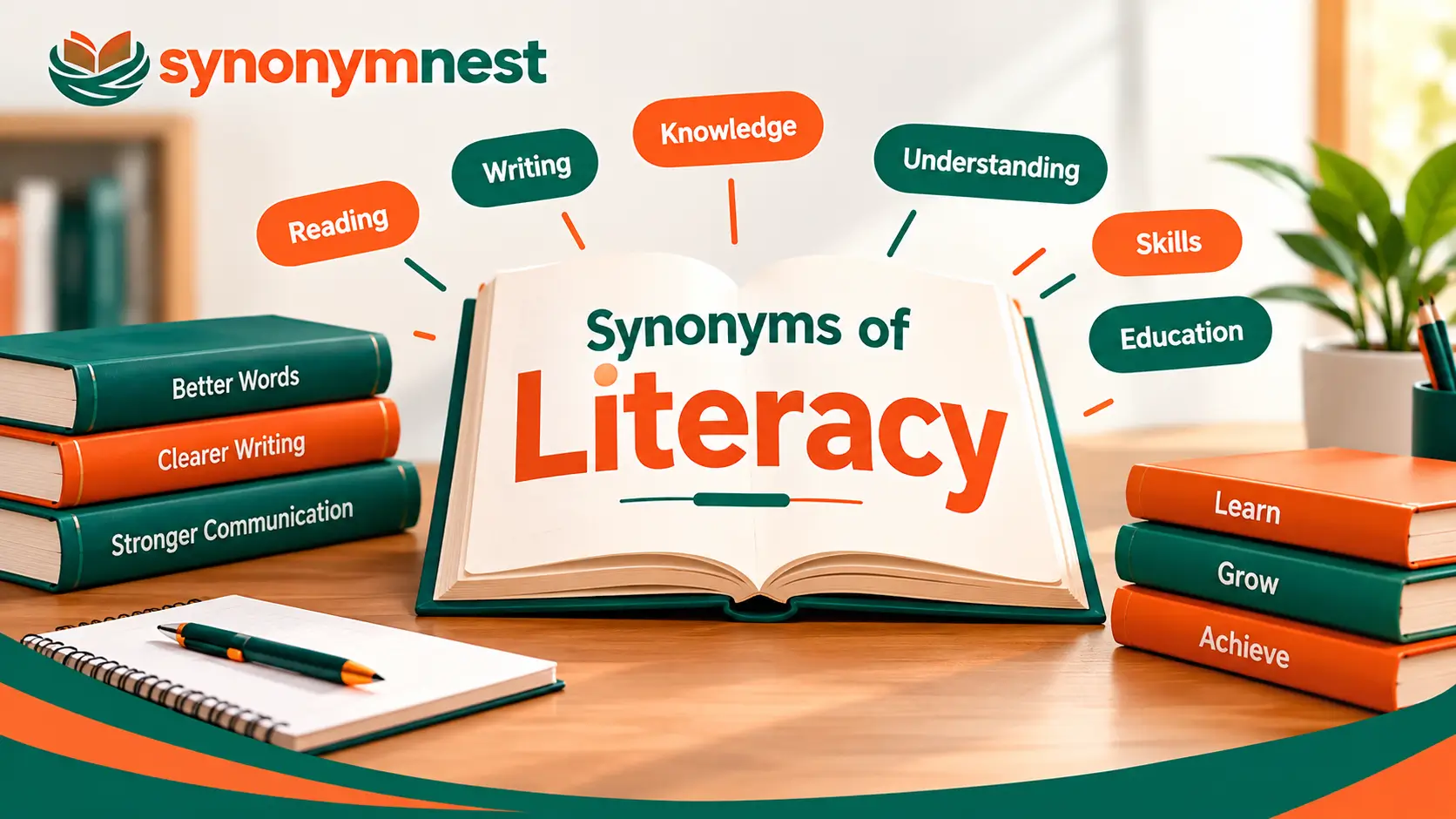
Some close alternatives include:
- Reading ability
- Writing ability
- Reading proficiency
- Writing proficiency
- Language proficiency
- Language skills
- Reading and writing skills
- Written communication skills
- Educational competence
- Functional reading skills
Words such as education, knowledge, and learning are related to literacy but are broader concepts rather than exact synonyms.
30 Synonyms and Related Terms for Literacy
1. Reading Ability
Meaning: The ability to understand written words and text.
Example:
Strong reading ability helps students understand complex lessons.
Best use: When specifically talking about the reading part of literacy.
2. Writing Ability
Meaning: The ability to communicate ideas through written language.
Example:
Good writing ability is useful in school and the workplace.
Best use: When focusing on written expression.
3. Reading Skills
Meaning: Skills used to read, understand, and interpret written material.
Example:
Parents can help children develop their reading skills at home.
Best use: Education and child development.
4. Writing Skills
Meaning: The ability to write clearly and effectively.
Example:
Writing skills are important for students and professionals.
Best use: Academic and professional contexts.
5. Reading and Writing Skills
Meaning: The combined ability to read and produce written language.
Example:
The program helps adults improve their reading and writing skills.
Best use: This is one of the closest descriptive alternatives to basic literacy.
6. Reading Proficiency
Meaning: A person’s level of skill in reading and understanding text.
Example:
The assessment measures reading proficiency among young students.
Best use: Formal educational writing.
7. Writing Proficiency
Meaning: A person’s ability to write accurately, clearly, and effectively.
Example:
The course is designed to improve writing proficiency.
Best use: Academic and language-learning contexts.
8. Language Proficiency
Meaning: The level of ability a person has in using a language.
Example:
English language proficiency can improve access to education and employment.
Best use: Language learning. It is broader than literacy because it can include speaking and listening.
9. Language Skills
Meaning: Abilities related to reading, writing, speaking, and listening.
Example:
Students develop language skills through regular practice.
Best use: General education and language learning.
10. Written Communication Skills
Meaning: The ability to communicate information and ideas effectively in writing.
Example:
Strong written communication skills are valuable in many careers.
Best use: Workplace and professional contexts.
11. Functional Reading Skills
Meaning: The ability to read and understand information needed for everyday activities.
Example:
Functional reading skills help people understand signs, forms, instructions, and schedules.
Best use: Adult education and practical literacy.
12. Functional Literacy
Meaning: The ability to read, write, and use these skills effectively in everyday life.
Example:
Functional literacy allows people to complete forms and understand written instructions.
Best use: Education, employment, and social development.
13. Reading Competence
Meaning: The ability to read and understand written information successfully.
Example:
The teacher evaluated each student’s reading competence.
Best use: Formal educational contexts.
14. Writing Competence
Meaning: The ability to produce understandable and effective written language.
Example:
Regular writing practice can improve students’ writing competence.
Best use: Academic and educational writing.
15. Written Language Skills
Meaning: Skills needed to understand and produce written language.
Example:
Children develop written language skills gradually through reading and writing practice.
Best use: Education and language development.
16. Communication Skills
Meaning: The abilities used to exchange information and ideas with others.
Example:
Literacy can support stronger communication skills.
Best use: A broader term that includes speaking, listening, reading, and writing.
17. Comprehension
Meaning: The ability to understand the meaning of written or spoken information.
Example:
Reading comprehension is an important part of literacy development.
Best use: When focusing on understanding rather than simply reading words.
18. Understanding
Meaning: The ability to grasp the meaning of information or ideas.
Example:
Good reading habits can improve understanding of difficult subjects.
Best use: General contexts. It is related to literacy rather than a direct synonym.
19. Fluency
Meaning: The ability to use a language or reading system smoothly and confidently.
Example:
Reading fluency allows students to read text more naturally.
Best use: Reading and language education.
20. Education
Meaning: The process of gaining knowledge, skills, and understanding through learning.
Example:
Education can provide opportunities for people to develop literacy skills.
Best use: Education is broader than literacy and should not be treated as an exact synonym.
21. Learning
Meaning: The process of gaining knowledge or developing skills.
Example:
Lifelong learning can strengthen reading and writing abilities.
Best use: General educational contexts.
22. Knowledge
Meaning: Information and understanding gained through learning or experience.
Example:
Literacy helps people access and understand knowledge.
Best use: Knowledge is related to literacy but has a much broader meaning.
23. Scholarship
Meaning: Serious academic study, learning, or research.
Example:
Her scholarship in language education has influenced many teachers.
Best use: Academic contexts. It is not a direct synonym for literacy.
24. Erudition
Meaning: Extensive knowledge gained through study and learning.
Example:
His erudition was evident in his detailed discussion of literature.
Best use: Formal writing when referring to deep knowledge.
25. Reading Capability
Meaning: The ability or capacity to read and understand written material.
Example:
Early education can improve a child’s reading capability.
Best use: Educational and descriptive contexts.
26. Writing Capability
Meaning: The ability to create written language that communicates ideas.
Example:
The training program develops students’ writing capability.
Best use: Education and professional training.
27. Literary Skills
Meaning: Skills connected with reading, writing, and understanding written works.
Example:
The course helps students develop stronger literary skills.
Best use: Literature and language education.
28. Educational Skills
Meaning: Skills that help a person learn, study, and apply information.
Example:
Basic educational skills can support future academic success.
Best use: A broader term related to literacy and learning.
29. Information Skills
Meaning: The ability to find, understand, evaluate, and use information.
Example:
Strong information skills are valuable in the digital age.
Best use: Modern education and information literacy.
30. Literacy Skills
Meaning: The practical skills involved in reading, writing, understanding, and using written information.
Example:
Schools work to improve literacy skills from an early age.
Best use: Education, training, and professional development.
Direct Synonyms vs. Related Terms
Not every word associated with literacy can replace literacy in every sentence. Understanding this difference helps you choose the right word.
| Term | Relationship to Literacy | Best Context |
|---|---|---|
| Reading ability | Very close | Reading |
| Writing ability | Very close | Writing |
| Reading skills | Very close | Education |
| Writing skills | Very close | Education |
| Reading proficiency | Close | Formal education |
| Writing proficiency | Close | Language learning |
| Functional literacy | Close | Everyday skills |
| Language proficiency | Related | Language learning |
| Comprehension | Related | Understanding text |
| Fluency | Related | Reading/language |
| Education | Broader | Academic learning |
| Learning | Broader | General development |
| Knowledge | Broader | Information and understanding |
| Scholarship | Broader | Academic study |
| Erudition | Broader | Advanced knowledge |
Types of Literacy
Modern literacy is not limited to reading and writing. The term is now used in many areas of life.
Digital Literacy
Digital literacy is the ability to use digital devices, applications, and online information effectively.
Example:
Digital literacy helps students use online learning platforms safely.
Financial Literacy
Financial literacy means understanding money, budgeting, saving, borrowing, and other financial concepts.
Example:
Financial literacy can help young adults make informed money decisions.
Media Literacy
Media literacy is the ability to understand, evaluate, and analyze media messages.
Example:
Media literacy helps students evaluate information they see online.
Health Literacy
Health literacy involves finding, understanding, and using health information.
Example:
Health literacy can help people understand instructions about medicines and healthcare services.
Information Literacy
Information literacy is the ability to find, evaluate, and use information effectively.
Example:
Information literacy is important when researching a topic online.
Computer Literacy
Computer literacy refers to the ability to use computers and basic software effectively.
Example:
Computer literacy is often useful in modern workplaces.
Cultural Literacy
Cultural literacy involves understanding important cultural references, traditions, ideas, and practices.
Example:
Cultural literacy can improve communication between people from different backgrounds.
Why Is Literacy Important?
Literacy affects many areas of everyday life. People use reading and writing skills to understand instructions, complete forms, communicate with others, study, work, and access information.
Strong literacy skills can also support:
- Academic learning
- Workplace communication
- Independent learning
- Everyday decision-making
- Access to information
- Digital activities
- Social participation
Literacy therefore plays an important role in both education and everyday communication.
Literacy Synonyms in Different Contexts
Choosing the right alternative depends on what you want to say.
For basic reading and writing
Use:
- Reading ability
- Writing ability
- Reading and writing skills
- Literacy skills
For education
Use:
- Reading proficiency
- Writing proficiency
- Reading competence
- Writing competence
- Educational skills
For language learning
Use:
- Language skills
- Language proficiency
- Fluency
- Reading fluency
For understanding information
Use:
- Comprehension
- Understanding
- Information skills
For everyday tasks
Use:
- Functional literacy
- Functional reading skills
- Practical literacy skills
Examples of Literacy in Sentences
Here are some natural examples showing how literacy is used:
- Basic literacy is essential for everyday communication.
- Schools help children develop strong reading and writing skills.
- Digital literacy has become increasingly important in modern education.
- Adult education programs can improve functional literacy.
- Good reading proficiency helps students understand academic texts.
- Financial literacy can help people manage their money more effectively.
- Strong writing skills are useful in almost every profession.
- Information literacy helps students evaluate online sources.
What Is the Opposite of Literacy?
The most direct opposite of literacy is illiteracy.
Illiteracy refers to a lack of the basic ability to read and write.
Other related terms may include:
- Lack of literacy
- Limited literacy
- Inability to read and write
- Educational disadvantage
However, these expressions do not always have exactly the same meaning as illiteracy.
Common Questions About Literacy Synonyms
What is another word for literacy?
There is no perfect one-word replacement for literacy in every context. Reading ability, writing ability, reading proficiency, and functional literacy are close alternatives depending on the meaning.
Is education a synonym for literacy?
No. Education is a broader concept that includes learning knowledge and skills in many areas. Literacy specifically focuses on the ability to read, write, and use written information.
Is reading a synonym for literacy?
Not exactly. Reading is one part of literacy. Literacy generally includes both reading and writing, along with the ability to understand and use written information.
Is fluency the same as literacy?
No. Fluency describes smooth and effective performance, especially in reading or language use. Literacy refers more broadly to the ability to read and write.
What is a synonym for literacy skills?
Useful alternatives include reading and writing skills, reading ability, writing ability, reading proficiency, writing proficiency, and language skills, depending on the context.
What are the main types of literacy?
Common types include basic literacy, functional literacy, digital literacy, financial literacy, media literacy, health literacy, information literacy, and computer literacy.
Why are literacy synonyms useful?
They help writers avoid repetition and choose words that match a specific context. For example, reading proficiency is more precise when discussing reading performance, while functional literacy is appropriate when discussing everyday reading and writing tasks.
Final Thoughts
Understanding the synonyms of literacy can help you improve vocabulary and write more precisely. However, many words connected with literacy are not exact synonyms. Terms such as reading ability, writing ability, reading proficiency, writing proficiency, and functional literacy are useful when discussing specific aspects of literacy.
Broader terms such as education, learning, knowledge, and scholarship should be used carefully because they describe wider concepts.
Literacy itself remains an essential foundation for education, communication, employment, and lifelong learning. By understanding its related terms and choosing the right expression for each situation, you can make your English writing clearer, more accurate, and more natural.