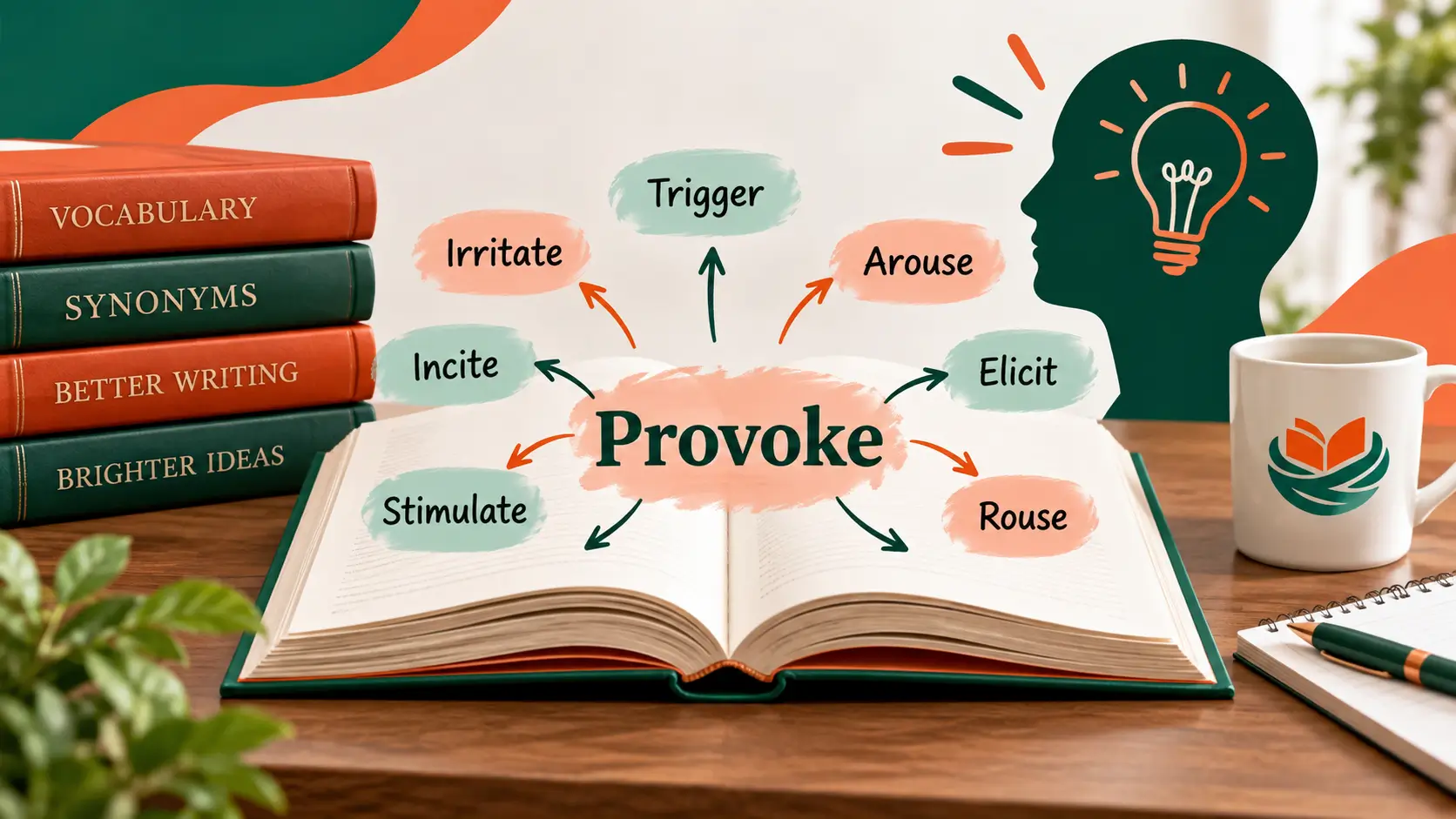
The word provoke means to cause a reaction, feeling, response, or action. It is often associated with anger or irritation, but it can also describe something that stimulates curiosity, discussion, thought, or interest.
For example, a rude comment may provoke anger, while an interesting question may provoke thought or discussion. Understanding the different synonyms of provoke can help you choose words that express the exact meaning and intensity you want.
In this guide, we explore 30 useful synonyms of provoke, along with their meanings, pronunciations, and examples.
Meaning of Provoke
Provoke (verb): To cause a particular reaction, emotion, or action, sometimes deliberately.
Examples
- His rude comments provoked anger among the audience.
- The teacher’s question provoked an interesting discussion.
- The article provoked strong reactions from readers.
The meaning of provoke depends on the context. It can describe causing anger, encouraging action, creating a response, or stimulating thought.
Pronunciation of Provoke
- US: /prəˈvoʊk/
- UK: /prəˈvəʊk/
- Syllables: pro-voke
Etymology of Provoke
The word provoke comes from the Latin provocare, meaning “to call forth” or “to challenge.” It entered English through Old French provoquer.
Over time, its meaning developed to include causing a reaction, especially an emotional response such as anger, but it can also refer to stimulating thought, discussion, or action.
30 Synonyms of Provoke
Here are 30 useful synonyms of provoke, with their meanings and examples. Because these words have slightly different meanings, the best choice depends on the context.
1. Agitate
Meaning: To make someone worried, upset, or emotionally disturbed.
Examples:
- The speech agitated the crowd.
- The unexpected announcement agitated the employees.
Best used for: Strong emotional disturbance or unrest.
2. Irritate
Meaning: To annoy or bother someone.
Examples:
- His constant interruptions irritated the teacher.
- The loud noise irritated everyone in the room.
Best used for: Mild to moderate annoyance.
3. Annoy
Meaning: To make someone slightly angry or uncomfortable.
Examples:
- His repeated questions annoyed his sister.
- The long delay annoyed the passengers.
Best used for: Everyday situations involving irritation.
4. Exasperate
Meaning: To make someone extremely annoyed or frustrated.
Examples:
- Her repeated lateness exasperated her manager.
- The constant interruptions exasperated the speaker.
Best used for: Serious frustration.
5. Enrage
Meaning: To make someone extremely angry.
Examples:
- The unfair decision enraged the students.
- The offensive remarks enraged the audience.
Best used for: Very intense anger.
6. Infuriate
Meaning: To make someone extremely angry.
Examples:
- His careless behavior infuriated his parents.
- The unfair treatment infuriated the workers.
Best used for: Extreme anger or outrage.
7. Incite
Meaning: To encourage people to take action, especially harmful, violent, or disruptive action.
Examples:
- The speech incited the crowd.
- The rumors incited conflict between the groups.
Best used for: Encouraging people toward action or unrest.
8. Rile
Meaning: To make someone angry or annoyed.
Examples:
- His sarcastic comments riled his coworkers.
- The unexpected delay riled the passengers.
Best used for: Informal descriptions of anger or irritation.
9. Foment
Meaning: To encourage or stir up trouble, conflict, or unrest.
Examples:
- The group was accused of fomenting unrest.
- The rumors fomented tension in the community.
Best used for: Conflict, unrest, or political and social tension.
10. Instigate
Meaning: To cause or initiate an action, argument, or conflict.
Examples:
- He instigated an argument between the two teams.
- The incident instigated a wider investigation.
Best used for: Starting something, especially a conflict or dispute.
11. Trigger
Meaning: To cause a reaction or event to happen.
Examples:
- The announcement triggered a heated debate.
- The incident triggered widespread concern.
Best used for: Events, reactions, emotions, or processes.
12. Vex
Meaning: To annoy, trouble, or worry someone.
Examples:
- The difficult question vexed the students.
- The ongoing problem vexed the manager.
Best used for: Formal or literary descriptions of annoyance.
13. Rouse
Meaning: To awaken or stimulate a feeling, reaction, or action.
Examples:
- The speech roused the audience.
- The story roused curiosity among the students.
Best used for: Strong emotional or motivational responses.
14. Perturb
Meaning: To disturb, worry, or unsettle someone.
Examples:
- The unexpected news perturbed the residents.
- His unusual behavior perturbed his colleagues.
Best used for: Formal descriptions of worry or disturbance.
15. Excite
Meaning: To cause strong interest, enthusiasm, or emotional response.
Examples:
- The announcement excited the fans.
- The new discovery excited considerable interest.
Best used for: Positive excitement or strong interest.
16. Arouse
Meaning: To cause a feeling, reaction, interest, or emotion.
Examples:
- The story aroused curiosity.
- The decision aroused public concern.
Best used for: Feelings, curiosity, interest, concern, or emotions.
17. Prompt
Meaning: To cause or encourage someone to do something.
Examples:
- The question prompted a lively discussion.
- The incident prompted officials to investigate.
Best used for: Causing a response or action.
18. Stimulate
Meaning: To encourage activity, thought, interest, or discussion.
Examples:
- The book stimulated an interesting debate.
- The lecture stimulated interest in science.
Best used for: Thought, discussion, interest, or activity.
19. Encourage
Meaning: To give someone support or motivation to do something.
Examples:
- The coach encouraged the players to continue.
- Her comments encouraged further discussion.
Best used for: Positive motivation or action.
20. Spur
Meaning: To encourage or motivate someone to take action.
Examples:
- The criticism spurred him to improve.
- The report spurred an investigation.
Best used for: Motivation that leads to action.
21. Goad
Meaning: To deliberately annoy or challenge someone so that they react.
Examples:
- His comments goaded his opponent into responding.
- She goaded him into accepting the challenge.
Best used for: Deliberately provoking someone into action.
22. Evoke
Meaning: To bring a feeling, memory, image, or response into someone’s mind.
Examples:
- The old photograph evoked happy memories.
- The music evoked a strong emotional response.
Best used for: Memories, emotions, images, and feelings.
23. Elicit
Meaning: To cause or obtain a particular response or reaction.
Examples:
- The question elicited several thoughtful answers.
- Her speech elicited applause from the audience.
Best used for: Responses, reactions, answers, or emotions.
24. Stir
Meaning: To cause or awaken a strong feeling or reaction.
Examples:
- The story stirred strong emotions.
- His speech stirred public interest.
Best used for: Emotions, feelings, interest, or controversy.
25. Kindle
Meaning: To start or encourage a feeling, interest, or emotion.
Examples:
- The documentary kindled interest in history.
- Her story kindled hope among the community.
Best used for: Hope, interest, enthusiasm, or emotions.
26. Awaken
Meaning: To cause a feeling, interest, or realization to develop.
Examples:
- The experience awakened his interest in photography.
- The book awakened her curiosity about science.
Best used for: Interest, awareness, curiosity, or emotions.
27. Generate
Meaning: To produce or cause something to happen.
Examples:
- The announcement generated considerable interest.
- The proposal generated a heated discussion.
Best used for: Interest, discussion, reactions, or activity.
28. Spark
Meaning: To cause something to begin or develop suddenly.
Examples:
- The article sparked a debate.
- The decision sparked widespread criticism.
Best used for: Sudden discussions, reactions, conflicts, or interest.
29. Aggravate
Meaning: To make a problem, situation, or irritation worse.
Examples:
- His behavior aggravated the situation.
- The delay aggravated the passengers.
Best used for: Making an existing problem or irritation worse.
30. Challenge
Meaning: To question, confront, or encourage someone to respond or prove something.
Examples:
- Her question challenged his assumptions.
- The criticism challenged the team to improve.
Best used for: Confrontation, questioning, or encouraging a response.
Synonyms of Provoke by Meaning
Not every synonym of provoke can replace the word in every sentence. The meaning and intensity can change depending on the synonym.
Provoke Anger
When provoke means to make someone angry, useful alternatives include:
- Irritate
- Annoy
- Rile
- Enrage
- Infuriate
- Exasperate
- Agitate
- Vex
- Goad
Provoke a Reaction
When provoke means to cause a response, you can use:
- Trigger
- Prompt
- Elicit
- Evoke
- Generate
- Spark
- Arouse
Provoke Action
When provoke means to encourage someone to act, consider:
- Spur
- Encourage
- Prompt
- Rouse
- Instigate
- Incite
- Goad
Provoke Thought or Discussion
When something causes people to think or discuss an issue, useful alternatives include:
- Stimulate
- Prompt
- Spark
- Elicit
- Challenge
- Arouse
- Evoke
Difference Between Provoke and Its Synonyms
Although these words are related, they are not always interchangeable.
Provoke vs. Irritate:
Provoke can mean causing many types of reactions, while irritate specifically means causing annoyance or discomfort.
Provoke vs. Incite:
Incite usually means encouraging people to take action, particularly action that may cause conflict or unrest.
Provoke vs. Trigger:
Trigger often refers to causing a reaction or event, while provoke can suggest a deliberate action designed to produce a response.
Provoke vs. Evoke:
Evoke usually means bringing a feeling, memory, or image to mind. It does not normally imply deliberate confrontation.
Provoke vs. Instigate:
Instigate generally means starting an action, argument, or conflict, while provoke has a broader range of meanings.
Provoke vs. Stimulate:
Stimulate often has a positive or neutral meaning and is commonly used for thought, interest, activity, or discussion.
Is Provoke Always Negative?
No. Provoke is not always negative.
It is often used in negative contexts, such as:
- The comment provoked anger.
- His behavior provoked an argument.
However, it can also be neutral or positive:
- The question provoked thoughtful discussion.
- The book provoked curiosity among readers.
Therefore, the surrounding context determines whether provoke has a positive, negative, or neutral meaning.
Antonyms of Provoke
Common antonyms of provoke include:
- Calm
- Soothe
- Pacify
- Appease
- Placate
- Discourage
- Prevent
For example:
- The teacher’s words calmed the students.
- The manager tried to soothe the angry customer.
- The mediator helped pacify the opposing groups.
Frequently Asked Questions
What does provoke mean?
Provoke means to cause a reaction, emotion, response, or action. It is frequently used when someone causes anger, but it can also refer to stimulating thought, curiosity, or discussion.
What is the best synonym for provoke?
There is no single best synonym because the appropriate word depends on context. Trigger, prompt, incite, irritate, evoke, stimulate, and elicit can all replace provoke in certain situations.
Is provoke a positive or negative word?
Provoke can be positive, negative, or neutral. It may describe causing anger, but it can also describe stimulating curiosity, thought, discussion, or interest.
What is a synonym for provoke anger?
Common synonyms include irritate, enrage, infuriate, annoy, rile, exasperate, and agitate.
What is the difference between provoke and incite?
Provoke has a broad meaning and can refer to causing many kinds of reactions. Incite specifically suggests encouraging someone to take action, often involving conflict, unrest, or other undesirable behavior.
What is the opposite of provoke?
Depending on the context, opposites of provoke include calm, soothe, pacify, appease, and placate.
Can provoke be used for positive reactions?
Yes. For example, a fascinating question can provoke thought, and an inspiring story can provoke curiosity or discussion.
Conclusion
Learning the synonyms of provoke can help you communicate more precisely and avoid repeating the same word. Depending on the context, provoke can be replaced by words such as irritate, incite, trigger, prompt, stimulate, evoke, elicit, rouse, spur, or spark.
The important point is that each synonym carries a slightly different meaning and level of intensity. Words such as enrage and infuriate express strong anger, while stimulate and evoke are more suitable for thought, interest, or emotion. Choosing the right synonym makes your writing clearer, more natural, and more effective.