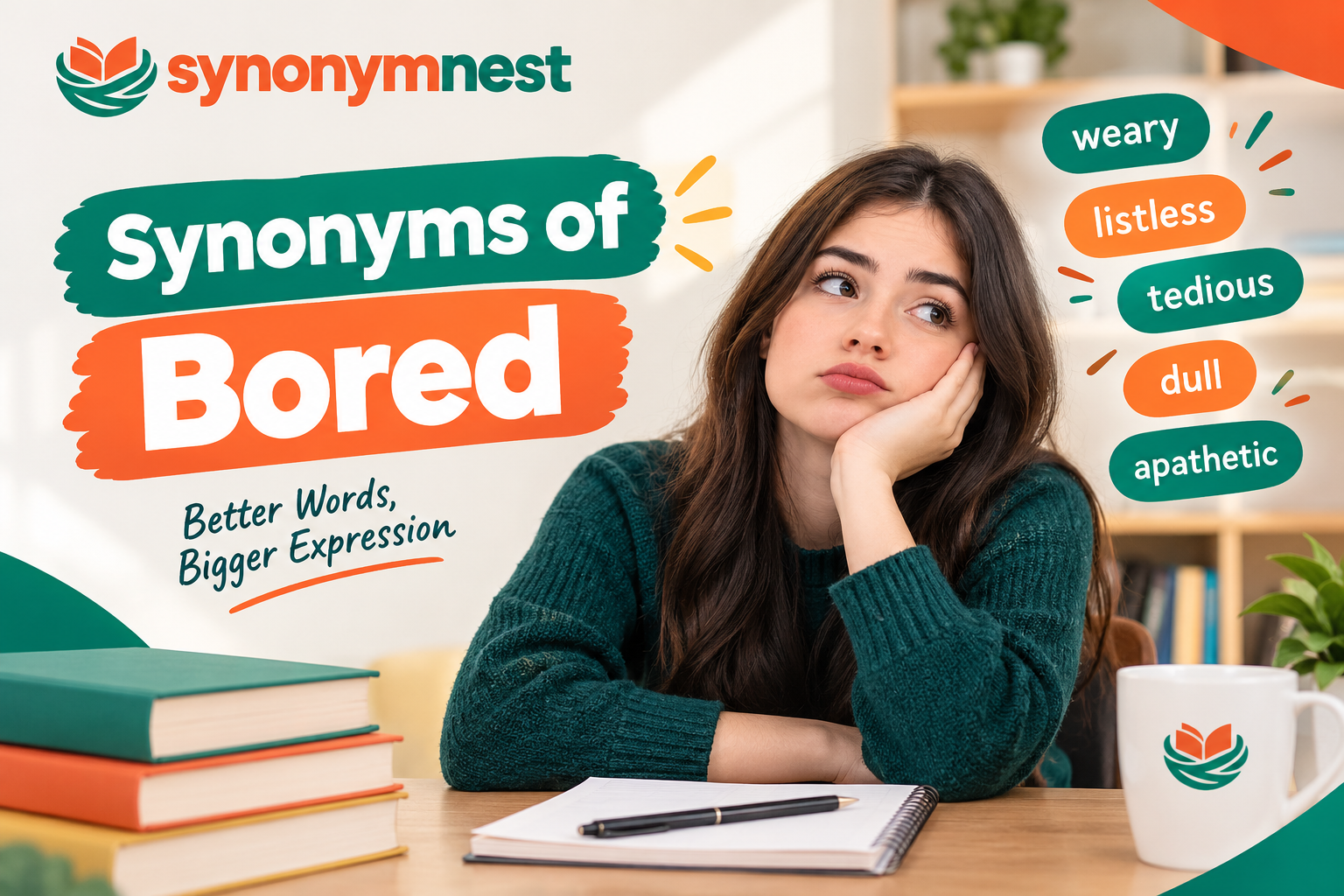
Synonyms of bored include uninterested, weary, fed up, disengaged, restless, apathetic, and unengaged. The best alternative depends on the situation. Some words describe a lack of interest, while others express frustration, mental tiredness, or dissatisfaction with repetitive activities. Choosing the right word makes your English more precise and natural.
Introduction
Boredom is a common feeling that occurs when an activity lacks excitement, variety, or personal interest. You might feel bored while waiting for an appointment, attending a long lecture, or repeating the same task every day. Although the word bored describes this feeling clearly, using it repeatedly can make your speaking and writing less expressive.
Learning synonyms of bored helps you explain your emotions more accurately. For example, uninterested describes a lack of curiosity, restless suggests difficulty staying still, and fed up expresses frustration with a situation. These alternatives can make everyday conversations, school assignments, professional communication, and creative writing more engaging.
However, not every word associated with boredom has exactly the same meaning. Some describe a person’s emotional state, while others describe an activity that causes boredom. Understanding these differences helps you choose suitable vocabulary instead of replacing one word with another incorrectly.
In this guide, you will discover 30 useful alternatives to bored, their meanings, example sentences, common expressions, grammatical patterns, antonyms, and answers to frequently asked questions.
Meaning of Bored
Definition: Bored is an adjective describing a feeling of being uninterested, unstimulated, or dissatisfied because something does not hold your attention.
Examples:
- I felt bored during the long meeting.
- The children became bored because they had nothing to do.
- She was bored with her daily routine.
The word describes a person’s feeling rather than necessarily describing the activity itself. A person can be bored even when other people find the same activity interesting.
Pronunciation of Bored
- US English: /bɔrd/
- UK English: /bɔːd/
- Syllables: One
- Part of speech: Adjective; also the past-tense and past-participle form of the verb bore.
The word bored commonly appears with the preposition with, as in “I am bored with this game.”
30 Synonyms of Bored With Meanings and Examples
The following words include close synonyms and context-dependent alternatives. Some describe the feeling of boredom directly, while others express related emotions or describe boring experiences.
1. Uninterested
Meaning: Not feeling curious about or attracted to something.
Examples:
- The students seemed uninterested in the lecture.
- He was uninterested in discussing celebrity news.
When to use it: Use uninterested when someone lacks curiosity or motivation to pay attention. It is one of the clearest alternatives to bored when a lack of interest is the main idea.
2. Weary
Meaning: Feeling physically or mentally tired, sometimes because of prolonged activity or repetition.
Examples:
- She grew weary of listening to the same complaints.
- He looked weary after a long day at work.
When to use it: Weary is appropriate when boredom overlaps with tiredness or frustration. It often sounds more formal than bored.
3. Fed Up
Meaning: Annoyed or frustrated because an unpleasant situation has continued for too long.
Examples:
- I am fed up with these constant delays.
- They were fed up with doing the same exercise every day.
When to use it: This informal expression is useful when boredom develops into irritation. It is stronger than simply saying you are bored.
4. Restless
Meaning: Unable to relax or remain still because of impatience, excess energy, or dissatisfaction.
Examples:
- The children became restless during the long journey.
- I felt restless while waiting for the results.
When to use it: Choose restless when boredom makes someone fidgety, impatient, or eager to do something different.
5. Apathetic
Meaning: Showing little interest, enthusiasm, or emotional involvement.
Examples:
- The audience seemed apathetic during the presentation.
- He became apathetic toward activities he once enjoyed.
When to use it: Apathetic suggests a broader lack of interest or concern. It is more serious than ordinary boredom in many contexts.
6. Indifferent
Meaning: Having little concern about something or not caring strongly about the outcome.
Examples:
- She was indifferent to the choice of restaurant.
- He appeared indifferent during the discussion.
When to use it: Use indifferent when someone does not care much about a subject or decision. It does not necessarily mean that the person feels bored.
7. Disengaged
Meaning: Not actively participating or mentally involved in an activity.
Examples:
- Several students became disengaged during the lesson.
- The employee seemed disengaged during the meeting.
When to use it: This word is particularly useful in education and workplace writing. It describes a lack of involvement that may result from boredom, confusion, or other reasons.
8. Unenthusiastic
Meaning: Showing little excitement or eagerness.
Examples:
- He gave an unenthusiastic response to the invitation.
- The team seemed unenthusiastic about the repetitive assignment.
When to use it: Use unenthusiastic when someone shows little excitement about a plan, activity, or opportunity.
9. Unengaged
Meaning: Not interested or involved in what is happening.
Examples:
- The audience looked unengaged during the speech.
- She felt unengaged with the material in the textbook.
When to use it: This word works well when describing participation, attention, or involvement in a particular activity.
10. Listless
Meaning: Lacking energy, enthusiasm, or motivation.
Examples:
- He sat listless at his desk all afternoon.
- The team looked listless during practice.
When to use it: Listless emphasizes a lack of energy as well as reduced interest. It can describe a person who seems inactive or unmotivated.
11. Jaded
Meaning: Tired of something after experiencing too much of it.
Examples:
- After years of attending similar events, she felt jaded.
- He became jaded by the endless cycle of office meetings.
When to use it: Use jaded when repeated exposure has reduced someone’s enthusiasm. It is particularly useful for describing people who have become unimpressed by familiar experiences.
12. Blasé
Meaning: Unimpressed or unconcerned because something has become too familiar.
Examples:
- She seemed blasé about meeting famous actors.
- He gave a blasé reaction to the announcement.
When to use it: Blasé often suggests that someone has seen or experienced something so frequently that it no longer excites them.
13. Apathetic Toward
Meaning: Showing little interest or concern about a particular subject or activity.
Examples:
- He became apathetic toward the competition.
- The students appeared apathetic toward the proposed changes.
When to use it: This expression is useful when you want to identify the specific subject toward which someone feels little interest. It overlaps with apathetic rather than representing a completely different synonym.
14. Dispirited
Meaning: Having lost enthusiasm, hope, or confidence.
Examples:
- The players felt dispirited after another disappointing match.
- She became dispirited by the lack of progress.
When to use it: Dispirited is more appropriate when boredom is accompanied by disappointment or low morale.
15. Weighed Down
Meaning: Feeling burdened or mentally overwhelmed by responsibilities or difficulties.
Examples:
- He felt weighed down by repetitive paperwork.
- She was weighed down by the demands of her daily routine.
When to use it: This expression is not a direct synonym for bored. It is useful when monotony also makes a person feel burdened.
16. Frustrated
Meaning: Upset or annoyed because something is difficult, unsuccessful, or prevents progress.
Examples:
- I became frustrated with the slow process.
- The students felt frustrated by the repetitive exercises.
When to use it: Choose frustrated when boredom is accompanied by irritation or dissatisfaction, particularly when someone wants a situation to change.
17. Annoyed
Meaning: Slightly angry or irritated by a person, activity, or situation.
Examples:
- She felt annoyed by the repeated interruptions.
- He was annoyed with the same old routine.
When to use it: Annoyed emphasizes irritation rather than a simple lack of interest.
18. Tired
Meaning: Lacking physical or mental energy.
Examples:
- I was tired of watching the same program.
- She felt tired after working all afternoon.
When to use it: Tired of can express being fed up with something. However, tired alone usually describes fatigue, so it is not always interchangeable with bored.
19. Drained
Meaning: Having very little mental or physical energy left.
Examples:
- I felt drained after the lengthy discussion.
- She was mentally drained by repetitive tasks.
When to use it: Use drained when an activity has exhausted your energy. It describes fatigue rather than boredom itself.
20. Exhausted
Meaning: Extremely tired physically or mentally.
Examples:
- He was exhausted after working a double shift.
- She felt exhausted by the demanding schedule.
When to use it: Exhausted is appropriate when tiredness is the main feeling. A person may be exhausted without being bored.
21. Unstimulated
Meaning: Not receiving enough mental or sensory activity to maintain interest.
Examples:
- The children felt unstimulated by the simple activity.
- He became unstimulated by work that offered no new challenges.
When to use it: This word is helpful when an activity lacks challenge, variety, or mental engagement.
22. Detached
Meaning: Emotionally distant or not closely involved in a situation.
Examples:
- She seemed detached from the conversation.
- He remained detached during the discussion.
When to use it: Detached describes emotional distance, not necessarily boredom. Use it when someone appears disconnected from what is happening.
23. Passive
Meaning: Not actively participating or taking action.
Examples:
- The students remained passive during the discussion.
- He took a passive role in the group activity.
When to use it: Passive describes behavior rather than the feeling of boredom. A passive person may be bored, but the two meanings are not identical.
24. Uninspired
Meaning: Lacking fresh ideas, creativity, or enthusiasm.
Examples:
- The presentation felt uninspired and predictable.
- Her writing seemed uninspired after weeks of repetition.
When to use it: This word is useful for describing work, ideas, performances, or activities that fail to create excitement.
25. Dull
Meaning: Lacking interest, excitement, or liveliness.
Examples:
- The movie was dull and predictable.
- It was a dull afternoon with nothing to do.
When to use it: Dull usually describes the thing that causes boredom rather than the person experiencing it.
26. Tedious
Meaning: Taking too much time or requiring repetitive effort in a way that becomes boring.
Examples:
- Completing the lengthy forms was tedious.
- The tedious process took several hours.
When to use it: Choose tedious for tasks, processes, or activities that feel tiresome because they require prolonged or repetitive effort.
27. Monotonous
Meaning: Repetitive and unchanging, with little variety.
Examples:
- The monotonous routine made the job less enjoyable.
- He found the machine’s constant noise monotonous.
When to use it: Monotonous is especially suitable when the same sounds, tasks, or activities occur repeatedly.
28. Dreary
Meaning: Dull, gloomy, and often depressing.
Examples:
- It was a dreary afternoon with constant rain.
- The dreary office environment made the day feel longer.
When to use it: Use dreary when an experience or setting feels dull and gloomy. It often conveys a more negative mood than bored.
29. Stale
Meaning: No longer fresh, original, or interesting.
Examples:
- The conversation became stale after the same topics kept returning.
- Their jokes began to sound stale.
When to use it: Stale is useful for ideas, routines, conversations, and entertainment that have lost their freshness.
30. Burned Out
Meaning: Experiencing severe exhaustion or reduced motivation after prolonged stress or excessive demands.
Examples:
- She felt burned out after months of working overtime.
- The employee needed a break after feeling burned out.
When to use it: Burned out is much stronger than bored. It generally refers to prolonged exhaustion and reduced capacity to cope, not simply a lack of entertainment.
Best Synonyms of Bored by Context
Choosing the right word depends on what you want to communicate.
| Situation | Suitable word or expression |
|---|---|
| You have no interest in a subject | Uninterested |
| You are tired of repeated problems | Fed up |
| You cannot sit still | Restless |
| You no longer enjoy familiar experiences | Jaded |
| You lack energy and motivation | Listless |
| A task is repetitive | Tedious |
| A routine never changes | Monotonous |
| An activity lacks excitement | Dull |
| You are irritated by delays | Frustrated |
| You feel exhausted after prolonged demands | Burned out |
These distinctions help you express the exact feeling instead of using bored for every situation.
Bored vs. Boring
The words bored and boring are related, but they serve different purposes.
Bored describes how someone feels.
Examples:
- I am bored during the lecture.
- The children were bored at home.
Boring describes something that causes a lack of interest.
Examples:
- The lecture is boring.
- It was a boring afternoon.
A useful rule is that people usually feel bored, while activities, books, meetings, or situations can be boring.
Bored vs. Uninterested
Both words can describe a lack of interest, but they emphasize different things.
- Bored: You are not enjoying an activity because it lacks interest or stimulation.
- Uninterested: You do not have much curiosity or desire to engage with something.
For example:
- I was bored during the long presentation.
- I am uninterested in celebrity gossip.
Someone can be uninterested in a subject without ever trying it. Boredom often develops while experiencing an activity that fails to hold attention.
Grammar: How to Use Bored Correctly
The adjective bored commonly appears in these sentence patterns.
1. Bored with something
Use this pattern to describe a lack of interest in an activity, subject, or routine.
- I am bored with this game.
- She became bored with her daily schedule.
2. Bored by something
Use this pattern to emphasize the thing causing boredom.
- The audience was bored by the lengthy speech.
- He was bored by the repetitive instructions.
3. Bored of something
This expression is also common, especially in informal English.
- I am bored of eating the same meal every day.
- They were bored of waiting.
For formal writing, bored with is often a safe, natural choice.
4. Get bored
Use this expression when someone begins to experience boredom.
- Children may get bored without activities.
- I get bored when I repeat the same task.
5. Feel bored
Use this pattern to describe someone’s emotional state.
- I feel bored when I have nothing to do.
- She felt bored during the long journey.
Antonyms of Bored
Antonyms are words with opposite or contrasting meanings. These alternatives describe interest, excitement, energy, or involvement.
Interested: Wanting to learn about or pay attention to something.
Example: I am interested in learning a new language.
Engaged: Actively involved in an activity.
Example: The students remained engaged throughout the lesson.
Fascinated: Extremely interested in something.
Example: She was fascinated by the history of ancient civilizations.
Enthusiastic: Showing strong interest or excitement.
Example: He was enthusiastic about joining the team.
Excited: Feeling happy and eager about something.
Example: The children were excited about their school trip.
Stimulated: Mentally encouraged or challenged by an experience.
Example: The discussion stimulated her curiosity.
Entertained: Amused or interested by something enjoyable.
Example: We were entertained by the comedian’s performance.
The best antonym depends on the situation. For example, engaged works well when someone actively participates, while fascinated expresses particularly strong interest.
Frequently Asked Questions
1. What is the most common synonym for bored?
Uninterested is a useful alternative when someone lacks interest in an activity or subject. Other choices include fed up, weary, and disengaged, depending on the intended meaning.
2. What is a formal word for bored?
Disengaged, apathetic, and weary can work in formal contexts, depending on the situation. For academic or workplace writing, choose the word that describes the person’s actual state rather than using a more complicated word unnecessarily.
3. What is another way to say “I am bored”?
You could say “I am uninterested,” “I am getting restless,” or “I am fed up with this routine.” Each expression communicates a slightly different feeling, so choose one that matches your situation.
4. Is bored a positive or negative word?
Bored generally has a negative meaning because it suggests a lack of interest, stimulation, or enjoyment. However, the feeling itself is common and does not necessarily indicate a serious problem.
5. Is tired a synonym for bored?
Sometimes, but not always. Tired usually refers to reduced physical or mental energy, while bored describes a lack of interest or stimulation. The expression tired of something can mean that you have become fed up with it.
6. What is the difference between bored and boring?
Bored describes a person’s feeling, whereas boring describes something that causes that feeling. For example, “I am bored” describes your experience, while “The movie is boring” describes the movie.
7. What is the opposite of bored?
Common contrasting words include interested, engaged, fascinated, enthusiastic, and excited. The most appropriate choice depends on whether you mean curiosity, active involvement, or strong excitement.
Conclusion
Learning synonyms of bored helps you describe feelings more clearly and communicate with greater precision. Words such as uninterested, restless, fed up, jaded, and disengaged can express different experiences, while dull, tedious, and monotonous describe activities that may cause boredom.
Remember that related words are not always interchangeable. A person may feel bored, an activity may be boring, and a repetitive task may be tedious. Understanding these differences will help you select the right vocabulary for everyday conversations, academic assignments, professional writing, and creative work.
Practice using a few new words in your own sentences each day. Over time, this simple habit can strengthen your vocabulary, improve your writing, and help you express your thoughts more naturally in English.