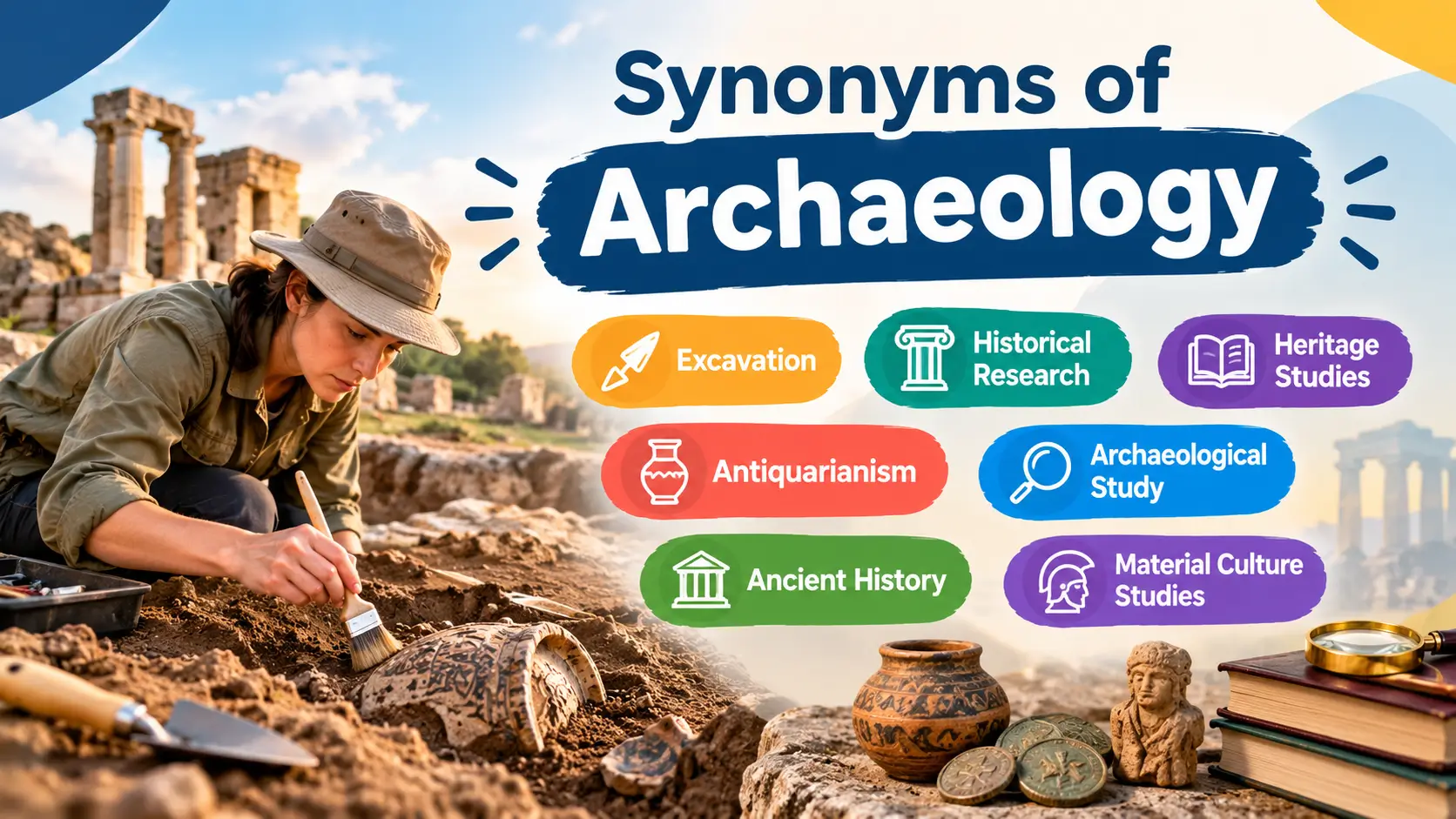
Archaeology is the scientific study of human history and prehistory through the excavation and analysis of artifacts, structures, and other physical remains. Picture standing at an ancient ruin, holding a piece of pottery shaped by human hands thousands of years ago — that moment captures what archaeology is about.
Because “archaeology” is often used loosely alongside related disciplines, this guide separates genuine synonyms (words that can replace “archaeology” in most sentences without changing the core meaning) from related fields and sub-branches (which overlap with archaeology but are not interchangeable with it). This distinction is the single most important thing to get right when building vocabulary around this word.
Meaning of Archaeology
Definition (noun): The scientific study of human history and prehistory through the excavation and analysis of artifacts, structures, and physical remains left behind by past societies.
Examples:
- Archaeologists uncovered tools that revealed details of prehistoric daily life.
- Archaeology helps us understand how ancient societies organized themselves.
Connotation
- Positive: fascinating, enlightening, educational
- Neutral: scientific, systematic, descriptive
- Negative (contextual): slow-moving, overly academic, niche
Etymology
- Origin: Greek arkhaiologia, from arkhaios (“ancient”) + -logia (“study of”)
- Path into English: The Greek term passed through Latin (archaeologia) and French before entering English usage
- First recorded English use: The word appears in English texts from the early 17th century, initially referring broadly to the study of antiquity and ancient customs rather than the scientific excavation-based discipline it became
- Discipline formalized: Archaeology developed into a systematic, evidence-based science mainly during the 19th century, alongside the rise of stratigraphic excavation methods
Pronunciation
- US: /ˌɑːr.kiˈɑː.lə.dʒi/
- UK: /ˌɑː.kiˈɒ.lə.dʒi/
- Syllables: ar-chae-ol-o-gy
Word Formation
- Root: archae- (ancient)
- Suffix: -ology (study of)
- Related forms: archaeologist (noun), archaeological (adjective), archaeologically (adverb)
Part 1: True Synonyms of Archaeology
These words can genuinely substitute for “archaeology” in general usage, referring to the overall study of the human past through physical remains.
1. Antiquities studies
Meaning: The study and collection of objects from ancient times.
- The museum’s antiquities studies department cataloged artifacts from three ancient civilizations.
- Antiquities studies rely heavily on the same excavation methods used in archaeology.
2. Excavation science
Meaning: The systematic practice of digging to uncover and record ancient remains.
- Excavation science is the practical backbone of archaeological research.
- Modern excavation science combines fieldwork with laboratory analysis.
3. Archaeological science
Meaning: The application of scientific methods (chemistry, physics, biology) to archaeological questions; sometimes used as a near-synonym for archaeology itself in academic contexts.
- Archaeological science helped date the pottery to within a few decades.
- Universities now offer degrees specifically in archaeological science.
4. Prehistoric studies
Meaning: The study of human societies before written records — the core subject matter of most archaeology.
- Her prehistoric studies focused on tool-making techniques from 10,000 years ago.
- Prehistoric studies depend almost entirely on archaeological evidence, since no written sources exist.
5. Historical archaeology
Meaning: The archaeological study of societies for which some written records also exist (used broadly as a synonym in contexts involving recent, but pre-modern, history).
- Historical archaeology examines colonial-era settlements using both artifacts and documents.
- Historical archaeology complements written history rather than replacing it.
Note: Genuine one-word synonyms for “archaeology” are rare in English, since it is a fairly specific and technical term. Most close alternatives are two- or three-word phrases, as shown above.
Part 2: Related Fields (Overlapping, but NOT Synonyms)
These disciplines are frequently confused with archaeology but describe different scopes of study. Using them interchangeably with “archaeology” is inaccurate.
| Term | What It Actually Studies | Why It Isn’t a Synonym |
|---|---|---|
| Anthropology | Human societies and cultures, both living and past | Broader field; includes living cultures, linguistics, and biology — archaeology is only one branch of it |
| Paleontology | Fossils and ancient life forms, including non-human life | Studies life in general (e.g., dinosaurs); not limited to humans or artifacts |
| History | Past events, primarily through written records | Relies on documents, not excavation; archaeology fills gaps history cannot reach |
| Ethnology | Comparative study of cultures and customs | Focuses on cultural comparison, not physical excavation |
| Paleoanthropology | Human evolution and early hominid species | Focused specifically on human biological evolution, not artifacts broadly |
| Egyptology | Ancient Egyptian civilization specifically | A regional specialization, not the general field |
| Numismatics | Coins and currency history | A narrow sub-tool used within archaeology, not the discipline itself |
| Epigraphy | Inscriptions and ancient writing systems | A specialized analytical technique, not a synonym |
| Stratigraphy | Layers of soil and rock at a dig site | A dating method used in excavation, not the field of study |
| Lithics | Stone tools and stone artifacts | A specific artifact category studied within archaeology |
| Archaeobotany | Ancient plant remains | A sub-specialty focused on plant evidence |
| Zooarchaeology | Animal remains at ancient sites | A sub-specialty focused on animal evidence |
| Bioarchaeology | Human skeletal remains and health history | A sub-specialty focused on human biology |
| Underwater archaeology | Submerged sites and shipwrecks | A sub-field defined by location/environment, not a general synonym |
| Archaeometry | Scientific dating and testing techniques | A methodological toolkit, not the field itself |
Use the table above when you need precision: if you’re writing about coins specifically, say “numismatics,” not “archaeology.” If you’re writing about the whole discipline, use one of the true synonyms from Part 1, or “archaeology” itself.
Antonyms
True antonyms of “archaeology” are hard to pin down, because it is a field of study, not a state or quality. The closest conceptual opposites relate to focus on the present rather than the past:
- Contemporary studies (focus on current, present-day society)
- Futurism (focus on projected future developments)
These aren’t strict opposites so much as contrasting orientations in time — there is no single word that means “the opposite of studying the past.”
Quick Reference: How to Choose the Right Word
- Talking about the whole field in general → archaeology, archaeological science, antiquities studies
- Talking about digging/fieldwork specifically → excavation, excavation science
- Talking about a time period with no writing → prehistoric studies
- Talking about a period with some records → historical archaeology
- Talking about a specific artifact type or technique (coins, inscriptions, stone tools, soil layers) → use the precise sub-field name from Part 2, not “archaeology”
Short Q&A
What does archaeology mean? The scientific study of human history through excavation and analysis of artifacts and physical remains.
When should I use a synonym instead of “archaeology”? When you want to avoid repetition in writing, or when you need to specify a particular scope (prehistoric vs. historical, general vs. scientific-methods-focused).
Is “anthropology” a synonym for “archaeology”? No — anthropology is the broader study of human culture and society, both past and present; archaeology is one branch within it.
What’s the real antonym of archaeology? There isn’t a clean one-word antonym, since archaeology is a discipline, not a trait or state.
Conclusion
“Archaeology” has genuine synonyms, but far fewer than most vocabulary lists suggest — most words commonly grouped with it (anthropology, paleontology, history, numismatics, stratigraphy, etc.) are actually related but distinct fields or sub-specialties, not interchangeable terms. Keeping this distinction clear makes your writing more accurate and more credible, especially in academic or professional contexts where precision matters.