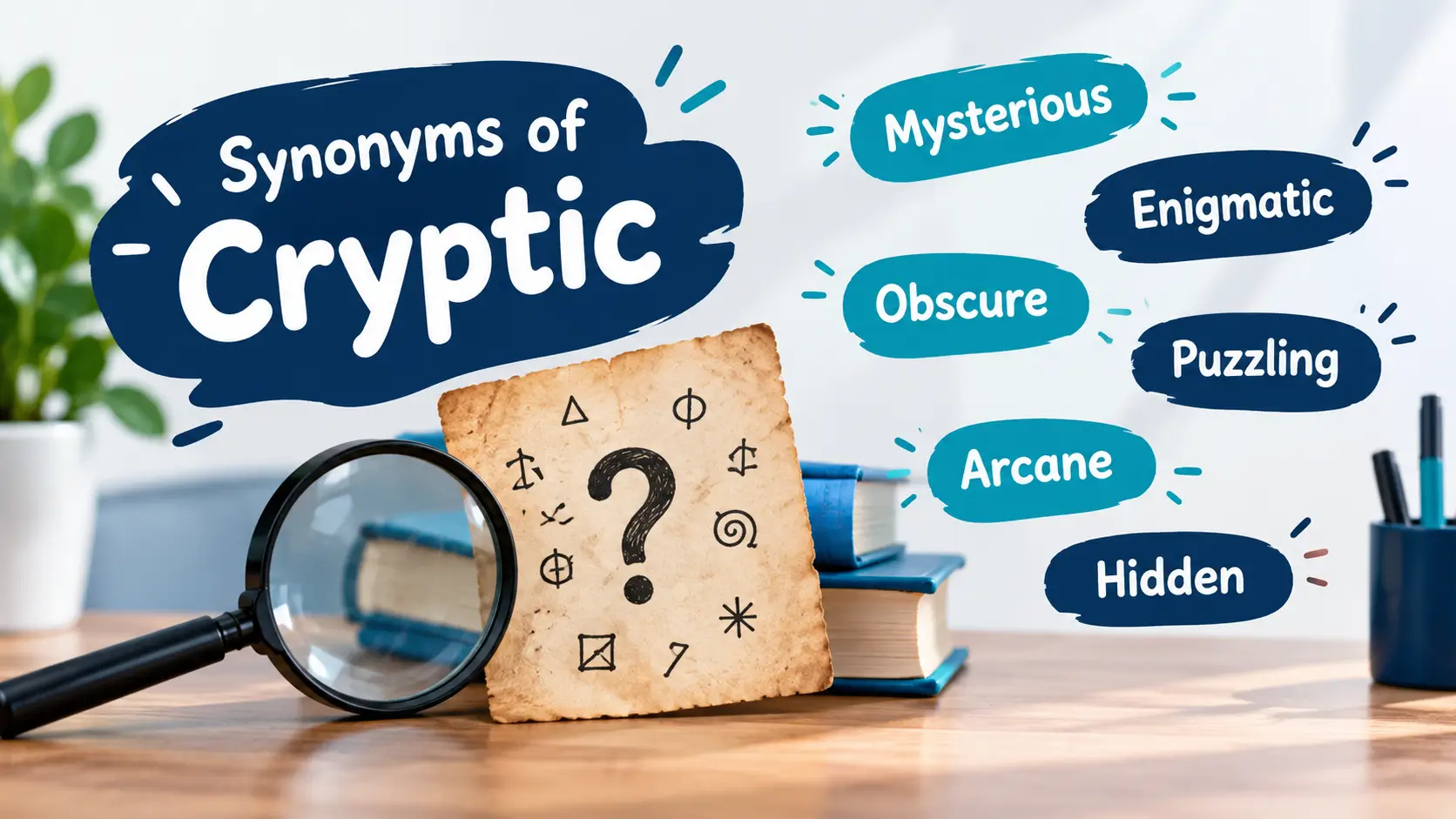
The word cryptic describes something mysterious, unclear, or difficult to understand. Imagine getting a short text from a friend that just says, “You’ll find out soon.” No details, no context — just confusion.
That message is cryptic. Writers, speakers, and puzzle-makers use this word whenever meaning is hidden or hard to interpret.
Learning synonyms of cryptic helps you avoid repetition, sharpen your writing, and express subtle shades of “unclear” with more precision.
Meaning of Cryptic
Definition (adjective): Having a hidden or unclear meaning; difficult to understand.
Examples:
- She gave me a cryptic smile and walked away.
- His message was short and cryptic, leaving everyone confused.
Connotation:
| Tone | Feeling |
|---|---|
| Positive | Mysterious, intriguing |
| Negative | Confusing, evasive |
| Neutral | Hidden, indirect |
Etymology
- Root: Greek kryptikos (“hidden”), from kryptein (“to hide”)
- Entered English: around 1638, first used in the sense of “hidden, secret, occult”
- Related word “crypt”: a separate borrowing from the same Greek root (krypte, “vault”), first recorded in English around 1789 — so crypt is not derived from cryptic; both come independently from the same Greek source
Word Family:
- cryptic (adjective)
- cryptically (adverb)
- crypticness (noun, rare)
- crypt (noun — related root, separate word)
- cryptography (noun — “hidden writing”)
Pronunciation (US & UK – IPA)
US: /ˈkrɪp.tɪk/ · UK: /ˈkrɪp.tɪk/ Syllables: cryp-tic
Common Collocations
Cryptic is frequently paired with these words — learning them helps you use the word (and its synonyms) naturally:
- cryptic message — a text or note with hidden meaning
- cryptic clue — used in puzzles, especially British-style crosswords
- cryptic crossword — a crossword where clues use wordplay instead of direct definitions
- cryptic smile / look — a facial expression that hints at something unsaid
- cryptic remark / comment — a spoken statement that’s deliberately vague
30 Synonyms of Cryptic
Deep Mystery
1. Mysterious — US /mɪˈstɪr.i.əs/ | UK /mɪˈstɪə.ri.əs/ Difficult to explain or understand.
She had a mysterious look on her face.
2. Enigmatic — US /ˌen.ɪɡˈmæt̬.ɪk/ | UK /ˌen.ɪɡˈmæt.ɪk/ Hard to interpret; puzzling in a deep way.
He is known as an enigmatic leader.
3. Arcane — US /ɑːrˈkeɪn/ | UK /ɑːˈkeɪn/ Understood by very few; secret and specialized.
The tax code contained arcane rules few lawyers understood.
4. Esoteric — US /ˌes.əˈter.ɪk/ | UK /ˌes.əˈter.ɪk/ Intended for or understood by a small, specialized group.
The lecture was full of esoteric philosophy terms.
5. Oracular — US /ɔːˈræk.jə.lɚ/ | UK /ɒˈræk.jə.lə/ Speaking in a mysterious, prophetic style.
Her oracular warning left the room silent.
General Unclear
6. Obscure — US /əbˈskjʊr/ | UK /əbˈskjʊə/ Not clear; difficult to understand.
The contract’s meaning was obscure even to lawyers.
7. Vague — US /veɪɡ/ | UK /veɪɡ/ Not clearly or precisely expressed.
His instructions were too vague to follow.
8. Ambiguous — US /æmˈbɪɡ.ju.əs/ | UK /æmˈbɪɡ.ju.əs/ Open to more than one interpretation.
The politician’s ambiguous answer avoided the real question.
9. Unclear — US /ʌnˈklɪr/ | UK /ʌnˈklɪə/ Not easy to understand.
His motives for resigning remain unclear.
10. Indistinct — US /ˌɪn.dɪˈstɪŋkt/ | UK /ˌɪn.dɪˈstɪŋkt/ Not sharply defined; blurred.
The voice on the recording was indistinct.
Hidden Meaning
11. Hidden — US /ˈhɪd.ən/ | UK /ˈhɪd.ən/ Kept out of sight or deliberately concealed.
There was a hidden message in the poem.
12. Veiled — US /veɪld/ | UK /veɪld/ Partly disguised or concealed, often a threat or criticism.
She made a thinly veiled threat.
13. Cloaked — US /kloʊkt/ | UK /kləʊkt/ Covered up or disguised.
His true intentions were cloaked in polite language.
14. Implicit — US /ɪmˈplɪs.ɪt/ | UK /ɪmˈplɪs.ɪt/ Suggested without being directly stated.
There was an implicit warning in his tone.
15. Symbolic — US /sɪmˈbɑː.lɪk/ | UK /sɪmˈbɒl.ɪk/ Representing something beyond its literal meaning.
The white dove was symbolic of peace.
16. Shadowy — US /ˈʃæd.oʊ.i/ | UK /ˈʃæd.əʊ.i/ Vague, mysterious, or hard to make out clearly.
Little is known about his shadowy past.
Puzzle-like / Confusing
17. Puzzling — US /ˈpʌz.lɪŋ/ | UK /ˈpʌz.lɪŋ/ Causing confusion; hard to figure out.
It was a puzzling remark to make at a funeral.
18. Perplexing — US /pɚˈplek.sɪŋ/ | UK /pəˈplek.sɪŋ/ Very confusing; baffling.
The disappearance remains a perplexing case.
19. Mystifying — US /ˈmɪs.tə.faɪ.ɪŋ/ | UK /ˈmɪs.tɪ.faɪ.ɪŋ/ Impossible to explain or understand.
Her sudden silence was mystifying to everyone.
20. Confusing — US /kənˈfjuː.zɪŋ/ | UK /kənˈfjuː.zɪŋ/ Causing uncertainty or a lack of understanding.
The exam questions were unnecessarily confusing.
21. Riddling — US /ˈrɪd.lɪŋ/ | UK /ˈrɪd.lɪŋ/ Speaking or written in riddles.
The old man gave a riddling reply to every question.
22. Incomprehensible — US /ˌɪn.kɑːm.prɪˈhen.sə.bəl/ | UK /ˌɪn.kɒm.prɪˈhen.sə.bəl/ Impossible to understand at all.
The legal jargon was incomprehensible to most readers.
Secretive / Indirect
23. Secretive — US /ˈsiː.krə.tɪv/ | UK /ˈsiː.krə.tɪv/ Reluctant to share information.
He’s always been secretive about his past.
24. Indirect — US /ˌɪn.dɚˈrekt/ | UK /ˌɪn.daɪˈrekt/ Not stated in a straightforward way.
She gave an indirect answer to dodge the question.
25. Subtle — US /ˈsʌt̬.əl/ | UK /ˈsʌt.əl/ Not obvious; delicate and hard to notice.
He dropped a subtle hint about the surprise party.
26. Delphic — US /ˈdel.fɪk/ | UK /ˈdel.fɪk/ Deliberately vague or ambiguous (from the Oracle of Delphi).
The CEO’s Delphic statement satisfied no one.
27. Elusive — US /ɪˈluː.sɪv/ | UK /ɪˈluː.sɪv/ Difficult to grasp, define, or pin down.
A clear answer proved elusive.
28. Coded — US /koʊdɪd/ | UK /kəʊdɪd/ Expressed in a hidden or disguised form, often deliberately.
The letter contained a coded message only she could read.
29. Furtive — US /ˈfɝː.t̬ɪv/ | UK /ˈfɜː.tɪv/ Secretive and evasive, often with a hint of guilt.
He gave a furtive glance before answering.
30. Impenetrable — US /ɪmˈpen.ə.trə.bəl/ | UK /ɪmˈpen.ɪ.trə.bəl/ Impossible to understand or see through.
The novel’s plot was almost impenetrable.
Prototype Meaning
The most typical sense of cryptic is “having a hidden meaning that is not easy to understand.” Most people picture a short message, secret hint, puzzle clue, or mysterious smile when they hear the word.
Categorization at a Glance
| Category | Synonyms |
|---|---|
| Deep Mystery | mysterious, enigmatic, arcane, esoteric, oracular |
| General Unclear | obscure, vague, ambiguous, unclear, indistinct |
| Hidden Meaning | hidden, veiled, cloaked, implicit, symbolic, shadowy |
| Puzzle-like | puzzling, perplexing, mystifying, confusing, riddling, incomprehensible |
| Secretive/Indirect | secretive, indirect, subtle, Delphic, elusive, coded, furtive, impenetrable |
Antonyms (with examples)
- Clear — Her instructions were perfectly clear.
- Obvious — The answer was obvious to everyone in the room.
- Explicit — He gave explicit directions to the venue.
- Direct — She gave a direct, honest response.
- Understandable — The manual was simple and understandable.
Short Questions and Answers
What does cryptic mean? It means having a hidden or unclear meaning that requires effort to decode.
When should I use “cryptic”? Use it for messages, expressions, remarks, or clues that are deliberately or naturally hard to interpret — for example, a cryptic text message or a cryptic crossword clue.
Is cryptic positive or negative? It depends on context. It can feel intriguing (a cryptic smile) or frustrating (a cryptic excuse).
How is “cryptic” different from “vague”? Cryptic implies something is deliberately hidden and needs decoding, like a puzzle. Vague implies a lack of precision or detail, without necessarily hiding anything on purpose. A vague answer might just be poorly thought out; a cryptic answer is often intentionally coded.
How is “cryptic” different from “ambiguous”? Ambiguous means a statement has two or more possible meanings. Cryptic means the meaning is hidden or obscure altogether — you may not even know where to start decoding it.
What is a “cryptic crossword”? A style of crossword (especially popular in the UK) where each clue is a wordplay puzzle — using anagrams, hidden words, or double meanings — rather than a direct definition.
Conclusion
Mastering cryptic and its synonyms sharpens both your writing and your reading comprehension. Instead of repeating “mysterious” or “unclear,” you now have words like enigmatic, veiled, Delphic, or impenetrable to match the exact shade of meaning you want — whether it’s intriguing mystery, deliberate secrecy, or plain confusion. Understanding the categories and the small but real differences between near-synonyms (like cryptic vs. vague vs. ambiguous) will make your English sound more precise and natural.