The word speaker refers to a person who talks or presents to an audience, or a device that produces sound. Imagine attending a conference where a motivational speaker inspires the audience with real-life stories.
Similarly, in everyday life, your phone’s speaker allows you to hear music or calls clearly. This word is commonly used in education, technology, and public speaking contexts.
Learning synonyms of speaker helps English learners and content writers diversify their vocabulary, communicate ideas precisely, and avoid repetition in writing.
This article explores the meaning of speaker, its synonyms, pronunciation, history, connotations, and practical examples, giving you a thorough understanding of its usage in different contexts.
Meaning of Speaker
Definition
Speaker (Noun): A person who talks to an audience, or a device that produces sound.
Examples:
- The speaker addressed the crowd with confidence.
- I connected my phone to a Bluetooth speaker to play music.
Connotative Meaning
- Positive tone: Inspiring, authoritative, motivating
- Negative tone: Loud, overbearing, monotonous
- Neutral tone: Informative, functional, technical
(Connotation: the emotional or cultural meaning associated with a word beyond its literal definition.)
Etymology
- Origin: Middle English spekere, from Old English sprecan, meaning “to speak”
- Short history:
- Old English (450–1100): sprecan — to speak
- Middle English (1100–1500): speker — someone who gives speeches or talks
- Modern English (1500–Present): speaker — formalized as both a person and a device
Pronunciation (US & UK – IPA)
- US: /ˈspiːkər/
- UK: /ˈspiːkə/
- Syllables: speak-er
Affixation pattern:
- Root: speak
- Prefix: none
- Suffix: -er (turns the verb “speak” into an agent noun — one who speaks)
- Related formations: speaks → speaker, speak + -er → speaker, compound forms like public speaker, loudspeaker
30 Synonyms of Speaker (Person Sense)
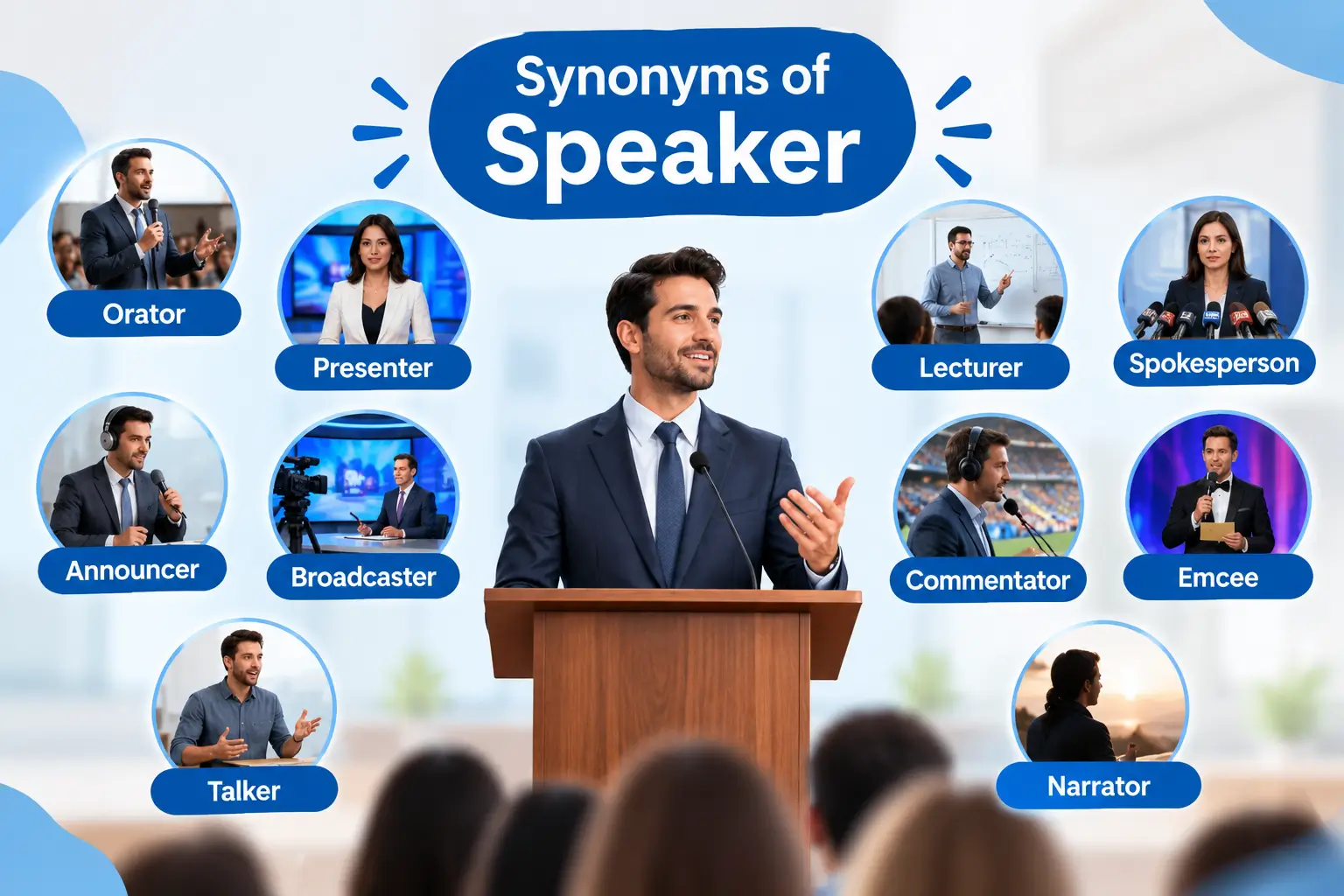
1. Orator (Noun) — US /ˈɔːrətər/ | UK /ˈɒrətə/ Meaning: Person skilled in formal public speaking
- The orator delivered a powerful speech.
- Famous orators inspire political movements.
2. Presenter (Noun) — US /prɪˈzɛntər/ | UK /prɪˈzɛntə/ Meaning: Person presenting information or content
- The presenter explained the new project to the team.
- News presenters inform viewers daily.
3. Lecturer (Noun) — US /ˈlɛkʧərər/ | UK /ˈlɛkʧərə/ Meaning: Teacher or speaker giving an academic talk
- The lecturer gave an engaging talk on history.
- University lecturers often publish research papers.
4. Spokesperson (Noun) — US /ˈspoʊksˌpɜrsən/ | UK /ˈspəʊkspɜːsən/ Meaning: Official representative who speaks on behalf of a group
- The company spokesperson announced the new policy.
- A spokesperson must remain professional.
5. Announcer (Noun) — US /əˈnaʊnsər/ | UK /əˈnaʊnsə/ Meaning: Person introducing programs or events
- The announcer welcomed guests to the concert.
- Sports announcers provide live commentary.
6. Broadcaster (Noun) — US /ˈbrɔːdkæstər/ | UK /ˈbrɔːdkɑːstə/ Meaning: Person transmitting radio or TV programs
- The broadcaster reported breaking news.
- Public broadcasters reach millions daily.
7. Commentator (Noun) — US /ˈkɒmənˌteɪtər/ | UK /ˈkɒmənteɪtə/ Meaning: Person providing spoken commentary
- The football commentator explained each play.
- TV commentators analyze current events.
8. Emcee (Noun) — US /ˌɛmˈsiː/ | UK /ˌɛmˈsiː/ Meaning: Master of ceremonies at an event
- The emcee introduced all performers.
- Weddings often have a professional emcee.
9. Talker (Noun) — US /ˈtɔːkər/ | UK /ˈtɔːkə/ Meaning: Someone who talks, informally
- He is a natural talker and captivates audiences.
- She is a great talker at networking events.
10. Narrator (Noun) — US /ˈnærˌeɪtər/ | UK /ˈnærətə/ Meaning: Person telling a story or giving commentary
- The narrator made the audiobook engaging.
- Documentaries require skilled narrators.
11. Public Speaker (Noun) — US /ˈpʌblɪk ˈspiːkər/ | UK /ˈpʌblɪk ˈspiːkə/ Meaning: A person who speaks to a public audience formally
- The public speaker motivated the students with his story.
- Conferences often hire experienced public speakers.
12. Oratorical Expert (Noun) — US /ˌɔːrəˈtɔːrɪkəl ˈɛkspɜrt/ | UK /ˌɒrəˈtɒrɪkəl ˈɛkspɜːt/ Meaning: Someone skilled in delivering speeches effectively
- She is an oratorical expert, captivating every audience.
- Political campaigns hire oratorical experts for debates.
13. Host (Noun) — US /hoʊst/ | UK /həʊst/ Meaning: A person who organizes or presents events
- The host welcomed everyone to the gala.
- Talk shows require charismatic hosts.
14. Debater (Noun) — US /dɪˈbeɪtər/ | UK /dɪˈbeɪtə/ Meaning: Someone who argues a topic in a structured discussion
- The debater impressed the judges with logical points.
- School debaters often practice for competitions.
15. Motivational Speaker (Noun) — US /ˌmoʊtɪˈveɪʃənəl ˈspiːkər/ | UK /ˌməʊtɪˈveɪʃənəl ˈspiːkə/ Meaning: Person who inspires others with speeches
- The motivational speaker shared techniques for success.
- Companies invite motivational speakers for employee events.
16. Elocutionist (Noun) — US /ˌɛləˈkjuːʃənɪst/ | UK /ˌɛləˈkjuːʃənɪst/ Meaning: Person trained in the art of clear, expressive public speaking
- The elocutionist trained students in voice projection and clarity.
- Elocutionists were once popular performers in Victorian theatre.
17. Mouthpiece (Noun) — US /ˈmaʊθpiːs/ | UK /ˈmaʊθpiːs/ Meaning: Someone who speaks officially for others
- The politician’s mouthpiece announced the policy.
- Companies often hire a mouthpiece for PR statements.
18. Podcaster (Noun) — US /ˈpɒdkæstər/ | UK /ˈpɒdkɑːstə/ Meaning: A person producing audio programs for online listeners
- The podcaster interviewed famous authors weekly.
- Many podcasters have loyal audiences worldwide.
19. Talk Show Host (Noun) — US /tɔːk ʃoʊ hoʊst/ | UK /tɔːk ʃəʊ həʊst/ Meaning: Presenter of a TV or radio talk show
- The talk show host discussed celebrity news.
- Popular talk show hosts influence public opinion.
20. Voice (Noun, figurative) — US /vɔɪs/ | UK /vɔɪs/ Meaning: A person expressing opinions or ideas publicly
- She became the voice of youth activism.
- The author uses his voice to advocate social change.
21. Raconteur (Noun) — US /ˌrækɒnˈtɜːr/ | UK /ˌrækɒnˈtɜː/ Meaning: Skilled storyteller, entertaining or informative
- The raconteur captivated the dinner guests with anecdotes.
- Famous raconteurs can hold any audience’s attention.
22. Speechmaker (Noun) — US /ˈspiːʧˌmeɪkər/ | UK /ˈspiːʧˌmeɪkə/ Meaning: A person who gives formal speeches
- The speechmaker addressed thousands at the rally.
- Experienced speechmakers often coach politicians.
23. Communicator (Noun) — US /kəˈmjunɪˌkeɪtər/ | UK /kəˈmjuːnɪˌkeɪtə/ Meaning: Person skilled in expressing ideas clearly
- A good communicator inspires teams to act.
- Leaders must be effective communicators.
24. Spokesman (Noun) — US /ˈspoʊksmən/ | UK /ˈspəʊksmən/ Meaning: Male representative speaking for a group or organization
- The company spokesman addressed the press.
- Each department has a spokesman for media inquiries.
25. Spokeswoman (Noun) — US /ˈspoʊkswʊmən/ | UK /ˈspəʊkswʊmən/ Meaning: Female representative speaking for a group
- The NGO’s spokeswoman announced their new program.
- Every campaign needs an official spokeswoman.
26. MC (Noun) — US /ˌɛm ˈsiː/ | UK /ˌɛm ˈsiː/ Meaning: Master of ceremonies guiding events or performances
- The MC introduced all the performers at the concert.
- Wedding parties often hire an experienced MC.
27. Radio Announcer (Noun) — US /ˈreɪdioʊ əˈnaʊnsər/ | UK /ˈreɪdiəʊ əˈnaʊnsə/ Meaning: Person speaking on radio broadcasts
- The radio announcer gave the morning news updates.
- Skilled radio announcers keep listeners engaged.
28. TV Host (Noun) — US /ˌtiːˈvi hoʊst/ | UK /ˌtiːˈvi həʊst/ Meaning: Presenter of television programs
- The TV host conducted interviews with celebrities.
- Award shows rely on charismatic TV hosts.
29. Rhetorician (Noun) — US /ˌrɛtəˈrɪʃən/ | UK /ˌrɛtəˈrɪʃən/ Meaning: Person skilled in the art of persuasive, effective speech
- The rhetorician structured his argument to win over skeptics.
- Ancient Greece produced many influential rhetoricians.
30. Keynote Speaker (Noun) — US /ˈkiːnoʊt ˈspiːkər/ | UK /ˈkiːnəʊt ˈspiːkə/ Meaning: The main, headline speaker at a conference or event
- The keynote speaker set the tone for the entire summit.
- Organizers invited a tech CEO as this year’s keynote speaker.
Bonus: Synonyms of Speaker (Device Sense)
Since “speaker” also refers to a sound-producing device, here are common alternatives for that meaning:
- Loudspeaker — a device that converts electrical signals into audible sound, often larger and more powerful.
- Amplifier — a device that boosts sound signals (technically distinct from a speaker but often used loosely as a synonym in casual speech).
- PA System (Public Address System) — a set of speakers used to project sound over a large area.
- Sound System — a general term for a set of connected audio devices, including speakers.
- Woofer/Tweeter — specific speaker components handling low and high frequencies respectively.
Examples:
- We set up a loudspeaker in the hall so everyone could hear the announcement.
- The sound system at the stadium was upgraded before the concert.
Prototype Meaning
Most people imagine a speaker as a person addressing an audience, whether formally or informally, or a device projecting sound. It conveys communication, authority, or entertainment.
Prototype Categorization
- Public Speaking: orator, lecturer, spokesperson, emcee, motivational speaker, keynote speaker
- Media / Broadcasting: broadcaster, announcer, commentator, TV host, radio announcer, podcaster
- Informal / General: talker, narrator, communicator, raconteur, speaker
- Device / Technology: loudspeaker, amplifier, PA system, sound system
Categorization helps select context-appropriate synonyms.
Antonyms of Speaker
Listener, audience, spectator, silent person, silence (for the device sense)
Short Questions and Answers
What does Speaker mean? A person who talks to others, or a device that produces sound.
When should Speaker be used? Use it for public speakers, presenters, or audio devices.
Is Speaker positive or negative? Usually positive or neutral; it can carry a negative tone if the person is overbearing or monotonous.
How is it different from similar words? “Speaker” is a general term for talking or devices; words like “broadcaster,” “lecturer,” or “loudspeaker” are more specific to context.
Conclusion
Learning “speaker” and its 30 synonyms improves vocabulary, strengthens communication, and allows precise usage in public speaking, media, and technology contexts. Using appropriate synonyms ensures clarity, avoids repetition, and enhances writing or speaking confidence. Daily practice helps English learners and writers master nuances and context-appropriate word choices.