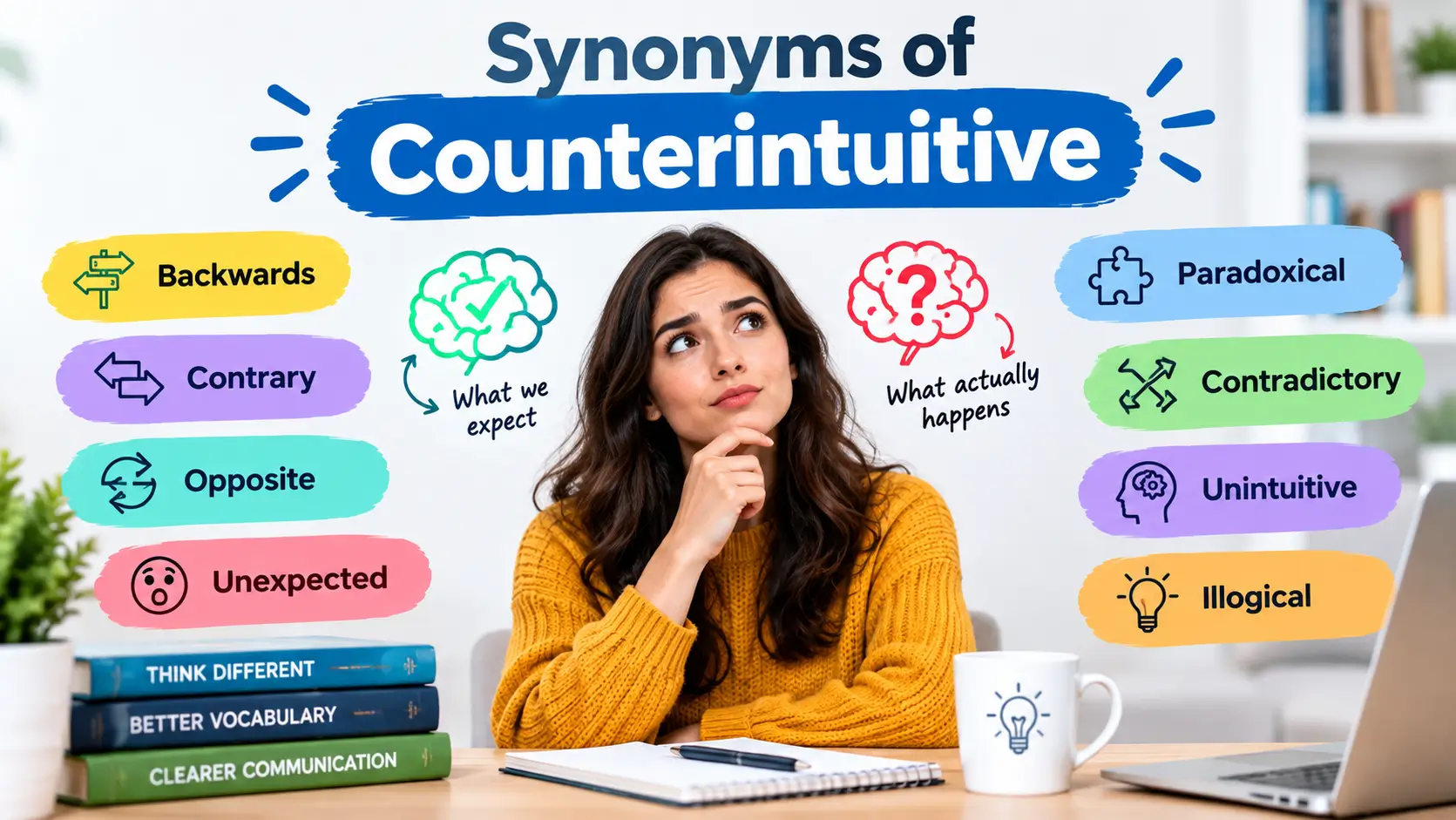
The word counterintuitive describes something that goes against what you’d naturally expect — yet turns out to be true. For example: “Running a mile can sometimes reduce fatigue rather than increase it — which feels counterintuitive.”
This article gives you accurate, genuine synonyms of “counterintuitive,” each checked for correct meaning (not just words that sound similar), along with pronunciation, examples, register notes, and common collocations.
Meaning of Counterintuitive
Counterintuitive (adjective): Contrary to what intuition or common sense would suggest, yet often correct or real.
Examples:
- It’s counterintuitive, but eating slightly fewer calories at breakfast can sometimes reduce hunger later.
- The counterintuitive finding surprised even the researchers who ran the study.
Adverb form: counterintuitively — “Counterintuitively, the smaller team finished the project faster.”
Connotation:
- Neutral-to-positive: often signals insight, cleverness, or an interesting discovery.
- Rarely negative — unlike words such as “illogical” or “absurd,” which imply something is wrong, “counterintuitive” implies something is surprising but right.
Etymology (Brief and Accurate)
- Root: Latin intuitus (“a looking at, consideration”), combined with the prefix counter- (“against, opposite”).
- First recorded use: The word entered English usage in the mid-20th century, gaining traction in psychology, economics, and scientific writing from the 1950s onward, as researchers needed a term for results that contradicted common expectations but were empirically verified.
- It did not exist in Old or Middle English — it’s a relatively modern coinage built from older Latin-derived parts.
Pronunciation:
- US: /ˌkaʊn.tər.ɪnˈtuː.ɪ.tɪv/
- UK: /ˌkaʊn.tər.ɪnˈtjuː.ɪ.tɪv/
Syllables: coun-ter-in-tu-i-tive
25 Genuine Synonyms of Counterintuitive
Each entry below actually shares the core meaning: surprising, yet plausible or true — not simply “confusing” or “wrong.”
Close, Direct Synonyms
1. Unintuitive — US /ˌʌn.ɪnˈtuː.ɪ.tɪv/ Not what intuition would suggest. “The keyboard shortcut felt unintuitive until I used it a few times.”
2. Nonintuitive — US /ˌnɑːn.ɪnˈtuː.ɪ.tɪv/ A more formal/technical variant of “unintuitive,” common in UX and science writing. “The algorithm’s nonintuitive approach turned out to be the most efficient.”
3. Paradoxical — US /ˌpær.əˈdɑːk.sɪ.kəl/ Seemingly self-contradictory, but true. “It’s paradoxical that giving people more choices can make them less satisfied.”
4. Unexpected — US /ˌʌn.ɪkˈspek.tɪd/ Surprising, not anticipated (broader than counterintuitive, but overlaps closely). “The unexpected result changed how scientists viewed the disease.”
5. Surprising — US /sərˈpraɪ.zɪŋ/ A plain, everyday alternative. “It’s surprising how often the quieter option in a negotiation wins.”
Formal / Academic Register
6. Contrary to expectation (phrase) — Common in academic writing. “Contrary to expectation, the smaller dose produced a stronger effect.”
7. Anti-intuitive — A rarer but attested formal variant. “Some economic principles are anti-intuitive at first glance.”
8. Incongruous — US /ɪnˈkɑːŋ.ɡru.əs/ Out of keeping with what would be expected in context. “His calm response felt incongruous given the chaos around him.”
9. Contradictory — US /ˌkɑːn.trəˈdɪk.tɔːr.i/ Use carefully — closer to “logically opposing” than “surprising but true.” Best when two findings genuinely conflict. “The two studies produced contradictory results.”
Everyday / Conversational
10. Odd — US /ɑːd/ “It’s odd that slower runners sometimes recover faster.”
11. Strange — US /streɪndʒ/ “It felt strange, but skipping the warm-up actually helped his performance.”
12. Backwards (informal) — US /ˈbæk.wərdz/ “It sounds backwards, but spending more upfront saved us money overall.”
13. Not what you’d expect (phrase) — Simple, spoken-register alternative. “The results were not what you’d expect at all.”
Describing Confusion Caused by a Surprising Idea
14. Puzzling — US /ˈpʌz.lɪŋ/ “Scientists found the results puzzling at first.”
15. Perplexing — US /pərˈplek.sɪŋ/ “The paradox was perplexing until she explained the underlying cause.”
16. Baffling — US /ˈbæf.lɪŋ/ “The pattern was baffling to everyone on the team.”
(Note: these three describe your reaction — confusion — rather than the fact itself being surprising-but-true. Use them when emphasizing difficulty of understanding, not the surprising nature of a correct result.)
Describing an Unconventional Approach or Method
17. Unconventional — US /ˌʌn.kənˈven.ʃə.nəl/ “Her unconventional strategy turned out to be the right call.”
18. Nontraditional — US /ˌnɑːn.trəˈdɪʃ.ən.əl/ “The nontraditional method surprised critics by working better than expected.”
19. Against the grain (idiom) “His decision went against the grain, but it paid off.”
Related to Logic and Reasoning (use with caution — see note below)
20. Illogical-seeming — Reserve for cases where something appears illogical but is proven correct; don’t shorten to plain “illogical,” which implies it’s actually flawed. “The illogical-seeming shortcut actually saved time.”
21. Anomalous — US /əˈnɑː.mə.ləs/ Deviating from what is normal or expected, often used in scientific/statistical contexts. “The anomalous data point didn’t fit the usual pattern, yet it was accurate.”
22. Ironic — US /aɪˈrɑː.nɪk/ Use only when there’s a genuine twist of fate or contrast, not just “surprising.” “It’s ironic that the safety feature caused the accident it was meant to prevent.”
Softer / Hedging Alternatives
23. Somewhat unexpected “The findings were somewhat unexpected but not shocking.”
24. Against common sense (phrase) “It goes against common sense, but pausing before responding often de-escalates conflict.”
25. Not obvious at first “The benefit isn’t obvious at first, but it becomes clear with more data.”
Words to Avoid Using as Synonyms
Several words are often mistakenly listed as synonyms of “counterintuitive” but actually mean something different:
| Word | Why it’s NOT a good match |
|---|---|
| Illogical | Implies the idea is false or unreasonable, not surprising-but-true |
| Absurd | Implies ridiculousness, not validity |
| Unreasonable | Implies poor judgment, not a valid surprising result |
| Bizarre | Implies strangeness without any sense of underlying truth |
Using these interchangeably with “counterintuitive” can flip your intended meaning — especially in academic or professional writing, where precision matters.
Quick Reference by Context
- Scientific/academic writing: paradoxical, anomalous, contrary to expectation, nonintuitive
- UX/design writing: unintuitive, nonintuitive
- Everyday conversation: odd, strange, backwards, not what you’d expect
- Describing confusion: puzzling, perplexing, baffling
- Describing an approach: unconventional, nontraditional, against the grain
Antonyms: intuitive, logical, expected, predictable, straightforward
Quick Q&A
Q: What does counterintuitive mean? Something that contradicts common expectation but is nonetheless true or valid.
Q: Is it positive or negative? Mostly neutral-to-positive — it usually signals an interesting or insightful finding, not a flawed one.
Q: What’s the biggest mistake people make with this word? Treating “illogical,” “absurd,” or “bizarre” as synonyms. These describe something as wrong or strange, while “counterintuitive” specifically describes something surprising yet correct.
Q: What’s a natural everyday alternative? “Not what you’d expect” or “surprising” work well in casual speech; “counterintuitive” itself is common enough to use directly in most writing.
Conclusion
“Counterintuitive” is a precise word — it says a result defies expectation and is still valid. The best synonyms preserve both halves of that meaning. Picking the right one for your register (academic vs. conversational) and making sure it doesn’t accidentally imply something is false rather than surprising will make your writing sharper and more accurate.