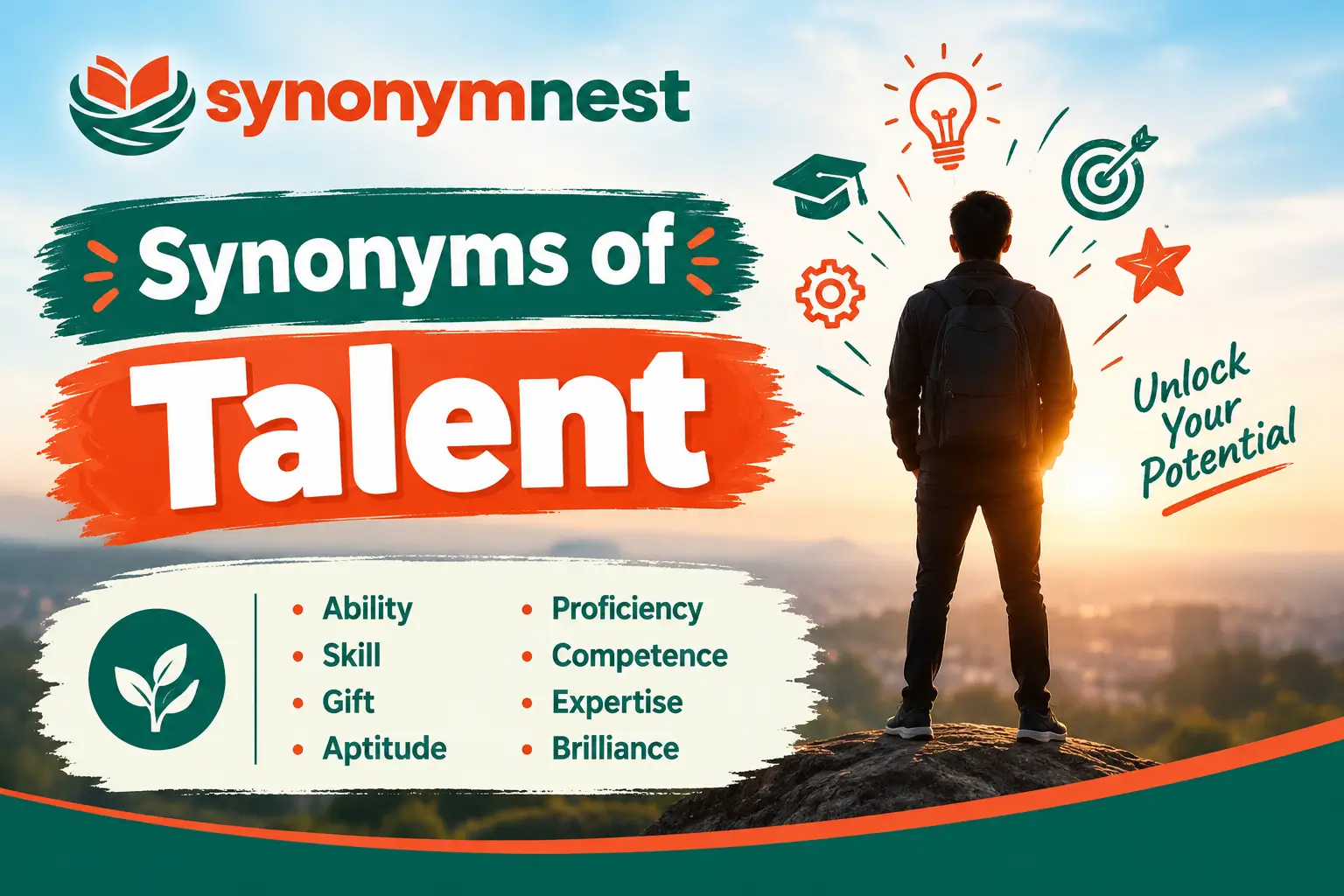
A synonym for talent is ability, skill, gift, aptitude, or knack. These words describe a person’s natural strengths or developed skills. The best choice depends on the situation: gift often suggests a natural ability, skill emphasizes practice, and aptitude describes a natural capacity to learn or develop a particular ability.
Talent is an important word in everyday English. We use it to describe someone who sings beautifully, solves difficult problems, creates impressive artwork, or performs exceptionally well at work. However, repeating the same word too often can make writing less interesting.
Learning synonyms of talent helps you express ideas more precisely, improve your vocabulary, and communicate confidently. Some alternatives describe natural ability, while others emphasize experience, creativity, intelligence, or the potential to improve.
In this guide, you will discover 30 useful synonyms of talent with simple definitions, pronunciation, and natural example sentences. You will also learn the differences between talent, skill, and ability, explore common phrases, and find answers to frequently asked questions.
Meaning of Talent
Definition: Talent is a natural ability or special aptitude that helps someone perform a particular activity well.
Talent can appear in many areas, including music, sports, writing, science, leadership, and problem-solving. Although some people show an ability early in life, talent can also develop through practice, education, and experience.
Examples:
- Maya has a natural talent for playing the piano.
- His talent for solving complex problems impressed his teachers.
- The company is looking for talented employees with strong communication skills.
Talent is usually a positive word because it highlights someone’s strengths and possibilities.
Connotative Meaning of Talent
Connotation refers to the feelings or associations connected with a word beyond its basic definition.
The word talent generally has a positive connotation. It suggests promise, ability, creativity, or exceptional performance.
- Positive: Her musical talent inspires everyone who hears her sing.
- Neutral: The coach evaluated the talent of each player.
- Pressure-related: His talent brings high expectations from his family and teachers.
The word itself is not normally negative, although expectations associated with exceptional ability can sometimes create pressure.
Etymology and History of Talent
The word talent comes through Old French and Latin from Greek talanton, which referred to a balance, weight, or unit of monetary value.
In the biblical tradition, the word was associated with a sum of money. Over time, its figurative meaning developed to describe a person’s abilities and gifts.
Today, talent commonly refers to natural ability, although the word is also used in workplaces to describe skilled people or employees.
Pronunciation of Talent
- American English: /ˈtæl.ənt/
- British English: /ˈtæl.ənt/
- Syllables: tal-ent
- Part of speech: Noun
The first syllable receives the main stress: TAL-ent.
Word Formation of Talent
The word talent does not normally require a prefix or suffix in its basic noun form. However, several related forms are commonly used.
- Talent: noun referring to an ability.
- Talents: plural noun referring to multiple abilities.
- Talented: adjective describing someone with talent.
- Talentless: adjective meaning without a particular talent or ability.
Examples:
- She has a talent for storytelling.
- He has several artistic talents.
- The talented student won the competition.
- The word talentless can sound harsh, so use it carefully.
30 Synonyms of Talent with Examples
The following words have meanings related to talent, but they are not interchangeable in every sentence. Choose an alternative according to the type of ability you want to describe.
1. Ability (noun)
Meaning: The power or capacity to do something.
Ability is one of the closest general alternatives to talent. It can describe natural strengths or abilities developed through learning.
Examples:
- She has the ability to explain difficult ideas clearly.
- His ability to remain calm helps him lead the team.
2. Skill (noun)
Meaning: The ability to do something well, often developed through practice or training.
A skill usually emphasizes performance and learned competence more than natural talent.
Examples:
- Her writing skills improved through daily practice.
- He has the technical skills needed for the job.
3. Gift (noun)
Meaning: A natural ability that makes someone particularly good at an activity.
Gift often suggests that an ability comes naturally.
Examples:
- She has a gift for making people laugh.
- His gift for music became clear at an early age.
4. Aptitude (noun)
Meaning: A natural ability or capacity to learn a particular subject or skill.
Aptitude is especially useful when discussing someone’s potential to learn.
Examples:
- Daniel has a strong aptitude for mathematics.
- Her aptitude for languages helped her learn French quickly.
5. Knack (noun)
Meaning: A special or natural ability to do something easily.
Knack is informal and commonly appears in everyday conversation.
Examples:
- My sister has a knack for finding creative solutions.
- He has a knack for remembering people’s names.
6. Flair (noun)
Meaning: A natural ability to do something with style, originality, or enthusiasm.
Flair is often used for artistic, creative, and expressive abilities.
Examples:
- She has a flair for interior design.
- His flair for storytelling makes his presentations memorable.
7. Genius (noun)
Meaning: Exceptional intellectual ability or extraordinary creative power.
Genius is much stronger than talent and should be reserved for outstanding ability.
Examples:
- The scientist demonstrated remarkable genius in her research.
- His musical genius became apparent through his original compositions.
8. Expertise (noun)
Meaning: Specialized knowledge or advanced skill gained through training and experience.
Expertise is particularly suitable for professional and academic writing.
Examples:
- Her expertise in digital marketing helped the business grow.
- The hospital relies on his expertise in cardiac surgery.
9. Capability (noun)
Meaning: The ability or capacity to perform a task or achieve a result.
Capability emphasizes what a person can do rather than whether that ability is naturally gifted.
Examples:
- She has the capability to manage a large team.
- The project demonstrated his capability as a leader.
10. Competence (noun)
Meaning: The ability to perform a task adequately and effectively.
Competence emphasizes meeting the requirements of a task or role.
Examples:
- The manager praised her competence in handling customer complaints.
- Effective communication is an important part of professional competence.
11. Proficiency (noun)
Meaning: A high level of skill or ability in a particular activity.
Proficiency often refers to languages, technical tasks, and professional skills.
Examples:
- Her proficiency in English helped her succeed in the interview.
- The course develops proficiency in computer programming.
12. Mastery (noun)
Meaning: A high level of knowledge or control over a subject or skill.
Mastery usually suggests extensive practice and a deep understanding.
Examples:
- Years of practice helped him achieve mastery of the violin.
- Her mastery of grammar makes her writing clear and precise.
13. Strength (noun)
Meaning: An area in which someone performs particularly well.
Strength is useful when discussing someone’s best qualities or abilities.
Examples:
- Problem-solving is one of her greatest strengths.
- His strength in mathematics helped him excel in engineering.
14. Forte (noun)
Meaning: A particular activity or subject at which someone is especially good.
Forte is often used to identify someone’s strongest area.
Examples:
- Creative writing is her forte.
- Negotiation has always been his forte.
15. Endowment (noun)
Meaning: A natural ability, quality, or characteristic that a person possesses.
This word is more formal and is often used in discussions of innate qualities.
Examples:
- Her natural endowment for music became evident during childhood.
- The program helps students develop their intellectual endowments.
16. Capacity (noun)
Meaning: The ability or potential to understand, learn, or perform something.
Capacity can emphasize the extent of what someone is able to do.
Examples:
- She has a remarkable capacity for learning new languages.
- His capacity for creative thinking helped solve the problem.
17. Ingenuity (noun)
Meaning: The ability to develop clever, original, and practical solutions.
Ingenuity is especially appropriate when talent involves invention or problem-solving.
Examples:
- The engineer used ingenuity to design an affordable device.
- Her ingenuity helped the team overcome a difficult challenge.
18. Creativity (noun)
Meaning: The ability to produce original ideas, designs, or solutions.
Creativity is a specific kind of ability rather than a complete synonym for every type of talent.
Examples:
- Her creativity shines through her paintings.
- The teacher encourages creativity through hands-on activities.
19. Dexterity (noun)
Meaning: Skill and coordination in using the hands or performing precise movements.
Dexterity is particularly useful for describing physical or manual ability.
Examples:
- The watchmaker’s dexterity allowed him to repair delicate parts.
- The surgeon demonstrated exceptional manual dexterity.
20. Brilliance (noun)
Meaning: Exceptional intelligence, talent, or outstanding quality.
Brilliance emphasizes an impressive level of performance or thought.
Examples:
- Her brilliance in mathematics earned her a scholarship.
- The student’s brilliance was evident in his original research.
21. Acumen (noun)
Meaning: The ability to make good judgments and understand situations quickly.
Acumen is commonly used in business, finance, and decision-making contexts.
Examples:
- Her business acumen helped the company enter new markets.
- The director demonstrated excellent strategic acumen.
22. Faculty (noun)
Meaning: A natural mental or physical power, such as the ability to reason or remember.
In this sense, faculty is a formal word. It also has a separate meaning referring to academic staff at a school or university.
Examples:
- Humans have the faculty of reasoning.
- His artistic faculty developed through years of observation and practice.
23. Savvy (noun)
Meaning: Practical knowledge, understanding, or good judgment in a particular area.
Savvy is often used in informal and professional contexts.
Examples:
- Her business savvy helped the small company become profitable.
- He has the technical savvy needed to troubleshoot computer problems.
24. Know-how (noun)
Meaning: Practical knowledge and the ability to do something effectively.
Know-how emphasizes experience and practical understanding rather than innate ability.
Examples:
- The technician has the know-how to repair complex machinery.
- Running a successful shop requires financial know-how.
25. Artistry (noun)
Meaning: Creative skill and expressive ability, especially in the arts.
Artistry is a strong choice when talent involves imagination, technique, and artistic expression.
Examples:
- The dancer’s artistry made the performance unforgettable.
- Her artistry is evident in every detail of the painting.
26. Potential (noun)
Meaning: The possibility of developing an ability or achieving something in the future.
Potential describes what someone may accomplish, not necessarily what they can already do.
Examples:
- The young athlete has the potential to become a champion.
- Her teacher recognized her potential as a writer.
27. Giftedness (noun)
Meaning: The condition of having unusually high ability in one or more areas.
Giftedness is often used in education and psychology.
Examples:
- The school provides additional challenges for students with exceptional giftedness.
- Early support can help children develop their abilities.
28. Resourcefulness (noun)
Meaning: The ability to find clever ways to handle difficulties or solve problems.
Resourcefulness focuses on adapting to challenges rather than on talent in general.
Examples:
- Her resourcefulness helped the team finish the project despite limited supplies.
- The rescue worker showed impressive resourcefulness during the emergency.
29. Aptness (noun)
Meaning: The quality of being suitable, appropriate, or well suited to a particular purpose; in some contexts, it can suggest a natural suitability for something.
Aptness is less common than aptitude and is not always a direct synonym for talent.
Examples:
- His aptness for the role became clear during the interview.
- Her aptness for careful observation helped her in scientific research.
30. Bent (noun)
Meaning: A natural tendency, inclination, or aptitude toward a particular activity.
Bent is commonly used in expressions such as a scientific bent or an artistic bent.
Examples:
- She has a strong artistic bent.
- His scientific bent encouraged him to explore how machines work.
Best Synonyms of Talent by Context
Different situations call for different words. The following groups can help you select the most appropriate alternative.
For natural ability
- Gift
- Aptitude
- Knack
- Bent
- Endowment
For professional ability
- Expertise
- Proficiency
- Competence
- Skill
- Know-how
For creative ability
- Flair
- Creativity
- Artistry
- Ingenuity
- Brilliance
For intellectual ability
- Genius
- Acumen
- Faculty
- Capacity
For someone’s strongest quality
- Strength
- Forte
- Ability
- Capability
For future development
- Potential
- Aptitude
- Capability
Remember that these groups overlap. The best synonym depends on whether you want to highlight natural ability, learned performance, creative expression, or future promise.
Talent vs. Skill vs. Ability
These three words are closely related, but their meanings are different.
| Word | Main meaning | Example |
|---|---|---|
| Talent | A natural ability or special aptitude | She has a talent for singing. |
| Skill | An ability developed or improved through practice | She developed her singing skills through lessons. |
| Ability | The general power to do something | She has the ability to sing in several styles. |
A person may have a natural talent for singing but still need training to develop strong vocal skills. The word ability can describe both natural and learned performance.
Common Phrases with Talent
Learning common expressions helps you use the word naturally in speaking and writing.
- Natural talent: He has a natural talent for drawing.
- Exceptional talent: The competition attracted performers with exceptional talent.
- Hidden talent: Cooking turned out to be her hidden talent.
- Musical talent: His musical talent was recognized at an early age.
- Artistic talent: The school encourages students to develop their artistic talent.
- Emerging talent: The gallery showcases emerging talent from local communities.
- Talent development: The company invests in talent development and employee training.
- Talented individual: She is a talented individual with strong leadership skills.
Antonyms of Talent
Antonyms are words with opposite or contrasting meanings. The appropriate antonym depends on the context.
1. Inability: The lack of ability to do something.
Example: His inability to meet the deadline delayed the project.
2. Ineptitude: A lack of skill or competence.
Example: The report revealed serious ineptitude in managing the budget.
3. Weakness: An area where someone lacks strength or performs less effectively.
Example: Public speaking was initially her greatest weakness.
4. Incompetence: The inability to perform a task adequately.
Example: The manager addressed the team’s incompetence in handling customer complaints.
5. Inaptitude: A lack of aptitude or suitability for a particular activity.
Example: His inaptitude for the task became clear after several unsuccessful attempts.
These words are not exact opposites in every situation. For example, a person without natural talent may still develop competence through practice.
Frequently Asked Questions
What is the closest synonym for talent?
Ability is one of the closest general synonyms. Gift and aptitude are especially suitable when describing natural ability.
What is another word for natural talent?
Common alternatives include gift, aptitude, knack, bent, and endowment. The best choice depends on the sentence and the type of ability.
What is a professional word for talent?
Expertise, proficiency, competence, and capability are useful in professional writing. Use expertise when you mean specialized knowledge developed through experience or training.
Are talent and skill the same?
No. Talent often suggests a natural ability, while skill usually emphasizes an ability developed or improved through practice. Both can contribute to excellent performance.
What is the difference between talent and aptitude?
Talent generally describes an ability someone possesses, while aptitude emphasizes a natural capacity to learn or develop an ability. The meanings overlap, but aptitude is particularly useful when discussing learning potential.
How do you describe someone with many talents?
You can call that person multitalented, versatile, or gifted in several areas. For example, “She is a versatile performer who can sing, dance, and act.”
Can talent be developed through practice?
Yes. Practice, education, coaching, and experience can help people improve their existing abilities and develop new skills. Natural aptitude may provide an advantage, but consistent effort is also important.
Conclusion
Learning synonyms of talent can make your English more precise, natural, and engaging. Words such as ability, gift, aptitude, and knack are useful for describing natural strengths, while skill, expertise, and proficiency emphasize developed abilities.
Other alternatives, including creativity, artistry, acumen, and resourcefulness, help you describe more specific qualities. However, these words are not interchangeable in every context.
Choose a synonym that matches your intended meaning, tone, and situation. Practice using these alternatives in sentences, conversations, and writing. With regular use, you can expand your vocabulary and communicate your ideas with greater confidence and clarity.