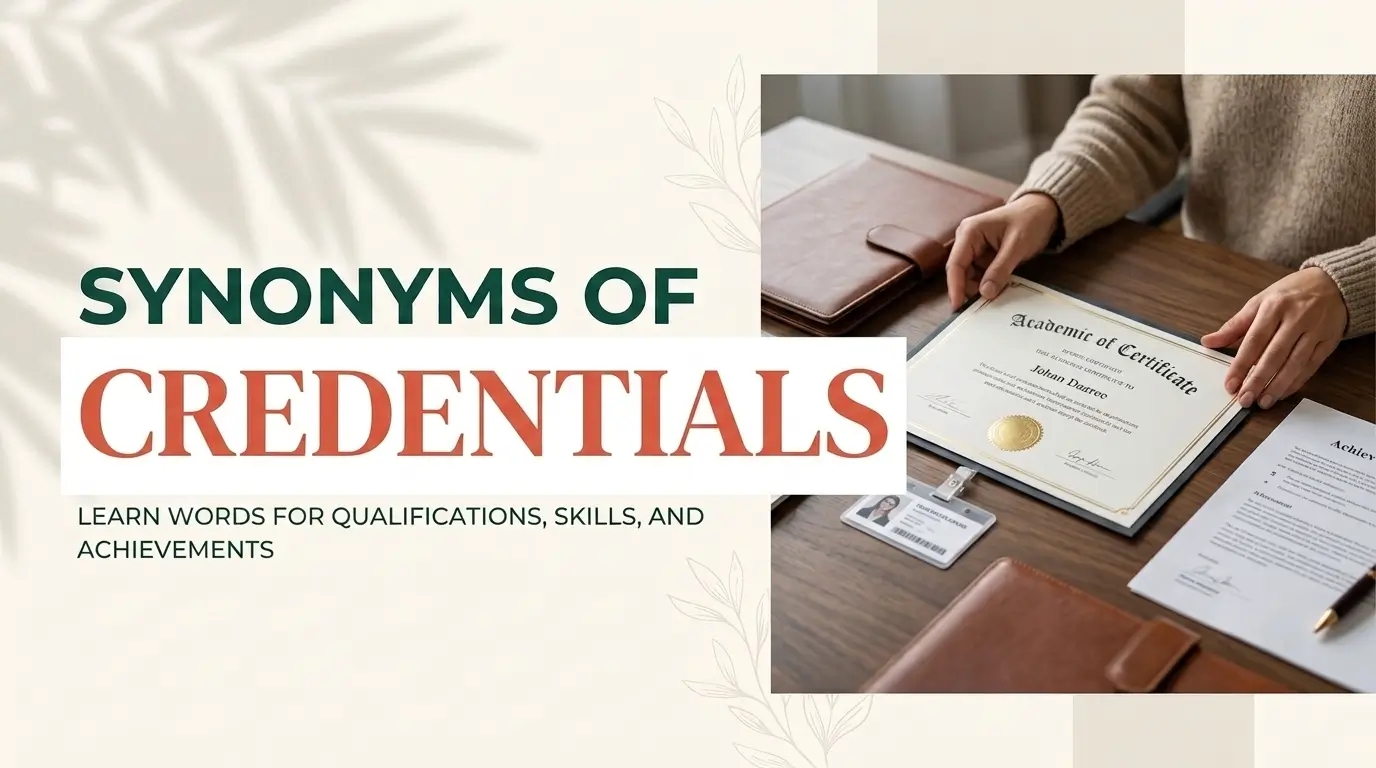
The word credentials refers to documents, qualifications, or information that prove a person’s identity, skills, education, or authority. For example, when you apply for a job, an employer may ask for your degrees, certificates, work history, or professional licenses. These documents help demonstrate that you have the necessary qualifications for the position.
Learning synonyms of credentials can improve your English vocabulary and make your writing more professional. Different words are suitable for different situations. For example, qualifications are often used when discussing education and skills, while documentation refers to official papers and login credentials describe the information needed to access an online account.
In this guide, you will learn 30 synonyms of credentials with simple meanings and practical examples. You will also discover how credentials are used in professional, academic, and digital settings, along with their pronunciation, history, grammatical forms, and common antonyms.
Meaning of Credentials
Credentials is a plural noun that refers to evidence of someone’s identity, qualifications, experience, or authority. The exact meaning depends on the situation in which the word is used.
For example, a teacher may present academic credentials to prove educational qualifications. A doctor may show professional credentials to demonstrate licensing and training. Similarly, a person signing in to an online account may need login credentials, such as a username and password.
Definition of Credentials
Credentials (noun): Documents, qualifications, or information used to establish a person’s identity, abilities, professional standing, or right to access something.
Examples of Credentials in Sentences
- The employer reviewed her credentials before offering her the position.
- The doctor displayed his professional credentials at the clinic.
- Please enter your login credentials to access your account.
- The university checked the applicant’s academic credentials.
- The security officer verified the visitor’s credentials before allowing entry.
Connotative Meaning of Credentials
The word credentials generally has a neutral or positive connotation. It often suggests that someone has the necessary qualifications, experience, or proof to be trusted for a particular role.
Positive meaning: Credentials can suggest professionalism, competence, and reliability.
Neutral meaning: The word may simply refer to documents or information used for identification or verification.
Negative meaning: Expressions such as fake credentials or fraudulent credentials suggest that someone is misrepresenting their qualifications or identity.
Etymology and History of Credentials
The word credentials comes from credential, which is related to the Latin word credere, meaning “to believe” or “to trust.” The related word credence also expresses the idea of belief or acceptance.
Over time, credential developed a meaning connected with documents or evidence that establish a person’s authority, identity, or qualifications.
Today, credentials are commonly used in education, employment, government services, healthcare, and technology. The word also has a digital meaning, referring to the information people use to access computer systems and online accounts.
Pronunciation of Credentials
- US pronunciation: /krɪˈden.ʃəlz/
- UK pronunciation: /krɪˈden.ʃəlz/
- Syllables: cre-den-tials
- Part of speech: Noun, usually used in the plural
The stress falls on the second syllable: DEN.
Word Formation and Grammar
The word credentials belongs to a word family associated with belief, trust, and proof.
- Credential: A document or qualification that establishes authority, identity, or competence.
- Credentials: The plural form, commonly used when referring to a person’s qualifications or proof.
- Credentialed: An adjective describing someone who has recognized qualifications or credentials.
- Credentialing: The process of verifying qualifications or granting recognized professional status.
In many contexts, credentials takes a plural verb when referring to multiple documents or pieces of evidence. However, the phrase login credentials is often treated as a collective expression.
30 Synonyms of Credentials with Examples and Meanings
The following words are useful alternatives to credentials. Some are close synonyms, while others are related expressions that fit particular contexts. Choosing the correct term depends on whether you mean qualifications, official documents, identity verification, or digital access information.
1. Qualifications
Meaning: Education, training, or abilities that make someone suitable for a particular job or activity.
Qualifications is one of the closest alternatives to credentials when discussing employment or education.
Examples:
- Her qualifications make her suitable for the teaching position.
- The employer reviewed his qualifications before the interview.
2. Certifications
Meaning: Official documents or recognized awards showing that someone has completed training or met specific professional standards.
Certifications are particularly relevant in technical, healthcare, and professional fields.
Examples:
- She earned several certifications in digital marketing.
- The company requires safety certifications for certain jobs.
3. Degrees
Meaning: Academic qualifications awarded by colleges or universities after completing a course of study.
Degrees are a specific type of academic credential.
Examples:
- He holds two degrees in computer science.
- Her university degree strengthened her academic credentials.
4. Diplomas
Meaning: Documents awarded to individuals who complete a particular educational or training program.
A diploma may demonstrate education or specialized training, depending on the institution and program.
Examples:
- She received a diploma in graphic design.
- The employer asked him to provide copies of his diplomas.
5. Licenses
Meaning: Official permissions that allow someone to perform a regulated activity or work in a specific profession.
Licenses are important credentials in fields such as medicine, law, and transportation.
Examples:
- Doctors must hold the appropriate licenses to practice.
- The agency verified the driver’s professional license.
6. Accreditations
Meaning: Official recognition that an institution, program, or organization meets established standards.
Accreditation usually applies to organizations and educational programs rather than serving as a direct synonym for an individual’s qualifications.
Examples:
- The university maintains recognized accreditation.
- Students checked the institution’s accreditation before enrolling.
7. Testimonials
Meaning: Statements from people who describe their experiences with or opinions about a person, product, or service.
Testimonials may support someone’s reputation, but they do not necessarily prove formal qualifications.
Examples:
- The designer displayed client testimonials on her website.
- Positive testimonials helped establish the consultant’s reputation.
8. References
Meaning: People or statements that can confirm someone’s character, experience, or professional abilities.
References are commonly requested during recruitment.
Examples:
- The hiring manager contacted her professional references.
- His references confirmed his previous work experience.
9. Records
Meaning: Documents or stored information that provide evidence of past activities, achievements, or events.
Records can support an individual’s credentials when they contain relevant information.
Examples:
- The administrator reviewed the employee’s training records.
- Her academic records confirmed that she had completed the course.
10. Documentation
Meaning: Documents or written information that support a claim, establish identity, or verify qualifications.
Documentation is a useful alternative when referring to paperwork collectively.
Examples:
- Applicants must submit documentation of their qualifications.
- Please provide the required documentation before registration.
11. Proof
Meaning: Evidence that establishes whether something is true or valid.
Proof is a broad term and may refer to evidence of identity, qualifications, or authorization.
Examples:
- The applicant provided proof of professional training.
- You must show proof of identity before collecting the document.
12. Evidence
Meaning: Information, facts, or documents that support a claim or demonstrate that something is true.
Evidence is broader than credentials because it can include many forms of information.
Examples:
- The committee examined the evidence of her professional experience.
- His certificates provided evidence of specialized training.
13. Portfolio
Meaning: A collection of work samples that demonstrates someone’s skills, experience, and achievements.
A portfolio is especially valuable for designers, photographers, writers, and other creative professionals.
Examples:
- The web designer presented her portfolio during the interview.
- His portfolio demonstrated his experience with complex projects.
14. Resume
Meaning: A document summarizing a person’s education, work experience, skills, and achievements.
A resume presents credentials but is not itself a qualification.
Examples:
- She updated her resume before applying for the position.
- His resume highlighted his professional experience and certifications.
15. Background
Meaning: A person’s previous education, experience, training, or personal and professional history.
Background is useful when discussing the broader information that supports someone’s suitability.
Examples:
- Her educational background prepared her for the research role.
- The employer considered his professional background before making a decision.
16. Authority
Meaning: The recognized power or right to make decisions, give instructions, or perform certain actions.
Authority may be supported by credentials, but the two words do not mean exactly the same thing.
Examples:
- The manager has the authority to approve the application.
- The officer presented documents confirming his official authority.
17. Verification
Meaning: The process of checking whether information, identity, or qualifications are genuine and accurate.
Verification describes the checking process rather than the documents themselves.
Examples:
- The company completed the verification of her qualifications.
- Identity verification is required before account access is restored.
18. Endorsements
Meaning: Statements or actions that express support, approval, or recommendation.
Professional endorsements may strengthen a person’s reputation but do not replace official qualifications.
Examples:
- The consultant received endorsements from experienced colleagues.
- Her professional endorsements highlighted her industry knowledge.
19. Identification
Meaning: Information or documents used to establish who someone is.
Identification is a suitable alternative when credentials refer specifically to identity.
Examples:
- Visitors must provide identification at the entrance.
- The bank requested identification before opening the account.
20. Badges
Meaning: Physical or digital symbols that identify a person, indicate membership, or represent a completed achievement.
Digital badges may demonstrate participation in a course or completion of training.
Examples:
- Employees wear identification badges inside the building.
- She added her verified learning badges to her professional profile.
21. Clearance
Meaning: Official permission to enter a place, access information, or perform an activity.
Security clearance is a specific form of authorization and may depend on background checks.
Examples:
- The employee received security clearance for the project.
- Only staff with the required clearance can access the restricted area.
22. Status
Meaning: A person’s position, standing, or recognized condition within a group or organization.
Status can be related to professional standing, but it is not an exact synonym for credentials.
Examples:
- Her professional status improved after she earned the qualification.
- The organization checked the applicant’s membership status.
23. Experience
Meaning: Knowledge or practical ability gained through work, study, or other activities.
Experience strengthens a professional profile, although it does not always require formal documentation.
Examples:
- His experience in web development made him a strong candidate.
- The employer valued her experience with customer service.
24. Skills
Meaning: Abilities that enable someone to perform tasks effectively.
Skills can be demonstrated through work samples, tests, qualifications, or practical performance.
Examples:
- Her technical skills matched the requirements of the position.
- The course helped him develop valuable communication skills.
25. Expertise
Meaning: A high level of knowledge or skill in a particular subject or activity.
Expertise describes competence rather than the documents that establish it.
Examples:
- The company hired a consultant with expertise in cybersecurity.
- Her expertise in user experience design impressed the client.
26. Identity
Meaning: The characteristics or information that establish who a person is.
When credentials refer to identity, the more precise expression may be identity documents or proof of identity.
Examples:
- The officer checked the visitor’s identity.
- The website uses secure methods to confirm a user’s identity.
27. Authorization
Meaning: Official permission to perform an action, use a resource, or access a system.
Authorization is closely related to credentials in security and administrative contexts, but it refers to permission rather than the proof itself.
Examples:
- The employee received authorization to access the database.
- You need administrator authorization to change these settings.
28. Validation
Meaning: The process of confirming that information, documents, or procedures meet specific requirements.
Validation may form part of a credential-checking process.
Examples:
- The institution completed the validation of the submitted documents.
- The system validates user information before allowing access.
29. Proof of Identity
Meaning: Documents or information used to establish a person’s identity.
Common examples include a passport, national identity card, or another accepted identification document.
Examples:
- Please provide proof of identity before completing registration.
- The office accepted her passport as proof of identity.
30. Attestation
Meaning: A formal statement or act confirming that a document, fact, or signature is genuine.
Attestation is often used in legal, educational, and administrative settings.
Examples:
- The university required attestation of the submitted documents.
- The official provided an attestation confirming the document’s authenticity.
Types of Credentials
Credentials can be grouped into several categories. Understanding these categories helps you select the most appropriate word for your writing.
Academic Credentials
Academic credentials demonstrate educational achievements and may include degrees, diplomas, transcripts, and academic certificates.
Example: The university reviewed the applicant’s academic credentials before admission.
Professional Credentials
Professional credentials establish that a person has completed relevant training, obtained required qualifications, or met recognized professional standards. They may include licenses, certifications, and professional memberships.
Example: The hospital verified the nurse’s professional credentials before employment.
Identity Credentials
Identity credentials help establish who a person is. Depending on the situation, these may include passports, identity cards, or other accepted documents.
Example: The government office requested identity documents to verify the applicant.
Digital and Login Credentials
Digital credentials are used to establish identity, permissions, or access in electronic systems. Login credentials commonly include a username and password, while some systems use security keys or other authentication methods.
Example: Never share your login credentials with an untrusted person.
Credentials vs. Qualifications
Credentials and qualifications are related, but they have different meanings.
Credentials generally refer to documents, information, or recognized evidence that establish identity, authority, or professional standing.
Qualifications refer to the education, training, or abilities that make someone suitable for a particular role.
For example, a university degree is a qualification, and the degree certificate can serve as a credential that provides evidence of that qualification.
Similarly, practical experience may be a qualification for a job, while employment records or references can help verify that experience.
How to Use Credentials in a Sentence
Use credentials when discussing proof of identity, education, professional standing, or digital access.
Here are some common expressions:
- Professional credentials: She listed her professional credentials in the application.
- Academic credentials: The admissions team verified his academic credentials.
- Login credentials: Enter your login credentials to access the account.
- Verify credentials: The employer must verify the candidate’s credentials.
- Strong credentials: Her strong credentials made her a competitive applicant.
- Fake credentials: The organization rejected the application because the credentials were fraudulent.
Choose a more specific term when possible. For example, use certifications when referring to training certificates, identification documents when proving identity, and login details when discussing access to an online account.
Antonyms of Credentials
Credentials does not have one perfect antonym that works in every context. However, several expressions communicate the opposite idea.
1. Lack of Qualifications
This phrase describes a situation in which someone does not possess the education, training, or abilities required for a role.
Example: The applicant was rejected because of a lack of required qualifications.
2. Unverified Credentials
This expression refers to credentials that have not yet been checked or confirmed.
Example: The employer requested further documents because the candidate’s credentials remained unverified.
3. Invalid Documentation
This phrase describes documents that are not accepted, valid, or suitable for a particular purpose.
Example: The application was delayed because the submitted documentation was invalid.
4. Lack of Evidence
This expression describes a situation in which there is insufficient information to support a claim.
Example: The committee could not confirm the applicant’s experience because of a lack of evidence.
5. Inexperience
Inexperience means having limited practical knowledge or experience in a particular activity or field.
Example: Although he showed enthusiasm, his inexperience made additional training necessary.
These expressions are contextual opposites rather than exact dictionary antonyms.
Frequently Asked Questions
What is another word for credentials?
Common alternatives include qualifications, certifications, documentation, records, and proof. The best choice depends on whether you mean education, professional ability, identity, or official documents.
Are credentials the same as qualifications?
No. Qualifications describe a person’s education, training, or abilities, while credentials generally refer to evidence that establishes those qualifications or confirms identity and authority.
What are professional credentials?
Professional credentials are qualifications or official evidence demonstrating that a person has the training, licensing, certification, or recognized standing needed for a particular profession.
What are login credentials?
Login credentials are the information or authentication methods used to access an account or computer system. They may include a username and password, an access key, or another approved authentication method.
How do you list credentials on a resume?
List relevant degrees, certifications, professional licenses, and other recognized qualifications in the appropriate sections of your resume. Include only accurate information and use the names of your qualifications as officially awarded.
What is the difference between credentials and experience?
Credentials provide evidence of identity, qualifications, or authority, while experience refers to practical knowledge gained through work or other activities. Both can help demonstrate a person’s suitability for a role.
Are credentials always documents?
No. In professional settings, credentials often include certificates or other documents. In computing, the term can also refer to login information or authentication data used to establish identity and access.
How can credentials be verified?
Credentials may be verified by contacting the issuing institution, checking official records, confirming a professional license with the relevant authority, or using an approved identity-verification process.
Conclusion
Learning synonyms of credentials can help you communicate more clearly in professional, academic, and digital settings. Words such as qualifications, certifications, degrees, documentation, and proof are useful alternatives, but each has a slightly different meaning.
The key is to choose a word that matches the context. Use qualifications when discussing education and abilities, certifications when referring to recognized training, identification documents when confirming identity, and login credentials when discussing account access.
By understanding these distinctions and practicing the examples in this guide, you can expand your English vocabulary and write with greater accuracy and confidence.