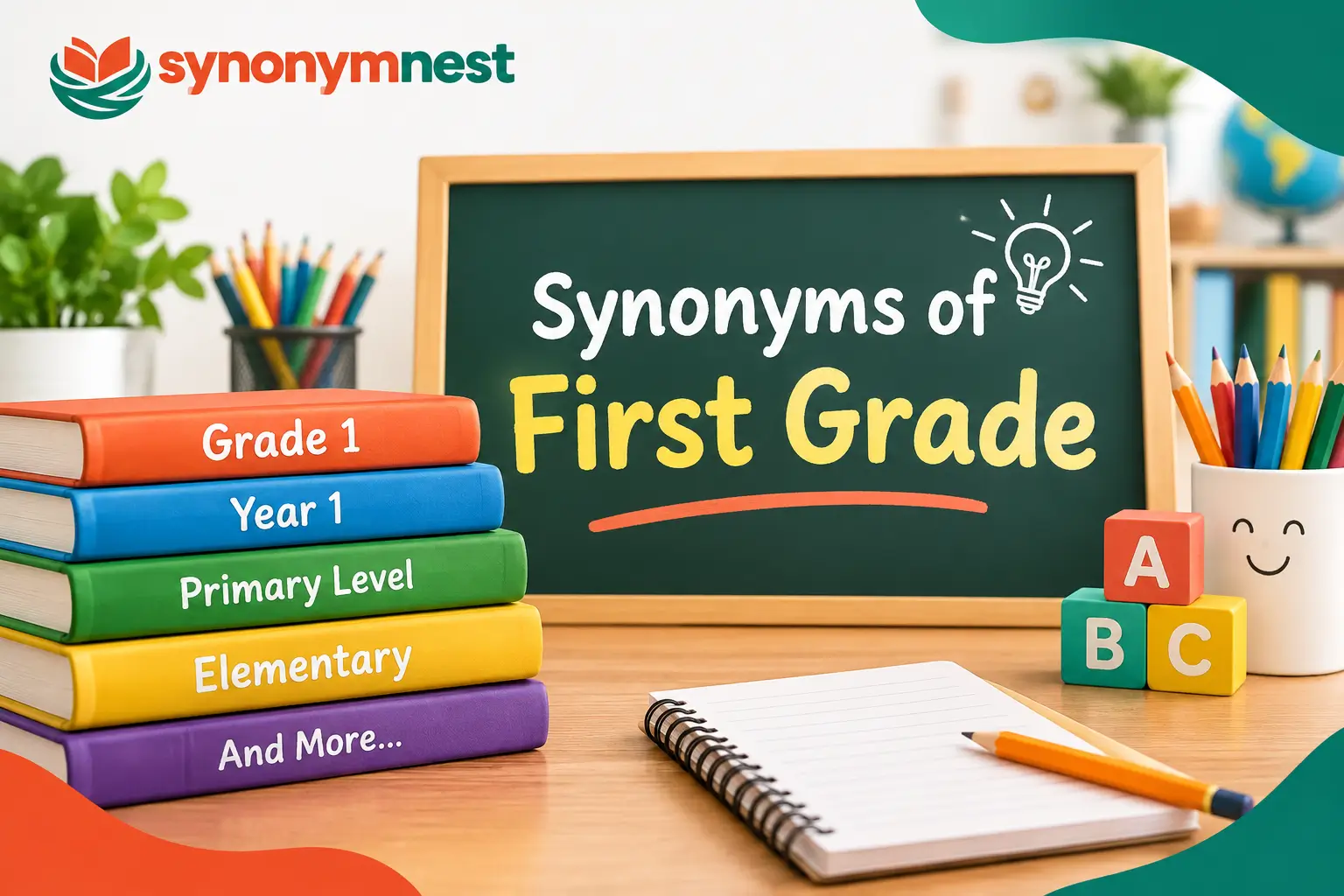
The phrase first grade usually refers to the first year of formal primary or elementary education. In the United States, first grade generally comes after kindergarten and is commonly attended by children around six or seven years old. In the United Kingdom, a similar stage is usually called Year 1.
Finding the right synonym for first grade can be useful when writing about education, school systems, children, teachers, or academic development. However, not every related term means exactly the same thing. Some expressions are direct equivalents, while others describe a broader educational level or a similar starting stage.
This guide explains 30 synonyms and related terms for first grade, with meanings, examples, pronunciation guidance, and notes about American and British English.
Meaning of First Grade
First grade is a noun phrase used mainly in American English for the first year of elementary school.
Example:
My son started first grade this fall.
In British English, the closest common equivalent is Year 1.
Example:
Her daughter is starting Year 1 next September.
First Grade as a Quality Expression
There is another meaning that should not be confused with the school-related meaning.
First-grade can also be an adjective meaning excellent, high-quality, or superior.
Example:
The company provides first-grade materials.
In this meaning, words such as first-rate, excellent, superior, and high-quality can be alternatives.
First Grade vs. First-Grade
The spelling depends on how the phrase is used.
First grade is normally written as two words when it refers to a school year.
Example:
She is in first grade.
First-grade is hyphenated when it works as a compound adjective before a noun.
Example:
He is a first-grade student.
When discussing quality, first-grade can also mean excellent or superior.
Example:
They sell first-grade equipment.
30 Synonyms and Related Terms for First Grade
1. Grade One
Grade One is a direct alternative to first grade in many education systems.
Example:
The Grade One students are learning basic multiplication.
Usage: Common in several countries, including Canada and some international school systems.
2. Grade 1
Grade 1 is the numerical form of Grade One and is widely understood internationally.
Example:
Her child will enter Grade 1 next year.
Usage: Common in international and North American educational contexts.
3. Year One
Year One is the common British English equivalent of first grade.
Example:
The Year One children are practicing their reading skills.
Usage: Especially common in the UK and some Commonwealth education systems.
4. Year 1
Year 1 is the standard British-style written form for the first year of primary education.
Example:
He will begin Year 1 in September.
Usage: UK English.
5. First School Year
First school year describes the first year of a particular school stage or educational program.
Example:
The first school year helps children develop basic academic and social skills.
Note: This can be broader than first grade because it does not always refer to a specific national grade system.
6. First Year of Primary School
This phrase directly describes the first year of primary education.
Example:
Her daughter is entering the first year of primary school.
Usage: Useful when writing for an international audience.
7. First Year of Elementary School
This is a clear American English description of first grade.
Example:
Children in the first year of elementary school begin developing stronger reading skills.
Usage: Mostly useful in US contexts.
8. Primary Year One
Primary Year One describes the first year of primary education.
Example:
The Primary Year One curriculum includes reading, writing, and basic mathematics.
Usage: More common in international educational contexts than everyday American English.
9. Primary One
Primary One is used in some countries to identify the first year of primary school.
Example:
The Primary One pupils are learning classroom routines.
Usage: Country-specific; it should not be treated as a universal replacement for first grade.
10. First Primary Year
First primary year describes the initial year of primary education.
Example:
The first primary year focuses on foundational literacy and numeracy.
Usage: More descriptive than conversational.
11. Primary Level
Primary level refers broadly to elementary or primary education rather than one specific grade.
Example:
Children at the primary level learn essential reading and mathematics skills.
Note: This is a related term, not an exact synonym.
12. Elementary Level
Elementary level refers to the early years of school education.
Example:
The program is designed for students at the elementary level.
Usage: Common in American English and international education.
13. Elementary School Level
This phrase describes the educational stage that includes first grade in the US.
Example:
The activity is suitable for children at the elementary school level.
Note: It covers multiple grades, so it is broader than first grade.
14. Entry Grade
Entry grade can describe the grade at which a student begins a particular school program.
Example:
The school has different requirements for its entry grade.
Note: This is a related educational term rather than a universal synonym for first grade.
15. Entry-Level Class
An entry-level class is a class designed for students who are beginning a particular course or stage.
Example:
The entry-level class introduces students to basic reading skills.
Note: It can refer to subjects or programs other than primary school.
16. Beginning Level
Beginning level describes the starting point of a learning sequence.
Example:
The children are working at the beginning level of the reading program.
Note: It is broader than first grade.
17. Beginner Level
Beginner level refers to an introductory stage for learners with little or no previous experience.
Example:
The beginner-level activities teach children basic vocabulary.
Note: It can apply to language courses, sports, music, and other subjects, so it is not a direct synonym for first grade.
18. Introductory Level
Introductory level means the initial stage where basic concepts are introduced.
Example:
Students at the introductory level learn fundamental mathematical concepts.
19. Introductory Grade
Introductory grade can describe an early grade that introduces students to foundational learning.
Example:
The introductory grade focuses on basic literacy and numeracy.
Note: This is descriptive rather than a standard universal name for first grade.
20. Foundation Level
Foundation level describes an early educational stage where fundamental skills are developed.
Example:
The foundation level prepares children for more advanced academic work.
Note: The exact meaning varies between education systems.
21. Foundation Year
A foundation year is a preparatory educational year in some countries.
Example:
The foundation year helps children develop early literacy and classroom skills.
Important: Foundation year is not always the same as first grade. Its position in the school system varies by country.
22. Preparatory Class
A preparatory class prepares children for formal schooling.
Example:
Children attend the preparatory class before entering the next stage of primary education.
Note: In many systems, this comes before first grade rather than replacing it.
23. Preparatory Year
A preparatory year is a year designed to prepare learners for a later educational stage.
Example:
The preparatory year gives children time to develop basic academic and social skills.
Note: Its relationship to first grade depends on the country.
24. Primary Class One
Primary Class One is used in some school systems to identify the first class of primary education.
Example:
The Primary Class One students participated in a reading activity.
Usage: Regional rather than universal.
25. Class One
Class One can refer to the first class or year of primary school in some countries.
Example:
The Class One pupils are learning simple sentences.
Note: The meaning varies by education system.
26. Initial School Year
Initial school year describes the beginning year of a particular educational stage.
Example:
The initial school year establishes important reading and writing skills.
Note: This is a descriptive phrase, not a standard official grade name.
27. Initial Grade
Initial grade can describe the first grade in a sequence.
Example:
Students enter the initial grade with different levels of reading experience.
Note: It is understandable but less common than Grade 1 or first grade.
28. First-Level Class
First-level class refers to a class at the first stage of an educational sequence.
Example:
The first-level class introduces students to numbers and basic writing.
Note: This term can also be used outside primary education.
29. Early Primary Grade
Early primary grade refers to one of the first years of primary education.
Example:
Teachers in the early primary grades often use games to support learning.
Note: This refers to a group of early grades rather than first grade alone.
30. Early Elementary Grade
Early elementary grade describes the first few years of elementary education.
Example:
Children in early elementary grades develop essential reading and mathematical skills.
Note: This is broader than first grade but useful when discussing early elementary education generally.
Quick Comparison of First Grade Terms
| Term | Meaning | Common Usage | Exact Synonym? |
|---|---|---|---|
| First grade | First year of elementary school | US | Yes |
| Grade One | First school grade | International | Yes/near-equivalent |
| Grade 1 | Numerical form of Grade One | International | Yes/near-equivalent |
| Year One | First primary year | UK/Commonwealth | Near-equivalent |
| Year 1 | Standard UK form | UK | Near-equivalent |
| Primary One | First primary year | Regional | Near-equivalent |
| Class One | First primary class | Regional | Related |
| Primary level | Broad primary education stage | International | No |
| Elementary level | Broad elementary stage | US/International | No |
| Foundation year | Preparatory educational year | Country-specific | No |
| Beginner level | Starting learning level | General education | No |
| Preparatory class | Class preparing students for school | Country-specific | No |
First Grade in American and British English
One of the most important differences is regional terminology.
In American English, the usual term is:
first grade
Example:
My daughter is in first grade.
In British English, the equivalent stage is generally:
Year 1
Example:
My daughter is in Year 1.
Other countries may use Grade 1, Grade One, Primary One, Class One, or another local term. Therefore, the best synonym depends on the education system being discussed.
Is Kindergarten a Synonym for First Grade?
No. Kindergarten should not normally be treated as a synonym for first grade.
In the typical US school sequence, kindergarten comes before first grade:
Preschool → Kindergarten → First Grade → Second Grade
Kindergarten and first grade are therefore related educational stages, but they are not interchangeable.
Is Grade 1 the Same as First Grade?
In many education systems, Grade 1 and first grade refer to the same or nearly the same stage.
For example:
- US: first grade
- International: Grade 1
- Some systems: Grade One
However, school structures can differ between countries, so the exact age and curriculum should be checked for a specific education system.
Is Year 1 the Same as First Grade?
Year 1 is generally the closest British English equivalent of US first grade.
However, the school systems are organized differently, so age cutoffs, curriculum, and terminology may vary.
First Grade as a Synonym for Excellent
The phrase first-grade can also describe something of very high quality.
In this meaning, useful synonyms include:
- First-rate
- Excellent
- Superior
- High-quality
- Outstanding
- Top-quality
- Premium
- Exceptional
Example:
The restaurant is known for its first-grade service.
A more natural modern alternative in many contexts would be:
The restaurant is known for its excellent service.
This quality-related meaning should not be confused with first grade, the school year.
Antonyms and Contrasting Terms
There is no single exact antonym for first grade because it describes a position in an educational sequence.
Depending on the context, contrasting terms may include:
- Final grade
- Last grade
- Senior year
- Advanced level
- Higher grade
- Later school year
For example:
First grade → an early stage of schooling
Final grade → the last stage of a particular school sequence
These are contrasts rather than strict dictionary antonyms.
Examples Using First Grade
Here are several natural examples:
- My son starts first grade in August.
- The first-grade teacher prepared a reading activity.
- First-grade students often practice basic addition.
- She remembers her first-grade classroom fondly.
- The school introduced a new first-grade curriculum.
- Parents attended a first-grade orientation session.
- He made several new friends in first grade.
- The children are developing stronger reading skills in first grade.
Common Mistakes to Avoid
Mistake 1: Calling kindergarten first grade
Kindergarten and first grade are normally separate stages in the US school system.
Mistake 2: Assuming Year 1 means exactly the same thing everywhere
Year 1 is strongly associated with the UK, but educational systems differ between countries.
Mistake 3: Using elementary as an exact synonym
Elementary usually describes a broader school level or educational stage.
Mistake 4: Confusing first grade with first-rate
First grade can refer to schooling, while first-rate normally means excellent or superior.
Mistake 5: Treating every related term as interchangeable
Terms such as foundation year, preparatory class, beginner level, and entry-level class may describe related concepts but do not necessarily refer to the same school year.
Frequently Asked Questions
What is another word for first grade?
Common alternatives include Grade 1, Grade One, and Year 1. Grade 1 and Grade One are especially close equivalents, while Year 1 is commonly used in British English.
What is first grade called in the UK?
In the UK, the closest equivalent is generally Year 1.
What is first grade called in other countries?
Depending on the country, it may be called Grade 1, Grade One, Year 1, Primary One, Class One, or another local term.
Is Grade 1 the same as first grade?
In many school systems, yes. Both generally refer to the first formal grade of primary or elementary education.
Is kindergarten the same as first grade?
No. In the typical US system, kindergarten comes before first grade.
What is the difference between first grade and first-grade?
First grade normally refers to the school year itself.
First-grade is used as a compound adjective before a noun, such as first-grade student.
What does first-grade mean when describing quality?
When used as an adjective, first-grade can mean excellent, superior, or high-quality.
What is the simplest synonym for first grade?
For American English, Grade 1 or Grade One is a simple equivalent. In British English, Year 1 is generally the appropriate term.
Final Thoughts
The best synonym for first grade depends on the education system and the context. Grade 1 and Grade One are close alternatives in many settings, while Year 1 is the usual British English equivalent.
Terms such as primary level, elementary level, foundation year, preparatory class, and beginner level are related expressions, but they should not automatically be treated as exact synonyms.
It is also important to distinguish the school-related phrase first grade from the adjective first-grade, which can describe something excellent or high-quality. Understanding these differences helps writers, teachers, students, and parents choose accurate vocabulary when discussing education.