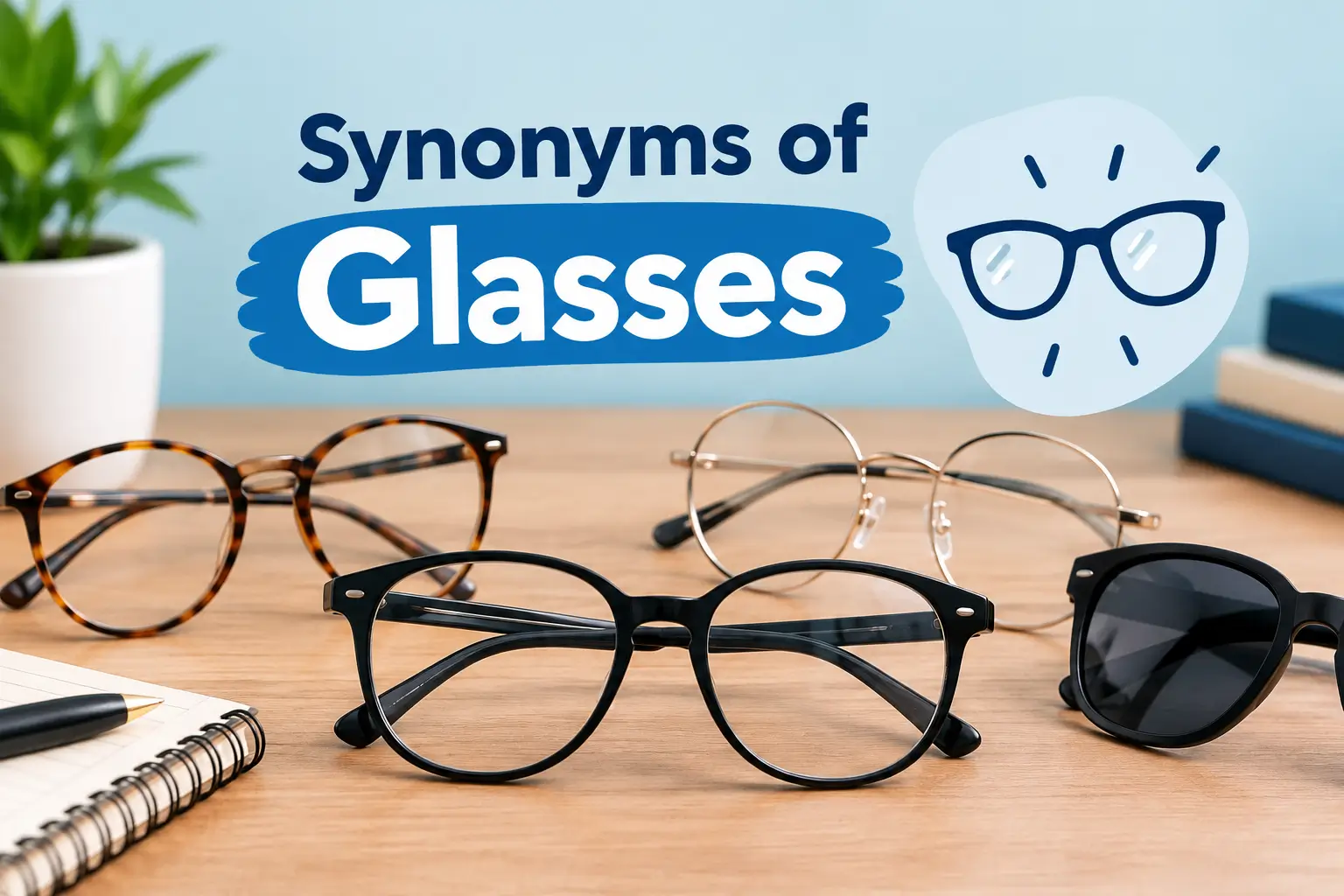
Glasses is a common English word with more than one meaning. Most often, it refers to eyewear worn on the face to improve vision, but it can also mean containers used for drinking. Depending on the context, different words can describe glasses more precisely, such as spectacles, eyeglasses, specs, eyewear, sunglasses, goggles, and corrective lenses.
Learning synonyms and related terms for glasses can help English learners choose the right word for formal writing, casual conversation, medical discussions, fashion descriptions, and everyday communication. However, not every related term is an exact synonym. For example, spectacles and eyeglasses can directly refer to glasses, while bifocals and sunglasses describe particular types.
This guide explains 30 useful synonyms, related terms, and specific expressions connected with glasses. Each word includes a simple meaning, pronunciation, and example sentence so you can understand exactly when to use it.
Meaning of Glasses
Glasses usually means a pair of lenses held in a frame and worn in front of the eyes to correct or improve vision.
Example:
She wears glasses because she cannot see distant objects clearly.
The word can also refer to drinking containers made from glass or another material.
Example:
Please put two glasses on the table.
Therefore, the meaning of glasses depends on the sentence and context.
Direct Synonyms of Glasses
Some words can directly refer to glasses worn for vision correction. These are the closest alternatives to the word.
1. Spectacles
Meaning: A formal or traditional word for glasses worn to improve eyesight.
US/UK Pronunciation: /ˈspɛktəkəlz/
Example:
She adjusted her spectacles before reading the letter.
Usage: Spectacles is especially common in formal, traditional, and British English contexts.
2. Eyeglasses
Meaning: Glasses worn to correct or improve vision.
US Pronunciation: /ˈaɪˌɡlæsɪz/
UK Pronunciation: /ˈaɪˌɡlɑːsɪz/
Example:
He bought a new pair of eyeglasses last week.
Usage: Eyeglasses is particularly common in American English.
3. Specs
Meaning: An informal shortened form of spectacles.
Pronunciation: /spɛks/
Example:
Where did I leave my specs?
Usage: Specs is casual and conversational. It is not usually appropriate for formal medical writing.
4. Eyewear
Meaning: A general term for items worn around the eyes, including glasses and sunglasses.
US Pronunciation: /ˈaɪˌwɛr/
UK Pronunciation: /ˈaɪˌweə/
Example:
The store sells fashionable eyewear for men and women.
Important: Eyewear is a broader term than glasses, so it is a related term rather than an exact synonym in every situation.
Related Terms for Glasses
The following expressions are closely connected with glasses, but they do not always mean ordinary glasses exactly.
5. Corrective Eyewear
Meaning: Eyewear designed to correct vision problems.
Example:
The optometrist recommended corrective eyewear for reading.
6. Corrective Lenses
Meaning: Lenses designed to correct problems such as nearsightedness or farsightedness.
Example:
He uses corrective lenses to see distant objects clearly.
Note: Corrective lenses can be used in glasses or contact lenses, so this is a related term rather than a perfect synonym.
7. Prescription Glasses
Meaning: Glasses made according to an individual’s vision prescription.
Example:
She ordered new prescription glasses after her eye examination.
8. Prescription Eyewear
Meaning: Eyewear made to match a person’s prescribed vision correction.
Example:
The clinic offers prescription eyewear in several frame styles.
9. Optical Wear
Meaning: A broad expression referring to eyewear and optical products.
Example:
The company sells a wide range of optical wear.
Note: This is more of an industry-related expression than an everyday synonym for glasses.
10. Vision Aids
Meaning: Devices or tools that help people see better.
Example:
Glasses are one of the most common vision aids.
Note: Vision aids include more than glasses, so this is a broader category.
Types of Glasses and Eyewear
These terms describe particular kinds of glasses. They should not always be treated as exact synonyms, but they are useful vocabulary related to glasses.
11. Reading Glasses
Meaning: Glasses designed to help with close-up reading.
Example:
My grandfather keeps his reading glasses beside his chair.
12. Sunglasses
Meaning: Glasses with tinted or dark lenses that reduce bright light and provide protection from sunlight.
Example:
She wore sunglasses while walking on the beach.
13. Safety Glasses
Meaning: Protective glasses designed to reduce the risk of eye injury.
Example:
Workers must wear safety glasses in the laboratory.
14. Protective Eyewear
Meaning: Eyewear designed to protect the eyes from hazards.
Example:
The technician used protective eyewear while working with chemicals.
15. Computer Glasses
Meaning: Glasses marketed or designed for people who spend significant time looking at computer screens.
Example:
He bought computer glasses for his long work sessions.
Note: The benefits of specialized blue-light or computer glasses can depend on the individual product and person; the term describes the intended use rather than guaranteeing a particular health effect.
16. Blue-Light Glasses
Meaning: Glasses designed to filter or reduce some wavelengths of blue light.
Example:
She wears blue-light glasses while working at her computer.
17. Bifocals
Meaning: Glasses containing two optical powers, usually for distance and near vision.
Example:
He uses bifocals for both driving and reading.
18. Trifocals
Meaning: Glasses containing three optical viewing zones.
Example:
Her optometrist prescribed trifocals for different viewing distances.
19. Safety Goggles
Meaning: Protective eyewear that fits closely around the eyes.
Example:
The students wore safety goggles during the science experiment.
Note: Goggles are different from ordinary glasses because they generally provide more coverage around the eyes.
20. Sports Glasses
Meaning: Glasses designed for use during sports or physical activities.
Example:
He wears sports glasses while cycling.
Historical and Specialized Terms
Some words refer to older or specialized forms of eyewear.
21. Monocle
Meaning: A single optical lens worn over one eye.
Example:
The historical character was shown wearing a monocle.
Note: A monocle is not a synonym for ordinary glasses because it has only one lens.
22. Pince-Nez
Meaning: A type of eyeglasses that rests on the nose without traditional side arms.
Pronunciation: /ˌpænsˈneɪ/
Example:
The museum displayed an old pair of pince-nez.
Note: Pince-nez is mainly a historical term today.
23. Shades
Meaning: An informal term commonly used for sunglasses.
Example:
He put on his shades before going outside.
Usage: Shades is casual and should generally be used for sunglasses rather than ordinary prescription glasses.
24. Sunshades
Meaning: An informal or descriptive term for sunglasses.
Example:
She bought a new pair of sunshades for her vacation.
Parts of Glasses
The next terms are associated with glasses but refer to their individual components rather than the entire item.
25. Frames
Meaning: The structure that holds the lenses in place.
Example:
She chose lightweight frames for her new glasses.
Important: Frames alone are not the complete glasses.
26. Lenses
Meaning: The transparent optical components through which the wearer looks.
Example:
The optician replaced the scratched lenses.
Important: Lenses are part of glasses, not a complete synonym for glasses.
27. Corrective Lenses
Meaning: Lenses designed to improve vision by changing how light enters the eye.
Example:
His corrective lenses help him see clearly while driving.
28. Eye Protection
Meaning: Equipment used to reduce the risk of eye injury.
Example:
Proper eye protection is required in the workshop.
Note: Eye protection is a broad category that may include safety glasses, goggles, and face shields.
Alternatives to Glasses
These terms are sometimes confused with synonyms because they can perform a similar function, but they are different from glasses.
29. Contact Lenses
Meaning: Thin lenses placed directly on the surface of the eye to correct vision.
Example:
She wears contact lenses instead of glasses when playing sports.
Usage: Contact lenses are an alternative to glasses, not an exact synonym.
30. Unaided Vision
Meaning: Seeing without glasses, contact lenses, or another corrective device.
Example:
His unaided vision is not clear enough for driving.
Note: This is not a synonym for glasses. It is useful as a contrasting expression when discussing vision with and without corrective eyewear.
Glasses vs. Eyeglasses vs. Spectacles
These three words are closely related, but their usage can differ.
Glasses is the most common everyday term:
I forgot my glasses at home.
Eyeglasses is more specific and is especially common in American English:
She needs new eyeglasses.
Spectacles sounds more formal or traditional:
He adjusted his spectacles before speaking.
In everyday conversation, glasses is usually the most natural choice.
Glasses vs. Eyewear
The words glasses and eyewear are related but not identical.
Glasses normally refers to a specific pair of eyewear worn on the face.
Eyewear is a broader category that can include:
- Prescription glasses
- Sunglasses
- Safety glasses
- Sports glasses
- Goggles
- Other protective or optical products
For example:
She bought new glasses.
This normally means a particular pair.
But:
The store has a large eyewear collection.
This can refer to many different types of products.
Glasses vs. Goggles
Glasses and goggles are both worn around the eyes, but they have different designs and purposes.
Glasses usually have lenses held in a frame with arms that rest over the ears.
Goggles generally fit more closely around the eyes and are often designed for protection.
For example:
I wear glasses to correct my vision.
But:
I wear goggles while swimming.
Glasses vs. Contacts
Glasses and contact lenses can both correct vision, but they are worn differently.
Glasses sit in front of the eyes.
Contact lenses sit directly on the eyes.
Example:
I wear glasses when I am studying.
I wear contacts when I play basketball.
Therefore, contacts are an alternative to glasses, not a direct synonym.
The Other Meaning of “Glasses”
The word glasses can also refer to drinking containers.
For example:
We need four glasses for the dinner table.
In this context, the word has nothing to do with eyesight.
Related words can include:
Drinking Glass
A container used for drinking beverages.
He filled a drinking glass with water.
Tumbler
A type of drinking glass, usually without a stem.
She poured juice into a tumbler.
Goblet
A drinking vessel with a stem and a bowl-shaped top.
The table was decorated with elegant goblets.
Glassware
A general term for glass items used for serving food and drinks.
The restaurant has expensive glassware.
These terms should not be confused with eyeglasses.
Synonyms of Glasses by Context
Choosing the right word depends on the context.
| Context | Useful Term |
|---|---|
| Everyday conversation | Glasses |
| American English | Eyeglasses |
| Formal or traditional writing | Spectacles |
| Informal conversation | Specs |
| General category | Eyewear |
| Vision correction | Corrective eyewear |
| Prescription | Prescription glasses |
| Reading | Reading glasses |
| Sun protection | Sunglasses |
| Workplace protection | Safety glasses |
| Swimming | Goggles |
| Two vision zones | Bifocals |
| Three vision zones | Trifocals |
| Alternative to glasses | Contact lenses |
Which Word Should You Use?
If you are writing a normal sentence, glasses is usually the safest and most natural choice.
Use spectacles when you want a formal or traditional tone.
Use eyeglasses when you want a more specific term, especially in American English.
Use specs in casual conversation.
Use eyewear when discussing glasses as part of a wider category of eye products.
Use sunglasses when talking about protection from sunlight.
Use safety glasses when discussing workplace or laboratory protection.
Use goggles when the eyewear covers the eyes more closely, such as during swimming or certain work activities.
Grammar of “Glasses”
When glasses means eyewear, it is normally treated as a plural noun.
We commonly say:
My glasses are on the desk.
Not:
My glasses is on the desk.
When talking about one item, the expression a pair of glasses is very common.
I bought a new pair of glasses.
The same pattern can be used when describing several items:
She owns three pairs of glasses.
When glasses means drinking containers, it is also a plural noun:
There are six glasses on the table.
Pronunciation of Glasses
The pronunciation of glasses is:
US: /ˈɡlæsɪz/
UK: /ˈɡlɑːsɪz/
The word has two syllables:
glass-es
The final -es is pronounced as an extra syllable.
Word Family of Glass
The main word family includes:
- Glass — noun
- Glasses — plural noun
- Glassy — adjective
- Glassware — noun
- Eyeglass — noun
- Eyeglasses — plural noun
The word glass can refer to the material, while glasses can refer to eyewear or drinking containers depending on context.
Common Mistakes with Glasses Synonyms
Mistake 1: Calling every type of eyewear a synonym
Words such as goggles, sunglasses, bifocals, and monocle describe specific types of eyewear. They should not automatically be treated as exact synonyms.
Mistake 2: Using “lenses” to mean the entire glasses
Lenses are only one component of glasses.
Mistake 3: Treating contacts as glasses
Contact lenses can perform a similar vision-correction function, but they are worn directly on the eyes.
Mistake 4: Using “spectacles” in every casual sentence
Spectacles is correct, but glasses is usually more natural in everyday conversation.
Mistake 5: Confusing glasses with drinking glasses
Context determines the meaning.
I cleaned my glasses.
Here, the meaning is probably eyewear.
I cleaned the glasses after dinner.
Here, the meaning is probably drinking containers.
Antonyms and Contrasting Expressions
There is no single exact antonym for glasses because glasses are a physical object rather than a quality with a direct opposite.
Depending on the context, contrasting expressions include:
- Unaided vision
- Naked-eye vision
- Seeing without correction
- No corrective eyewear
For example:
She can read the sign with her glasses.
She cannot read the sign with unaided vision.
These expressions describe the absence of corrective eyewear rather than being strict dictionary antonyms.
Frequently Asked Questions
What is another word for glasses?
Common alternatives include spectacles, eyeglasses, and specs. The best choice depends on the level of formality and regional usage.
What is the formal word for glasses?
Spectacles is a traditional and formal word for glasses. Eyeglasses is also a standard term, particularly in American English.
What is the short word for spectacles?
Specs is the common informal short form of spectacles.
Is eyewear a synonym for glasses?
Eyewear is a related and broader term. It can include glasses, sunglasses, goggles, and other products worn around the eyes.
Are sunglasses a synonym for glasses?
Sunglasses are a type of glasses designed primarily for reducing bright light and protecting the eyes from sunlight. They are therefore a specific type rather than an exact synonym.
Are contact lenses another word for glasses?
No. Contact lenses are an alternative to glasses for correcting vision. They are placed directly on the eyes.
What are glasses called in British English?
Glasses is common in British English, while spectacles is another traditional term.
What are glasses called in American English?
Glasses and eyeglasses are both common in American English.
What does “a pair of glasses” mean?
“A pair of glasses” refers to one complete set of eyewear consisting of a frame and lenses.
What is the difference between glasses and spectacles?
They generally refer to the same type of vision-correcting eyewear. Glasses is more common in everyday speech, while spectacles can sound more formal or traditional.
Conclusion
The word glasses has several related terms, but they are not all exact synonyms. Spectacles, eyeglasses, and specs are the closest direct alternatives when referring to vision-correcting glasses. Terms such as eyewear, corrective lenses, prescription glasses, sunglasses, safety glasses, and goggles describe broader categories or specific types.
Choosing the right word depends on context. Use glasses for everyday communication, eyeglasses for a more specific American English term, spectacles for a formal or traditional style, and specs for casual conversation. Understanding these distinctions helps English learners write more accurately and naturally.
The word glasses can also mean drinking containers, so always consider the context before choosing a synonym. By learning the differences among these related terms, you can improve your vocabulary and communicate more clearly in everyday, academic, professional, and technical English.