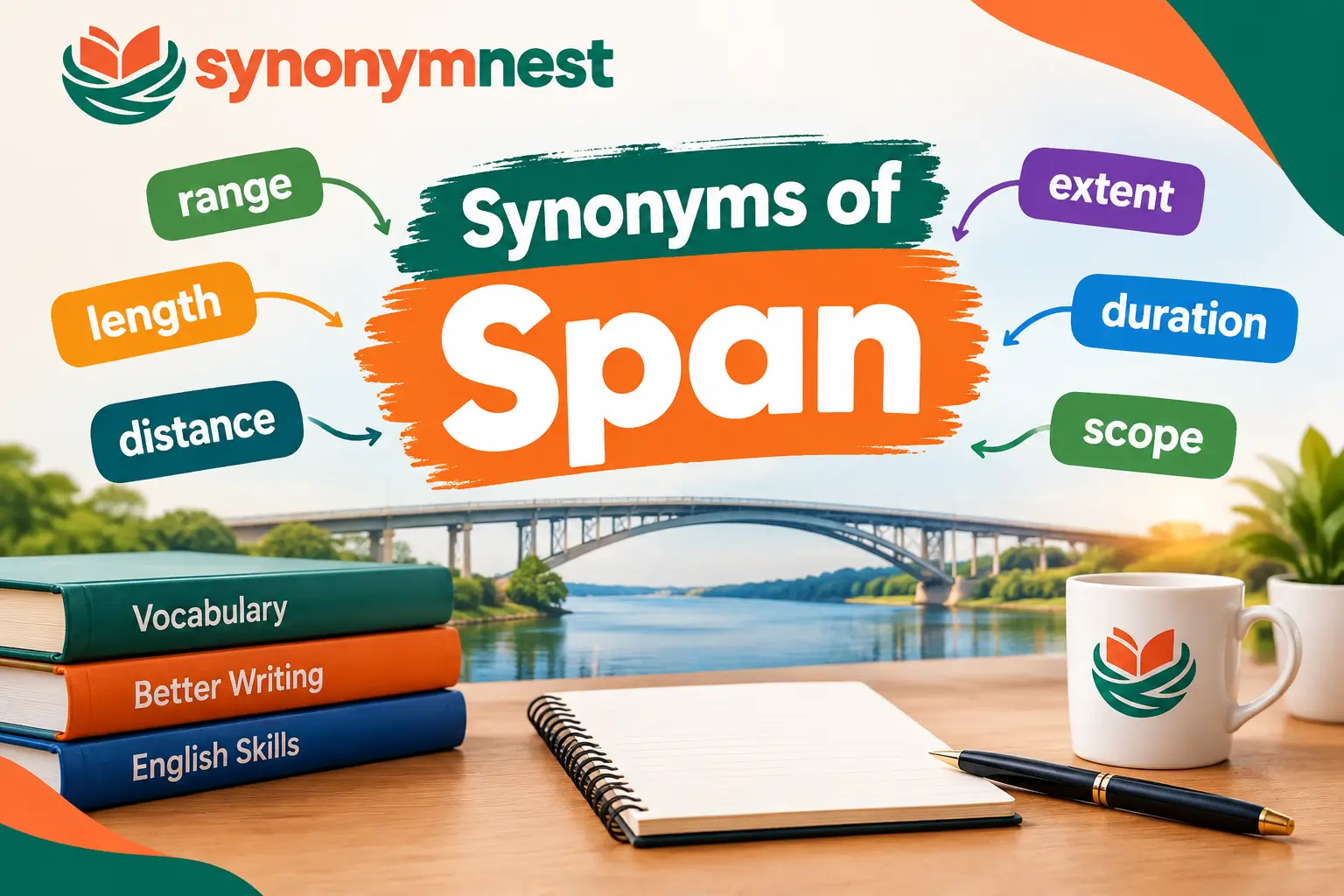
The word span describes the full distance, extent, or period between two points. It can refer to physical space, a period of time, or the extent of something such as influence, activity, or coverage.
For example, the distance covered by a bridge can be called its span, while the amount of time between the beginning and end of a project can be called its span or duration.
Learning the right synonyms of span can help you avoid repetition and choose more precise vocabulary for academic writing, professional communication, and everyday English.
Meaning of Span
Span can be used as both a noun and a verb.
Span as a Noun
As a noun, span means the distance, extent, or period between two points.
Examples:
- The bridge has a span of 300 meters.
- The project was completed within a short time span.
- His career had an impressive span of more than 40 years.
Span as a Verb
As a verb, span means to stretch across, cover, or continue throughout a particular distance or period.
Examples:
- The bridge spans the entire river.
- Her career spanned four decades.
- The forest spans several miles along the coast.
Pronunciation of Span
- US: /spæn/
- UK: /spæn/
- Syllables: 1
Word Forms of Span
Common forms of the word include:
- Span — present/base form
- Spans — third-person singular
- Spanned — past tense and past participle
- Spanning — present participle
30 Synonyms of Span
The best synonym for span depends on the context. Some alternatives describe physical distance, while others are more suitable for time, scope, reach, or coverage.
1. Range
Meaning: The extent between two limits or the variety covered by something.
Examples:
- The store offers a wide range of products.
- The research covers a broad range of subjects.
Best used for: Extent, variety, and limits.
2. Extent
Meaning: The degree, size, or distance to which something reaches.
Examples:
- Scientists measured the extent of the damage.
- We did not realize the full extent of the problem.
Best used for: Overall size, reach, or degree.
3. Stretch
Meaning: A continuous length or distance of something.
Examples:
- We drove along a long stretch of highway.
- A beautiful stretch of beach runs along the coast.
Best used for: Physical distance or a continuous period.
4. Length
Meaning: The measurement from one end of something to another.
Examples:
- The length of the bridge is 500 meters.
- Measure the length of the table carefully.
Best used for: Physical measurement.
5. Distance
Meaning: The amount of space between two points.
Examples:
- The distance between the two towns is 20 miles.
- We walked a considerable distance before reaching the village.
Best used for: Physical space between locations.
6. Duration
Meaning: The amount of time something continues or lasts.
Examples:
- The duration of the film is two hours.
- The experiment continued for the duration of the study.
Best used for: Time rather than physical space.
7. Period
Meaning: A particular length or section of time.
Examples:
- He worked there for a long period.
- The project was completed over a six-month period.
Best used for: General references to time.
8. Timespan
Meaning: The amount of time between two points.
Examples:
- The story covers a timespan of several decades.
- The research examined a short timespan.
Best used for: Time-specific uses of span.
9. Scope
Meaning: The range or area covered by an activity, subject, or project.
Examples:
- The scope of the project changed significantly.
- The report examines the scope of the problem.
Best used for: Projects, subjects, responsibilities, and activities.
10. Reach
Meaning: The distance or extent to which something extends or influences others.
Examples:
- The company has a global reach.
- Social media has increased the reach of the campaign.
Best used for: Influence, communication, and physical extension.
11. Breadth
Meaning: The width, range, or variety of something.
Examples:
- The breadth of her knowledge is impressive.
- The course has considerable breadth.
Best used for: Width, knowledge, subjects, or variety.
12. Width
Meaning: The measurement from side to side.
Examples:
- The width of the river varies throughout the year.
- Check the width of the doorway before moving the furniture.
Best used for: Physical dimensions.
13. Coverage
Meaning: The area, subject, or range included or reached by something.
Examples:
- The news channel provides extensive coverage of international events.
- The insurance plan offers broad coverage.
Best used for: Media, insurance, networks, and subject areas.
14. Sweep
Meaning: A broad or continuous extent across an area, subject, or period.
Examples:
- The sweep of the mountains was spectacular.
- The book examines the broad sweep of modern history.
Best used for: Large physical or historical extent.
15. Spread
Meaning: The area or distance over which something extends or is distributed.
Examples:
- The spread of the forest covers several valleys.
- The disease had a rapid spread across the region.
Best used for: Distribution and geographical extent.
16. Breadth of coverage
Meaning: The amount or variety of material included within a particular area.
Examples:
- The breadth of coverage in the report is impressive.
- The course has a wide breadth of coverage.
Best used for: Academic, professional, and informational contexts.
17. Continuum
Meaning: A continuous sequence or range between two extremes.
Examples:
- The study places the results on a continuum.
- Human abilities exist along a broad continuum.
Best used for: Gradual ranges and theoretical contexts.
18. Extent of coverage
Meaning: How much area, time, or subject matter something includes.
Examples:
- The extent of coverage depends on the available resources.
- We evaluated the extent of coverage provided by the policy.
Best used for: Formal and professional writing.
19. Term
Meaning: A fixed period during which something continues or applies.
Examples:
- The contract has a three-year term.
- He served his full term as director.
Best used for: Contracts, positions, agreements, and periods of service.
20. Lifetime
Meaning: The entire period during which a person, animal, object, or organization exists.
Examples:
- The product has an expected lifetime of ten years.
- She achieved many things during her lifetime.
Best used for: The full duration of existence.
21. Lifespan
Meaning: The length of time a person, animal, object, or organism lives or remains functional.
Examples:
- The average lifespan of the species is about 15 years.
- Proper maintenance can increase the machine’s lifespan.
Best used for: Life or useful operating duration.
22. Interval
Meaning: A period between two events or points in time.
Examples:
- There was a short interval between the two meetings.
- The medicine should be taken at regular intervals.
Best used for: Gaps or periods between events.
23. Coverage area
Meaning: The physical area reached or included by a service, system, or activity.
Examples:
- The router provides a large coverage area.
- The network’s coverage area has expanded.
Best used for: Networks, services, and geographical areas.
24. Territory
Meaning: An area or region over which something extends, operates, or has influence.
Examples:
- The company expanded into new territory.
- The species occupies a large territory.
Best used for: Geographical and organizational contexts.
25. Domain
Meaning: A particular area of knowledge, activity, influence, or control.
Examples:
- Artificial intelligence covers a broad domain of research.
- The company is expanding into a new domain.
Best used for: Knowledge, expertise, technology, and influence.
26. Field
Meaning: An area of study, activity, or professional work.
Examples:
- She has worked in the medical field for many years.
- The field of robotics is developing quickly.
Best used for: Subjects, professions, and areas of activity.
27. Coverage span
Meaning: The total range or area covered by something.
Examples:
- The network has a wide coverage span across the region.
- The report has a broad coverage span of related topics.
Best used for: Formal descriptions of coverage and reach.
28. Reach across
Meaning: To extend from one point or area to another.
Examples:
- The organization reaches across several countries.
- The bridge reaches across the valley.
Best used for: The verb sense of span when something extends across an area.
29. Extend across
Meaning: To stretch from one side, point, or period to another.
Examples:
- The road extends across the valley.
- The research extends across several decades.
Best used for: Physical distance and periods of time.
30. Cover
Meaning: To include, occupy, or extend over a particular area, subject, or period.
Examples:
- The course covers several important topics.
- His career covered more than 30 years.
Best used for: Subjects, periods, areas, and activities.
Synonyms of Span by Context
Not every synonym works naturally in every sentence. Choosing the right alternative depends on what span means in that sentence.
Span Meaning Physical Distance
When span refers to physical distance, useful alternatives include:
- Distance
- Length
- Width
- Stretch
- Reach
- Extent
- Breadth
- Spread
Example:
- The bridge spans the river.
- The bridge extends across the river.
- The bridge covers a considerable distance.
Span Meaning Time
When span refers to time, these alternatives are usually more natural:
- Duration
- Period
- Timespan
- Term
- Lifetime
- Lifespan
Example:
- His career spanned 40 years.
- His career lasted for a period of 40 years.
- His career had a duration of 40 years.
Span Meaning Range or Scope
When span refers to the breadth or range of something, consider:
- Range
- Extent
- Scope
- Reach
- Breadth
- Coverage
- Domain
Example:
- The project has a broad span of activities.
- The project has a broad scope.
- The project covers a wide range of activities.
Span as a Verb: Useful Alternatives
When span is used as a verb, the closest alternatives depend on the sentence.
Extend
Span: The bridge spans the river.
Alternative: The bridge extends across the river.
Cover
Span: His career spanned four decades.
Alternative: His career covered four decades.
Stretch Across
Span: The forest spans several miles.
Alternative: The forest stretches across several miles.
Continue Throughout
For time-related usage, span can sometimes be replaced by a phrase such as continue throughout.
Example:
- The tradition spanned several generations.
- The tradition continued throughout several generations.
Span vs. Range
Span and range can sometimes be used similarly, but they are not always interchangeable.
Span often emphasizes the total distance, period, or extent between two points.
Range often emphasizes the limits, variety, or different values within an area.
Examples:
- The bridge has a span of 500 meters.
- The study covers a wide range of subjects.
Span vs. Length
Length normally refers to a physical measurement from one end to another.
Span can describe physical distance, but it can also refer to time or broader extent.
Examples:
- The length of the table is two meters.
- The bridge has a span of 200 meters.
- His career had a span of 30 years.
Span vs. Duration
Duration is specifically connected to time.
Span is broader and can describe physical distance, time, or extent.
Examples:
- The duration of the movie is two hours.
- The span of the bridge is 200 meters.
- His career spanned several decades.
Common Expressions with Span
The word span appears in many common English expressions.
Time Span
A time span is a period between two points in time.
Example: The study covers a time span of five years.
Life Span
A life span refers to the length of time someone or something lives or remains active.
Example: Regular maintenance can extend the machine’s life span.
Attention Span
An attention span is the length of time someone can remain focused on something.
Example: Short videos may be easier to follow for people with a limited attention span.
Span of Control
A span of control refers to the number of people or responsibilities managed by one person, especially in an organization.
Example: The manager has a wide span of control.
Span of Influence
A span of influence refers to the range or extent of someone’s influence.
Example: The author’s span of influence extends beyond the literary world.
Connotation of Span
The word span is generally neutral. It does not automatically have a positive or negative emotional meaning.
The surrounding context determines the impression.
For example:
- Positive: She had a long and successful career span.
- Neutral: The bridge has a span of 400 meters.
- Negative: The project was completed over an unexpectedly long time span.
Therefore, span should normally be understood as a descriptive word rather than a word with a fixed positive or negative connotation.
Etymology of Span
The noun span has a long history in English and was originally associated with the distance measured by an outstretched hand. Over time, its meaning expanded to describe other kinds of distance, extent, and duration.
Today, span can describe physical space, periods of time, and the extent or reach of activities and influence.
Antonyms of Span
The opposite of span depends on the context.
For physical extent, possible contrasting concepts include:
- Narrowness
- Smallness
- Shortness
- Restriction
For time-related usage, contrasting concepts include:
- Short duration
- Brevity
- Briefness
For range or scope, contrasting concepts include:
- Limitation
- Restriction
- Narrow scope
These are contextual opposites rather than universal antonyms because span has several different meanings.
Frequently Asked Questions
What does span mean?
Span means the full distance, extent, or period between two points. It can describe physical distance, time, or the range of something.
What is the closest synonym for span?
The closest synonym depends on the context. Range, extent, stretch, length, distance, duration, and scope can all work in particular situations.
What is another word for span of time?
Common alternatives include duration, period, timespan, term, and length of time.
Is range a synonym for span?
Yes, range can be a synonym or close alternative when span refers to the extent or limits of something. However, the two words are not interchangeable in every sentence.
What is the difference between span and length?
Length usually describes a physical measurement from one end to another. Span has a broader meaning and can describe distance, time, or overall extent.
What is the difference between span and duration?
Duration specifically refers to how long something lasts. Span can refer to duration but can also describe physical distance and overall extent.
Can span be used as a verb?
Yes. As a verb, span means to extend across, cover, or continue throughout a particular distance or period.
Example: The bridge spans the river.
What is another word for span across?
Useful alternatives include extend across, stretch across, reach across, and cover.
What is a synonym for life span?
Depending on the context, alternatives include lifespan, lifetime, life expectancy, and period of existence.
What is a synonym for attention span?
Depending on the intended meaning, alternatives can include attention duration, concentration period, or length of attention.
Conclusion
The word span is useful because it can describe physical distance, periods of time, range, scope, and extent. The best synonym depends on the meaning intended in a particular sentence.
For physical distance, words such as distance, length, stretch, width, and reach may be appropriate. For time, duration, period, timespan, term, and lifespan are useful alternatives. When discussing range or scope, extent, range, scope, breadth, and coverage can often provide more precise wording.
Understanding these differences helps writers choose the right word instead of treating every synonym as interchangeable. This makes English writing clearer, more natural, and more precise.