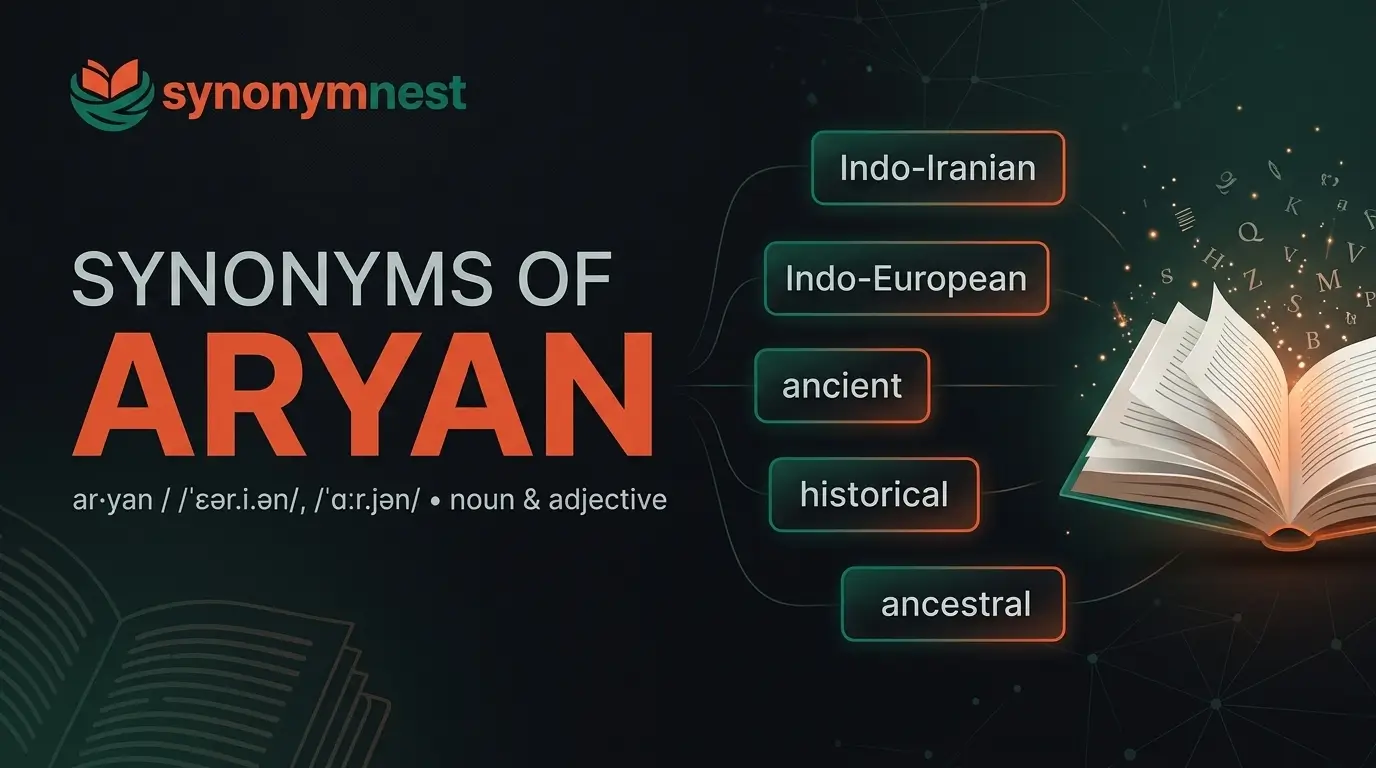
What is a synonym for Aryan? The closest alternative to Aryan depends on the context. In historical and linguistic writing, terms such as Indo-Iranian and Indo-Aryan may be appropriate in specific situations. However, these terms have different meanings and are not always interchangeable. Choose the word that accurately describes the people, language, or historical subject being discussed.
Introduction
The word Aryan has a long and complex history. It is associated with ancient Indo-Iranian traditions and has been used in historical and linguistic discussions. However, its meaning has changed across different periods and contexts. The term also became widely associated with racist ideologies, especially under Nazi Germany, where it was misused to promote the false idea of racial superiority.
Understanding the meaning of Aryan is important for students, researchers, English learners, and writers. Although many words are related to its historical meaning, very few are exact synonyms. Words such as Indo-Iranian, Indo-Aryan, linguistic group, and historical community may be useful alternatives when they accurately describe the intended subject.
In this guide, you will discover 30 context-based alternatives and related terms, along with their meanings and examples. You will also learn how Aryan differs from Indo-European, Indo-Iranian, and Indo-Aryan, why some alternatives require careful use, and how to select appropriate vocabulary for academic and everyday writing.
Meaning of Aryan
Aryan (noun/adjective): A historical term associated with ancient Indo-Iranian peoples and languages, later also misused in racial theories.
The term has different meanings depending on the historical period and subject. In linguistic and historical studies, it may appear in discussions of ancient Indo-Iranian traditions or Indo-Aryan languages. In modern discussions, it may refer to the history of racial ideology and its misuse of the word.
Examples of Aryan
- The historian examined the use of the term Aryan in ancient texts.
- The documentary discussed how Nazi ideology misused the word Aryan.
- The researcher explained the historical relationship between Indo-Iranian languages.
Historical Origin of Aryan
The English word Aryan is associated with Sanskrit ā́rya and related ancient Iranian forms. These terms had particular meanings within their original cultural and historical settings.
During the development of European linguistic scholarship, the word became associated with Indo-Iranian languages and peoples. Later, some European racial theorists incorrectly expanded the term into a supposed racial category. Nazi Germany adopted this distorted interpretation to support discriminatory laws, persecution, and genocide.
Modern scholarship distinguishes linguistic relationships from racial classifications. A shared language family does not establish that people belong to a single biological race, nor does it demonstrate superiority or inferiority.
30 Synonyms and Related Terms for Aryan
The following words are context-based alternatives and related expressions, not 30 exact synonyms. Their suitability depends on whether you are discussing languages, ancient populations, ancestry, culture, or historical ideology.
1. Indo-Iranian
Part of speech: Adjective or noun
Meaning: Relating to the Indo-Iranian branch of the Indo-European language family or its historical linguistic and cultural context.
Examples:
- Researchers studied ancient Indo-Iranian languages.
- The book discusses Indo-Iranian linguistic history.
Usage: This is a useful term when the subject specifically concerns Indo-Iranian languages or related historical contexts.
2. Indo-Aryan
Part of speech: Adjective or noun
Meaning: Relating to the Indo-Aryan branch of Indo-European languages, primarily associated with South Asia.
Examples:
- Hindi belongs to the Indo-Aryan language group.
- The scholar researched Indo-Aryan linguistic development.
Usage: Use this term when discussing Indo-Aryan languages or relevant historical subjects. It is not interchangeable with every use of Aryan.
3. Indo-European
Part of speech: Adjective or noun
Meaning: Relating to a large family of languages that includes English, Hindi, Persian, Greek, and many others.
Examples:
- English is part of the Indo-European language family.
- The researcher compared Indo-European languages.
Usage: This term is broader than Indo-Iranian and Indo-Aryan. It should not be presented as an exact synonym for Aryan.
4. Iranian
Part of speech: Adjective or noun
Meaning: Relating to Iranian languages, peoples, or historical and cultural traditions, depending on context.
Examples:
- The team studied the history of Iranian languages.
- The article examined ancient Iranian traditions.
Usage: Appropriate when the subject specifically concerns Iranian history, language, or culture.
5. Historical Community
Part of speech: Noun phrase
Meaning: A group of people connected by a particular period, place, or historical experience.
Examples:
- The historian studied a historical community mentioned in ancient records.
- The settlement was home to an important historical community.
Usage: A general alternative when the exact identity of a past population needs further explanation.
6. Ancient Population
Part of speech: Noun phrase
Meaning: People who lived in a particular region during an ancient period.
Examples:
- Archaeologists investigated an ancient population.
- The study explored the movement of ancient populations.
Usage: Useful in archaeology and population history when a specific ethnic or linguistic label is uncertain.
7. Historical Population
Part of speech: Noun phrase
Meaning: A group of people who lived in a particular place during a specific period in history.
Examples:
- The researcher examined a historical population through written records.
- Migration changed the region’s historical population.
Usage: Use when referring broadly to people in the past without assigning them an unsupported identity.
8. Ancient People
Part of speech: Noun phrase
Meaning: People who lived in ancient times.
Examples:
- Ancient people developed different systems of communication.
- The museum displays objects used by ancient people.
Usage: A broad expression for general historical writing, not a direct replacement for Aryan.
9. Early Society
Part of speech: Noun phrase
Meaning: A community or organized group that existed during an early historical period.
Examples:
- The documentary explored an early society.
- Agriculture influenced the development of early societies.
Usage: Appropriate when discussing social organization rather than a specific linguistic group.
10. Ancient Community
Part of speech: Noun phrase
Meaning: A community that existed in the distant past.
Examples:
- The excavation revealed evidence of an ancient community.
- Researchers studied the traditions of an ancient community.
Usage: Useful when the discussion focuses on settlement, social life, or archaeological evidence.
11. Linguistic Group
Part of speech: Noun phrase
Meaning: A group of languages or people connected through a language or linguistic classification.
Examples:
- The researcher compared two linguistic groups.
- Linguistic groups can have complex historical relationships.
Usage: When discussing languages, identify the particular branch whenever possible.
12. Language Family
Part of speech: Noun phrase
Meaning: A group of languages believed to have developed from a common ancestral language.
Examples:
- Indo-European is a major language family.
- The students learned how a language family develops over time.
Usage: A useful expression for linguistic discussions, but it refers to languages rather than a single ethnic population.
13. Ethnolinguistic Group
Part of speech: Noun phrase
Meaning: A group associated with a shared language and aspects of cultural identity.
Examples:
- The research described an ethnolinguistic group in the region.
- Language can be an important feature of an ethnolinguistic group.
Usage: Use only when both linguistic and cultural identity are relevant and supported by evidence.
14. Ethnic Group
Part of speech: Noun phrase
Meaning: A group whose members share a sense of identity associated with culture, ancestry, history, or other social factors.
Examples:
- The historian documented the traditions of an ethnic group.
- An ethnic group may include people who speak different languages.
Usage: This is a broad social term, not an exact synonym for Aryan.
15. Cultural Group
Part of speech: Noun phrase
Meaning: People connected through shared cultural practices, beliefs, or traditions.
Examples:
- The museum organized an exhibition about a cultural group.
- Cultural groups may preserve distinctive traditions.
Usage: Appropriate when cultural practices are the main subject.
16. Ancestral Community
Part of speech: Noun phrase
Meaning: A community connected to the ancestry of a person or population.
Examples:
- The study explored the history of an ancestral community.
- Researchers examined evidence about the ancestral community.
Usage: Use when discussing ancestry, provided the historical connection is supported.
17. Ancestral Population
Part of speech: Noun phrase
Meaning: A population from which a later population is understood to have descended.
Examples:
- The researchers investigated an ancestral population.
- Historical records offered clues about the ancestral population.
Usage: Particularly useful in population history, genetics, and historical research when evidence supports the relationship.
18. Heritage Group
Part of speech: Noun phrase
Meaning: A group connected by a shared heritage or a commitment to preserving it.
Examples:
- The heritage group preserved historical documents.
- Members of the heritage group organized a cultural exhibition.
Usage: This usually refers to a modern community or organization and is not a direct historical synonym.
19. Linguistic Community
Part of speech: Noun phrase
Meaning: People who use or share an interest in a particular language or language variety.
Examples:
- The linguistic community documented an endangered language.
- Members of the linguistic community worked together on a dictionary.
Usage: Suitable when language use is more important than ancestry.
20. Historical Society
Part of speech: Noun phrase
Meaning: A society from the past, or an organization dedicated to studying history, depending on context.
Examples:
- The historian examined the structure of an ancient historical society.
- A local historical society collected documents from the period.
Usage: Make the intended meaning clear because the expression can refer to either a past society or a modern organization.
21. Ancient Civilization
Part of speech: Noun phrase
Meaning: A complex society that developed during an ancient period.
Examples:
- The museum presented artifacts from an ancient civilization.
- Researchers investigated the trade networks of an ancient civilization.
Usage: This describes a society, not a particular people or language. Use it only when relevant.
22. Early Settlers
Part of speech: Noun phrase
Meaning: People who established a settlement in an area during an early period.
Examples:
- Archaeologists studied the homes of early settlers.
- Early settlers adapted to the region’s environment.
Usage: Appropriate when evidence establishes settlement in a particular place. It should not be used as a generic synonym for Aryan.
23. Tribal Community
Part of speech: Noun phrase
Meaning: A community organized around a tribal identity or social structure.
Examples:
- The researcher documented the history of a tribal community.
- The documentary examined the community’s social traditions.
Usage: Use only when the description is historically and culturally appropriate. Do not assume that every ancient population was a tribe.
24. Population Group
Part of speech: Noun phrase
Meaning: A group of people identified according to a particular demographic, geographic, or research criterion.
Examples:
- The study compared two population groups.
- The researchers examined migration between population groups.
Usage: A neutral expression for demographic or historical analysis.
25. Community
Part of speech: Noun
Meaning: A group of people connected by location, identity, interests, or social relationships.
Examples:
- The community preserved its historical records.
- Researchers worked with the local community.
Usage: A broad alternative that requires additional context to identify the people being discussed.
26. Society
Part of speech: Noun
Meaning: An organized group of people who share social institutions, relationships, or a way of life.
Examples:
- The historian studied how the society changed over time.
- Trade influenced the development of the society.
Usage: Best for discussing social organization rather than a specific historical identity.
27. Ancestry
Part of speech: Noun
Meaning: A person’s or population’s family origins or ancestral background.
Examples:
- The researcher investigated the ancestry of the population.
- Historical documents provided information about family ancestry.
Usage: This word refers to origins or descent, not to an ethnic or linguistic group itself.
28. Lineage
Part of speech: Noun
Meaning: A line of descent from ancestors.
Examples:
- The historian traced the lineage described in the manuscript.
- The family preserved records of its lineage.
Usage: Appropriate for genealogical or descent-related discussions, but not a direct substitute for Aryan.
29. Cultural Heritage
Part of speech: Noun phrase
Meaning: Traditions, objects, knowledge, and practices inherited from previous generations.
Examples:
- The museum protected the region’s cultural heritage.
- Oral traditions are part of a community’s cultural heritage.
Usage: Use when discussing inherited culture rather than a group of people.
30. Historical Identity
Part of speech: Noun phrase
Meaning: The identity associated with a person or group as understood through historical experiences, records, and traditions.
Examples:
- The historian examined how historical identity changed over time.
- Written sources influenced later interpretations of historical identity.
Usage: Helpful when discussing how a group has been described across different periods, especially when terminology is contested.
How to Choose the Right Alternative to Aryan
Choosing an appropriate alternative requires understanding the subject of the sentence. The word Aryan does not have one universal replacement.
- For language history: Use Indo-Iranian, Indo-Aryan, or Indo-European only when the specific linguistic relationship supports the term.
- For ancient populations: Consider ancient population, historical population, or ancestral population when those descriptions are accurate.
- For cultural discussions: Cultural group, community, or cultural heritage may be more precise.
- For family origins: Use ancestry or lineage when discussing descent.
- For discussions of racism: Refer directly to Nazi racial ideology, racist racial classifications, or the historical misuse of the term Aryan.
For example, if a sentence concerns Hindi, Indo-Aryan may be the correct linguistic term. If it concerns English, Indo-European is appropriate. Replacing either term with Aryan without explaining the historical context could create confusion.
Aryan vs. Indo-Aryan vs. Indo-Iranian vs. Indo-European
These terms are related historically, but their meanings differ.
Aryan: A historically complex term associated with ancient Indo-Iranian traditions and later racial misuse.
Indo-Aryan: Relates to a branch of Indo-European languages associated primarily with South Asia.
Indo-Iranian: Relates to a branch of the Indo-European language family that includes Indo-Aryan and Iranian languages.
Indo-European: Refers to the broader language family that includes Indo-Iranian as well as many other branches, including Germanic, Romance, and Greek.
These distinctions matter because a language classification does not automatically identify a person’s ethnicity, ancestry, or biological characteristics.
Connotative Meaning of Aryan
The word’s associations depend strongly on the context in which it appears.
Historical or linguistic context: The term may occur in discussions of ancient texts, language history, or Indo-Iranian traditions.
Racist or political context: The word is strongly associated with the false racial hierarchy promoted by Nazi ideology and other racist movements.
Modern academic context: Writers should define the intended meaning and prefer more precise terminology, such as Indo-Aryan or Indo-Iranian, when appropriate.
The safest approach is to explain the term rather than assume that all readers interpret it in the same way.
Common Mistakes When Using Aryan
1. Treating all related terms as synonyms
Indo-European, Indo-Iranian, and Indo-Aryan describe different linguistic categories. They should not be used interchangeably.
2. Using Aryan as a label for a supposedly superior race
The idea of an inherently superior Aryan race is a racist ideological construct, not a valid scientific classification.
3. Confusing language with ethnicity
People may speak related languages without sharing the same ethnic identity or ancestry.
4. Calling every ancient population Aryan
A population should not receive this label unless the historical or linguistic context justifies it.
5. Using unrelated words as direct replacements
Words such as society, heritage, population, and civilization may be related to a discussion of history, but they do not have the same meaning as Aryan.
Antonyms of Aryan
There is no standard antonym for Aryan because it is primarily a historical and linguistic term, not a word with a straightforward opposite.
Terms such as outsider, foreigner, and unrelated population are not genuine antonyms. They describe different relationships or categories and cannot be treated as opposites of Aryan.
For vocabulary learning, it is more useful to study related terms and understand their differences than to create an inaccurate antonym list.
Frequently Asked Questions
1. What is the closest synonym for Aryan?
There is no single synonym that fits every context. Indo-Iranian may be appropriate in some historical or linguistic discussions, while Indo-Aryan is more precise for the relevant South Asian language branch. The correct choice depends on the intended meaning.
2. Is Indo-Iranian the same as Aryan?
No. Indo-Iranian is a linguistic branch of the Indo-European language family. Aryan is a historically complex term with different uses and associations. The terms may overlap in some historical discussions but are not universally interchangeable.
3. Is Indo-European a synonym for Aryan?
No. Indo-European refers to a much larger language family that includes Indo-Iranian and many other branches. It is not an exact synonym for Aryan.
4. Why is the word Aryan considered sensitive?
The term became strongly associated with racist theories, especially Nazi ideology, which falsely portrayed an imagined Aryan race as superior. Writers should explain the intended historical meaning and avoid repeating racist claims as facts.
5. Can Aryan be used in academic writing?
Yes, when the historical or linguistic context makes the meaning clear. However, writers should use more specific terms, such as Indo-Aryan or Indo-Iranian, when those terms better describe the subject.
6. What is the difference between Aryan and Indo-Aryan?
Aryan has a complex history and multiple uses. Indo-Aryan specifically refers to a branch of Indo-European languages associated primarily with South Asia. The latter is often more precise when discussing languages in that branch.
7. Are ancestry and lineage synonyms for Aryan?
No. Ancestry describes origins or descent, while lineage refers to a line of descent. Both may be relevant to historical research, but neither is a direct synonym for Aryan.
8. What should I use instead of Aryan in modern writing?
Choose a term that identifies the subject accurately. Indo-Aryan may fit a discussion of a relevant language, Indo-Iranian may fit a broader linguistic context, and historical population or cultural community may be suitable when discussing people. Avoid using a general label when a specific one is available.
Conclusion
Learning the meaning and related terms of Aryan helps readers understand historical writing and use English vocabulary more accurately. However, not every word connected to history, ancestry, or culture is a true synonym. Indo-Aryan, Indo-Iranian, and Indo-European have distinct meanings and should be selected according to the subject being discussed.
The word Aryan also carries important historical associations because of its misuse in racist ideologies. Writers should explain its context, avoid unsupported racial classifications, and choose precise alternatives whenever possible. By understanding these distinctions, students and writers can communicate more clearly, responsibly, and confidently.