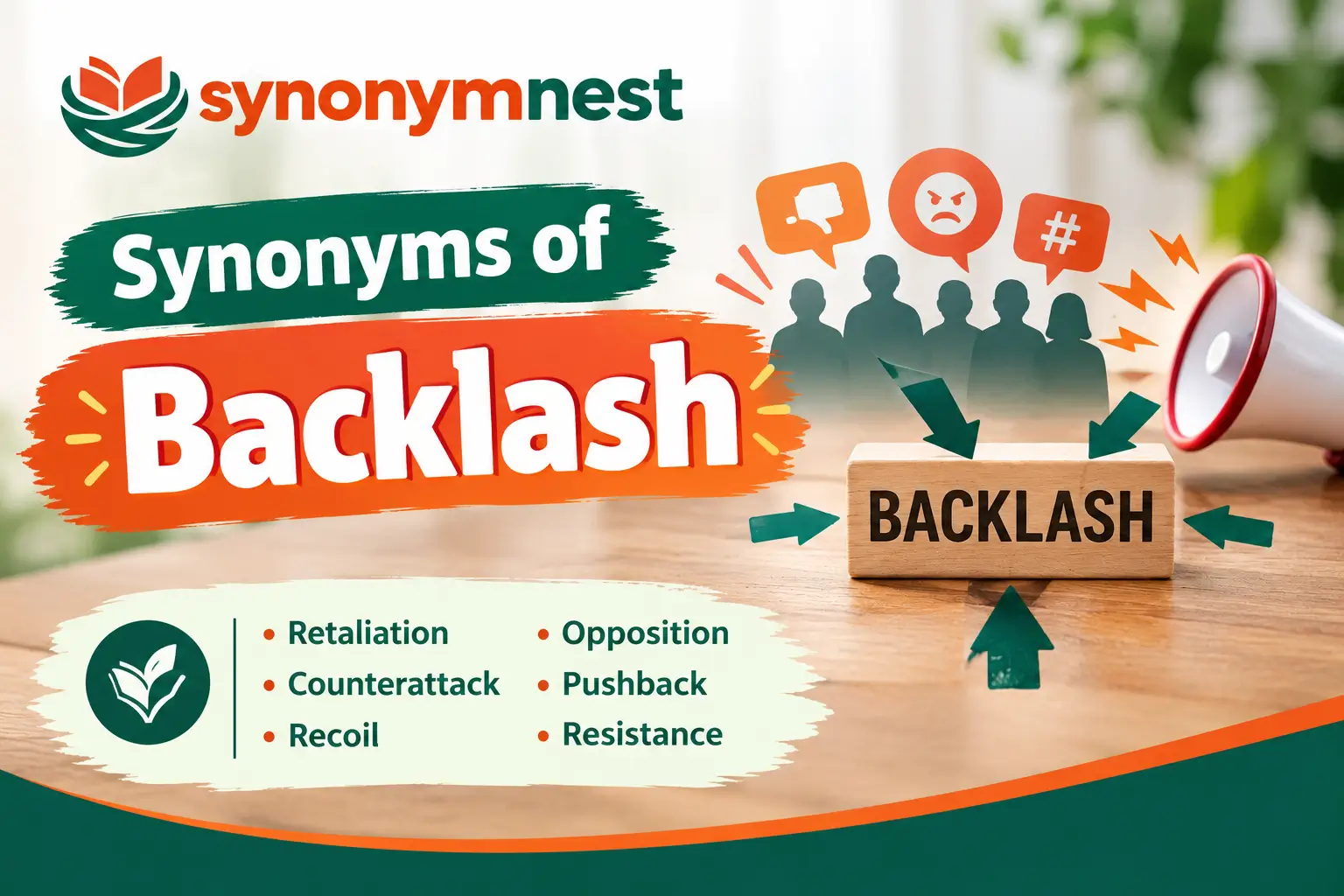
A synonym for backlash is pushback, opposition, outcry, criticism, or public protest. These words describe negative reactions to decisions, actions, statements, or events. The best alternative depends on the intensity of the reaction and whether you want to emphasize anger, disagreement, resistance, or public criticism.
A strong response to a controversial decision can take many forms. Customers may criticize a company, employees may resist a new workplace policy, or citizens may protest a government action. Although these situations can all involve a backlash, different words communicate different shades of meaning.
Learning the synonyms of backlash can help you write more clearly, avoid repetition, and choose vocabulary that fits your message. In this guide, you will discover 30 alternatives with definitions, examples, pronunciation guidance, antonyms, and practical usage tips.
Meaning of Backlash
Backlash is a noun that means a strong negative reaction to an action, decision, statement, or event. It often occurs when people believe that something is unfair, offensive, harmful, or unacceptable.
For example, a company might increase its prices without warning. If customers complain widely, criticize the decision on social media, and threaten to stop buying its products, the company may face a public backlash.
Examples:
- The government faced a public backlash after announcing the controversial policy.
- The advertisement triggered a backlash on social media.
- The company changed its decision in response to customer backlash.
Backlash is commonly used in politics, business, entertainment, workplaces, and online discussions.
Connotative Meaning of Backlash
The word backlash generally has a negative connotation because it suggests disapproval, anger, or resistance.
- Negative tone: A strong reaction against an unpopular decision.
- Emotional tone: Anger, outrage, resentment, or frustration.
- Public tone: Widespread criticism or opposition from a group of people.
- Neutral alternative: Reaction, when the emotional intensity is not important.
For example, “The announcement received a reaction” is neutral, while “The announcement triggered a public backlash” suggests a stronger negative response.
Pronunciation and Syllables of Backlash
- Part of speech: Noun; also used as a verb in established usage.
- US pronunciation: /ˈbækˌlæʃ/
- UK pronunciation: /ˈbæk.læʃ/
- Syllables: back-lash
- Word stress: First syllable
Word Formation and Etymology
The word backlash combines back and lash. Its modern meaning describes a strong reaction against something, particularly a reaction that follows an action, decision, or change.
The term became established in modern English during the nineteenth century. For precise historical details, consult a reputable historical dictionary.
Useful related forms and expressions include:
- Backlash: A strong negative reaction.
- Backlash against: Opposition to a particular action or decision.
- Face a backlash: Experience strong negative reactions.
- Trigger a backlash: Cause a strong negative response.
- Public backlash: Widespread negative reaction from the public.
Examples:
- The proposal triggered a backlash among local residents.
- The organization faced a backlash over its new rules.
- The announcement sparked a backlash against the company.
30 Synonyms for Backlash With Meanings and Examples
The following words and phrases can replace backlash in suitable contexts. Some are close synonyms, while others describe related reactions or consequences. Choosing the right alternative helps preserve the intended meaning.
1. Pushback (noun)
Meaning: Resistance or opposition to an idea, decision, request, or change.
Pushback is one of the closest alternatives to backlash, especially in workplace, business, and political contexts. It often describes people challenging a decision rather than expressing intense public anger.
Example: The manager faced pushback from employees after introducing a stricter attendance policy.
2. Opposition (noun)
Meaning: Disagreement with or resistance to an action, proposal, or authority.
Opposition is useful when people actively disagree with a plan or decision. Unlike backlash, it does not always imply that the disagreement developed in response to a recent event.
Example: The proposed law encountered strong opposition from community groups.
3. Outcry (noun)
Meaning: A strong public expression of anger, protest, or disapproval.
Outcry is especially appropriate when many people openly express dissatisfaction with a controversial issue.
Example: The sudden closure of the local hospital caused a public outcry.
4. Criticism (noun)
Meaning: The expression of disapproval or the identification of faults in something.
Criticism may be mild or severe. It is a useful alternative when the response involves negative comments, reviews, or judgments rather than organized resistance.
Example: The company faced criticism for failing to explain its new pricing policy.
5. Uproar (noun)
Meaning: A situation involving loud protest, strong disagreement, or public excitement.
Uproar emphasizes the intensity and commotion surrounding an issue.
Example: The unexpected announcement caused an uproar among university students.
6. Outrage (noun)
Meaning: Intense anger caused by something considered unfair, offensive, or unacceptable.
Outrage emphasizes the emotional strength of a reaction. It is often used when people believe that an action violates important values or expectations.
Example: The unfair treatment of workers sparked public outrage.
7. Resistance (noun)
Meaning: The act of opposing, refusing, or attempting to prevent something.
Resistance is appropriate when people actively try to stop a change or refuse to accept it.
Example: The new workplace rules met resistance from several departments.
8. Protest (noun)
Meaning: An expression of disagreement or objection, often made publicly.
A protest may involve a demonstration, formal statement, petition, or organized campaign. Not every backlash becomes a protest, but the terms overlap when people publicly oppose an action.
Example: Residents organized a protest against the planned demolition of the historic building.
9. Disapproval (noun)
Meaning: An unfavorable opinion or a lack of approval.
Disapproval is often less intense than backlash. It works well when the main point is that people do not support a decision or behavior.
Example: The director’s decision received widespread disapproval from the staff.
10. Objection (noun)
Meaning: A statement expressing disagreement with or opposition to something.
An objection is often specific and individual. It may contribute to a wider backlash when many people raise similar concerns.
Example: Several parents raised objections to the proposed changes in school policy.
11. Anger (noun)
Meaning: A strong feeling of displeasure or annoyance.
Anger describes the emotion behind a backlash rather than the entire public response.
Example: The unexpected cancellation caused anger among ticket holders.
12. Fury (noun)
Meaning: Extremely intense anger.
Fury is stronger than ordinary anger and is useful when describing an especially emotional response.
Example: The decision to cut essential services provoked fury among residents.
13. Resentment (noun)
Meaning: A feeling of bitterness caused by perceived unfairness or mistreatment.
Resentment may develop gradually and continue long after the original event. It can contribute to a backlash but does not necessarily involve immediate public protest.
Example: The unequal distribution of bonuses created resentment among employees.
14. Hostility (noun)
Meaning: Unfriendly, antagonistic, or openly opposed behavior.
Hostility emphasizes the unfriendly nature of a response rather than its size or public visibility.
Example: The proposal was met with hostility from members of the neighborhood association.
15. Dissent (noun)
Meaning: The expression of disagreement with an accepted opinion, decision, or authority.
Dissent is especially useful in political, academic, organizational, and legal discussions.
Example: Several board members expressed dissent over the proposed restructuring plan.
16. Rejection (noun)
Meaning: The refusal to accept, approve, or consider something.
Rejection is suitable when people refuse a proposal or idea. It is not always as strong or widespread as backlash.
Example: The proposal faced rejection after residents reviewed its potential effects.
17. Complaint (noun)
Meaning: An expression of dissatisfaction about a problem or experience.
A complaint may come from one person or a group. Multiple complaints can contribute to a broader backlash.
Example: The airline received numerous complaints after changing its baggage policy.
18. Denunciation (noun)
Meaning: A public or forceful statement condemning something as wrong.
Denunciation is more formal and severe than ordinary criticism. It is often used for controversial actions, misconduct, or policies.
Example: Several human rights organizations issued a strong denunciation of the discriminatory policy.
19. Critique (noun)
Meaning: A detailed evaluation that identifies strengths, weaknesses, or problems.
A critique may be constructive or negative, so it is not always a direct synonym for backlash.
Example: The proposal received a detailed critique from independent policy experts.
20. Clamor (noun)
Meaning: A loud or insistent expression of demands, complaints, or opinions.
Clamor often suggests that many people are making their voices heard at the same time.
Example: There was a growing clamor for greater transparency in the investigation.
21. Row (noun)
Meaning: A noisy or heated argument; commonly used in British English.
Row is an informal alternative when a controversy develops into a heated dispute. It does not necessarily imply widespread public opposition.
Example: The new contract caused a row between the company and its suppliers.
22. Rebellion (noun)
Meaning: Organized resistance against an authority, established system, or set of rules.
Rebellion is stronger than ordinary backlash and usually suggests more active or sustained opposition.
Example: The unpopular decision led to a rebellion among members of the organization.
23. Revolt (noun)
Meaning: An act of forceful resistance against a person, authority, or established system.
Revolt is suitable for major acts of opposition. In everyday business writing, it may sound too dramatic for routine complaints.
Example: The proposed changes sparked a revolt among the party’s local representatives.
24. Counterreaction (noun)
Meaning: A reaction that occurs in response to another reaction or action.
Counterreaction can describe a response to an earlier decision or development. However, it is less natural than backlash in many everyday situations.
Example: The initial criticism prompted a counterreaction from supporters of the policy.
25. Retaliation (noun)
Meaning: An action taken to punish or get back at someone for a previous action.
Retaliation is not a general synonym for backlash. Use it when the response involves revenge or a punitive counteraction.
Example: The company feared retaliation after reporting the fraud to the authorities.
26. Fallout (noun)
Meaning: The negative consequences that follow an event, decision, or controversy.
Fallout focuses on what happens afterward, whereas backlash focuses on the negative reaction itself.
Example: The company struggled with the financial fallout from the public controversy.
27. Repercussion (noun)
Meaning: An unintended or indirect consequence of an action or event, often a negative one.
Repercussion is related to backlash but usually describes a result rather than a reaction.
Example: The decision had serious repercussions for the organization’s reputation.
28. Negative reaction (noun phrase)
Meaning: An unfavorable response to an action, statement, or event.
This phrase is a straightforward alternative when you want to avoid the stronger emotional implications of backlash.
Example: The advertisement received a negative reaction from several customer groups.
29. Public condemnation (noun phrase)
Meaning: Open and strong disapproval of an action or decision.
Public condemnation is suitable when influential individuals, organizations, or members of the public openly state that something is wrong.
Example: The unethical business practice led to public condemnation from consumer advocates.
30. Storm of protest (noun phrase)
Meaning: A sudden and powerful wave of public objections or protests.
This expression is particularly useful for widespread opposition to a controversial announcement. It is more vivid than a simple reference to criticism.
Example: The decision to remove the community library triggered a storm of protest.
Best Synonyms for Backlash by Context
The most suitable synonym depends on the situation. Some words emphasize emotion, while others highlight opposition, public action, or consequences.
| Context | Best alternatives |
|---|---|
| Social media controversy | Outcry, criticism, outrage |
| Workplace disagreement | Pushback, resistance, dissent |
| Political controversy | Opposition, protest, public condemnation |
| Strong emotional response | Anger, fury, outrage |
| Heated public dispute | Uproar, clamor, row |
| Refusal to accept a proposal | Rejection, objection, opposition |
| Consequences after a controversy | Fallout, repercussions |
| Organized resistance | Rebellion, revolt, protest |
How to Choose the Right Synonym
Use pushback when people challenge a decision or resist a change. Choose outcry when many people publicly express anger or disapproval. Use criticism when the response involves negative evaluation, and choose outrage when intense anger is the main feature.
When describing the consequences of a controversial decision, use fallout or repercussions instead of backlash. These terms explain what happened as a result of the controversy rather than how people reacted to it.
For example:
- The policy triggered a backlash from customers.
- The policy faced criticism from consumer groups.
- The policy caused a public outcry.
- The policy’s fallout included lost sales and damaged trust.
Each sentence describes a related but slightly different aspect of the situation.
Antonyms of Backlash
Antonyms are words with opposite or contrasting meanings. Because backlash describes a strong negative reaction, its contextual opposites often express approval, support, or acceptance.
1. Approval
Meaning: A favorable opinion or acceptance of something.
Example: The proposal received widespread approval from local residents.
2. Support
Meaning: Agreement with or assistance for a person, idea, or decision.
Example: The new initiative gained strong support from employees.
3. Acceptance
Meaning: Willingness to receive, approve, or agree to something.
Example: The revised policy was met with general acceptance.
4. Praise
Meaning: Expression of admiration or approval.
Example: The company received praise for improving its customer service.
5. Endorsement
Meaning: A public or formal expression of support.
Example: The proposal gained endorsement from several community organizations.
These words are contextual opposites rather than exact antonyms in every situation. The best choice depends on whether you want to emphasize approval, agreement, or positive feedback.
Frequently Asked Questions
What is the closest synonym for backlash?
Pushback is one of the closest synonyms, particularly when people resist a decision, policy, or proposed change. Outcry may be more suitable when the reaction involves widespread public anger.
What is another word for public backlash?
Common alternatives include public outcry, widespread criticism, public opposition, and a storm of protest. The best choice depends on the intensity and nature of the response.
Is pushback the same as backlash?
Not exactly. Pushback usually means resistance or disagreement, while backlash often suggests a strong negative reaction following a particular action, decision, or event. The words can overlap in business and political contexts.
What is the difference between backlash and criticism?
Criticism means expressing disapproval or identifying faults. Backlash generally refers to a stronger negative response, which may include criticism, complaints, public opposition, or organized protest.
What is the opposite of backlash?
Contextual opposites include approval, support, acceptance, praise, and endorsement. These words describe favorable responses rather than strong negative reactions.
How do you use backlash in a sentence?
You can use backlash as a noun in expressions such as “face a backlash,” “trigger a backlash,” “spark a backlash,” and “public backlash.”
Example: The brand faced a backlash after announcing that it would discontinue a popular product.
Can backlash be used in business and politics?
Yes. In business, it can describe negative customer responses to pricing, policies, or advertising. In politics, it often refers to strong public opposition to a law, statement, or government decision.
Conclusion
Learning the synonyms for backlash helps you communicate negative reactions more precisely. Words such as pushback, opposition, criticism, outcry, and outrage are useful alternatives, but they emphasize different aspects of a response.
Use pushback for resistance, outcry for strong public protest, criticism for negative evaluation, and outrage for intense anger. When discussing the consequences of a controversy, fallout or repercussions may be more accurate than backlash.
The key is to select a word that matches the situation, tone, and intensity you want to convey. With practice, you can make your writing more natural, specific, and effective.