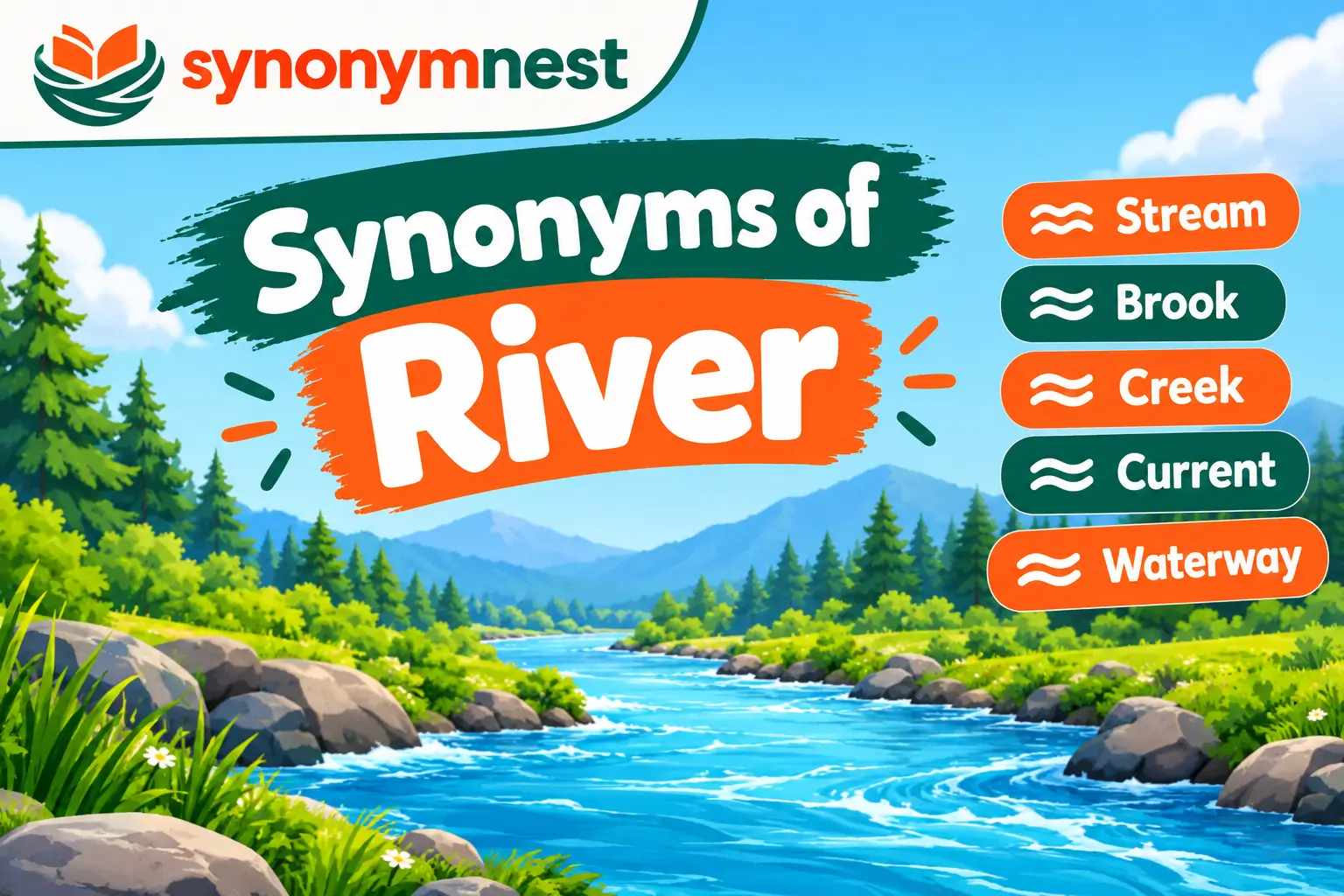
A synonym for river is stream, watercourse, or waterway, depending on the context. These words describe flowing water or the route it follows. Some words, such as creek, brook, and rivulet, usually refer to smaller streams, while others describe particular parts or types of a river. Choosing the right word makes your English clearer and more interesting.
A river is an important natural feature that supports people, animals, plants, and entire ecosystems. Rivers provide fresh water, support farming, create habitats, and help shape landscapes. They also appear frequently in books, poems, travel writing, and everyday conversations.
Learning synonyms of river can help you avoid repeating the same word in your writing. For example, instead of writing “The river flows through the valley” several times, you could write “The stream winds through the valley” when the watercourse is small, or “The waterway passes through the region” when discussing transportation.
However, not every word connected with a river is a true synonym. A tributary joins a larger river, while a delta forms near a river’s mouth. Understanding these differences helps you select words accurately.
In this guide, you will discover 30 synonyms and closely related alternatives for river, with simple meanings, example sentences, pronunciation guidance, and tips for using each word correctly.
Meaning of River
Definition
River (noun): A large natural stream of water that flows in a channel toward a sea, lake, or another river.
Rivers vary in length, width, depth, and speed. Some flow through mountains and forests, while others cross plains, cities, and agricultural regions.
Examples of River in Sentences
- The river flows through the center of the city.
- We enjoyed a peaceful walk beside the river.
- Heavy rain caused the river to rise.
- Many animals depend on the river for water.
Pronunciation and Syllables
- US pronunciation: /ˈrɪv.ɚ/
- UK pronunciation: /ˈrɪv.ə/
- Syllables: riv-er
- Part of speech: Noun
- Plural: rivers
30 Synonyms of River with Examples and Explanations
The following list includes direct or near-synonyms, regional terms, descriptive alternatives, and related geographical words. The explanations identify where a word is a suitable replacement and where it has a more specific meaning.
1. Stream (noun)
Pronunciation: /striːm/
Meaning: A body of flowing water, usually smaller than a large river.
Example: A clear stream flowed through the green meadow.
Usage: Stream is one of the most useful alternatives to river, especially when describing a small natural watercourse.
2. Creek (noun)
Pronunciation: /kriːk/
Meaning: A small stream or narrow watercourse. Its exact meaning varies by region.
Example: The children watched fish swimming in the creek.
Usage: Creek is common in American English. In some regions, the word can describe a much larger watercourse.
3. Brook (noun)
Pronunciation: /brʊk/
Meaning: A small natural stream.
Example: A gentle brook ran beside the walking trail.
Usage: Brook often appears in nature writing and descriptions of peaceful rural landscapes.
4. Watercourse (noun)
Pronunciation: /ˈwɔː.t̬ɚ.kɔːrs/ (US), /ˈwɔː.tə.kɔːs/ (UK)
Meaning: A natural or artificial channel through which water flows.
Example: The survey identified a watercourse running across the property.
Usage: Watercourse is a useful formal alternative in geographical, environmental, and legal writing.
5. Waterway (noun)
Pronunciation: /ˈwɔː.t̬ɚ.weɪ/ (US), /ˈwɔː.tə.weɪ/ (UK)
Meaning: A body or route of water that can be used for travel, transportation, or other purposes.
Example: The historic waterway connects several towns.
Usage: Waterway works well when discussing navigation and transportation, but it can also include canals and other artificial routes.
6. Rivulet (noun)
Pronunciation: /ˈrɪv.jə.lət/
Meaning: A very small stream of flowing water.
Example: A rivulet trickled down the rocky hillside.
Usage: Rivulet is useful in descriptive and literary writing when you want to emphasize the small size of a stream.
7. Streamlet (noun)
Pronunciation: /ˈstriːm.lət/
Meaning: A small stream.
Example: A narrow streamlet crossed the garden after the rain.
Usage: Streamlet is less common than stream but can add variety to descriptive writing.
8. Burn (noun)
Meaning: A small stream, especially in Scottish and Northern English usage.
Example: The hikers followed a burn through the Scottish countryside.
Usage: Burn is a regional term rather than a universal synonym for river.
9. Beck (noun)
Meaning: A small stream, especially in Northern England.
Example: A shallow beck flowed beneath the stone bridge.
Usage: Beck is particularly useful when describing landscapes in parts of northern England.
10. Run (noun)
Meaning: In some regional uses, a small stream or flowing watercourse.
Example: The old farm stood beside a small run of water.
Usage: Run has several meanings in English, so use it as a watercourse term only when the context or regional usage makes the meaning clear.
11. Torrent (noun)
Pronunciation: /ˈtɔːr.ənt/ (US), /ˈtɒr.ənt/ (UK)
Meaning: A strong, fast-moving flow of water.
Example: After the storm, a torrent rushed down the mountain.
Usage: Torrent emphasizes speed and force. It is not a neutral substitute for every river.
12. River channel (noun)
Meaning: The physical path in which a river flows.
Example: Floodwater spread beyond the river channel into nearby fields.
Usage: River channel is a descriptive geographical expression. It refers to the river’s path, not the entire river in every context.
13. River course (noun)
Meaning: The route a river follows from its source toward its mouth.
Example: The river course changes as the water crosses the plain.
Usage: River course is useful in geography and environmental writing.
14. Main stem (noun)
Meaning: The principal channel of a river system, excluding smaller tributaries.
Example: Several smaller streams eventually feed into the main stem.
Usage: This is a technical term used in hydrology and river-system descriptions.
15. Trunk stream (noun)
Meaning: The principal stream that receives water from smaller streams within a drainage network.
Example: The trunk stream carries water collected from several mountain valleys.
Usage: Trunk stream is a technical expression, not a general everyday synonym.
16. Freshwater stream (noun)
Meaning: A stream containing fresh rather than salt water.
Example: The freshwater stream provides habitat for native fish.
Usage: This expression is useful when the water’s salinity matters. It does not necessarily describe a large river.
17. Flowing water (noun phrase)
Meaning: Water that moves continuously or in a particular direction.
Example: The sound of flowing water made the woodland feel peaceful.
Usage: Flowing water describes the movement of water, not necessarily a river itself.
18. Running water (noun phrase)
Meaning: Water that is moving rather than standing still.
Example: The valley’s running water supports many plants and animals.
Usage: Running water is broader than river and can describe streams, springs, and water moving through pipes.
19. Current (noun)
Pronunciation: /ˈkɝː.ənt/ (US), /ˈkʌr.ənt/ (UK)
Meaning: The movement of water in a particular direction.
Example: The strong current made crossing the river dangerous.
Usage: Current describes how water moves, not the watercourse itself. Use it when discussing speed, direction, or strength.
20. Flow (noun)
Pronunciation: /floʊ/ (US), /fləʊ/ (UK)
Meaning: The movement or rate of movement of water.
Example: The dam reduced the flow of water downstream.
Usage: Flow is appropriate in technical and everyday descriptions of moving water, but it is not a direct replacement for river.
21. Whitewater (noun)
Meaning: Fast-moving, turbulent water that appears white because of bubbles and foam.
Example: Experienced kayakers navigated the whitewater carefully.
Usage: Whitewater is especially relevant to rapids and adventure sports.
22. Rapids (noun)
Pronunciation: /ˈræp.ɪdz/
Meaning: Sections of a river where water moves rapidly over rocks or an uneven riverbed.
Example: The rafting guide warned us about the dangerous rapids ahead.
Usage: Rapids describe a particular section of a river, not an entire river.
23. Tributary (noun)
Pronunciation: /ˈtrɪb.jə.ter.i/
Meaning: A stream or river that flows into a larger river or another water body.
Example: The small tributary joins the main river near the village.
Usage: Tributary is a related geographical term, not an exact synonym for river.
24. Distributary (noun)
Meaning: A branch that carries water away from the main channel of a river, often near its delta.
Example: The distributary carries river water toward the coastal wetlands.
Usage: This term is helpful when describing river deltas and branching river systems.
25. Estuary (noun)
Pronunciation: /ˈes.tʃuː.er.i/
Meaning: A coastal area where a river meets the sea and freshwater mixes with seawater.
Example: Many migratory birds feed in the estuary.
Usage: An estuary is a specific coastal environment associated with a river, not a synonym for the river itself.
26. Delta (noun)
Pronunciation: /ˈdel.tə/
Meaning: An area of land formed by sediment deposited where a river enters a larger body of water.
Example: The river delta contains fertile soil and productive wetlands.
Usage: Delta describes a landform created by river deposits, rather than a flowing river.
27. River system (noun)
Meaning: A river together with its tributaries and connected waterways.
Example: The river system supplies water to farms across the region.
Usage: Use river system when discussing the wider network of connected rivers and streams.
28. Drainage network (noun)
Meaning: A connected arrangement of streams and rivers that carries water across a landscape.
Example: The drainage network directs rainfall toward the main river.
Usage: Drainage network is a technical alternative when discussing how water moves through a region.
29. River basin (noun)
Meaning: The area of land drained by a river and its tributaries.
Example: Thousands of people depend on the river basin for agriculture and drinking water.
Usage: A river basin is the surrounding drainage area, not the river itself.
30. Canal (noun)
Pronunciation: /kəˈnæl/
Meaning: An artificial waterway constructed for navigation, irrigation, drainage, or water supply.
Example: The canal carries irrigation water to nearby farms.
Usage: Canal is related to waterways but is generally not a synonym for a natural river.
Best Synonyms of River for Different Contexts
Choosing the right word depends on what you want to communicate.
- Everyday English: stream, creek, brook.
- Formal and geographical writing: watercourse, river course, river channel.
- Literary descriptions: brook, rivulet, streamlet.
- Regional descriptions: burn, beck.
- Fast-moving water: torrent, whitewater.
- River geography: tributary, distributary, estuary, delta.
- Technical discussions: main stem, trunk stream, drainage network.
Remember that a word can be related to a river without having the same meaning. Select a replacement that preserves the meaning of your sentence.
River vs. Stream vs. Creek vs. Brook
These four words are closely related, but they are not always interchangeable.
| Word | Typical meaning | Common usage |
|---|---|---|
| River | A natural flowing watercourse, often relatively large | Geography and everyday English |
| Stream | A flowing body of water, often smaller than a river | General and descriptive writing |
| Creek | A small watercourse, with regional variations in size and meaning | Especially common in American English |
| Brook | A small stream | Nature writing and rural descriptions |
There is no universal size boundary separating a stream from a river. Local naming traditions, geography, and historical usage can affect what people call a particular watercourse.
For example, “The river carries water to the sea” describes a large natural watercourse. “The brook winds through the garden” suggests a much smaller stream.
Words That Describe a River
Sometimes, the best way to improve a sentence is to use an adjective rather than replace the word river.
- Winding river: a river that follows a curved path.
- Mighty river: a powerful or impressive river.
- Tranquil river: a peaceful and calm-looking river.
- Swift river: a river with fast-moving water.
- Shallow river: a river with little depth in a particular area.
- Broad river: a river that is wide.
- Meandering river: a river that follows a winding course.
- Turbulent river: a river with disturbed or rough water.
- Pristine river: a river that appears clean and unspoiled.
- Flooded river: a river that has risen beyond its usual level.
Examples:
- The winding river passed through the green valley.
- A mighty river supplied water to the surrounding communities.
- The swift river flowed over rocks after heavy rainfall.
Common Mistakes When Using River Synonyms
1. Treating every related term as an exact synonym
A tributary flows into a larger river, while a delta is a landform. Neither word can replace river in every sentence.
2. Assuming every stream is smaller than every river
Stream often refers to a smaller watercourse, but there is no single universal size rule.
3. Using current when you mean a watercourse
“The current flows through the valley” is usually less natural than “The river flows through the valley.” Current refers to the movement of water.
4. Confusing an estuary with a river mouth
An estuary is a coastal environment influenced by freshwater and tides. A river mouth is the place where a river enters another body of water.
5. Using regional terms without considering the audience
Words such as burn and beck are natural in certain British regional contexts but may be unfamiliar to some international readers.
Antonyms and Contrasting Terms
River has no perfect one-word antonym. However, some words describe conditions that contrast with flowing water.
- Dryness: the absence of moisture.
- Drought: an extended period of unusually low water availability.
- Still water: water that is not noticeably moving.
- Arid land: land with very little rainfall.
These are contrasting concepts, not direct dictionary antonyms of river.
Frequently Asked Questions
1. What is a synonym for river?
Stream, watercourse, and waterway are useful alternatives, depending on the context. Creek and brook are also common words for smaller flowing watercourses.
2. What is another word for a small river?
Stream, creek, brook, rivulet, and streamlet can describe smaller watercourses. The most appropriate choice depends on local usage and the size of the watercourse.
3. What is a formal synonym for river?
Watercourse is a useful formal term. River channel and river course are also appropriate in geographical writing when referring to a river’s channel or route.
4. Is a stream the same as a river?
Both are natural flowing watercourses, but stream commonly refers to a smaller one. Their exact distinction depends on local naming conventions and context.
5. Is a tributary a synonym for river?
Not exactly. A tributary is a stream or river that flows into a larger river or another water body. It is a related geographical term rather than a direct synonym.
6. What words describe a beautiful river?
Words such as tranquil, pristine, winding, clear, and picturesque can describe a river’s appearance or surroundings. Choose the adjective that best matches the scene.
Conclusion
Learning synonyms of river helps you describe water, landscapes, and natural environments with greater variety. Words such as stream, creek, brook, rivulet, and watercourse can work as alternatives in suitable contexts, while terms such as tributary, delta, estuary, and river basin describe related geographical features.
The key is to understand each word before using it. Instead of choosing a synonym only to avoid repetition, select the word that communicates your meaning accurately. With regular practice, you can make your English writing more natural, precise, and engaging.