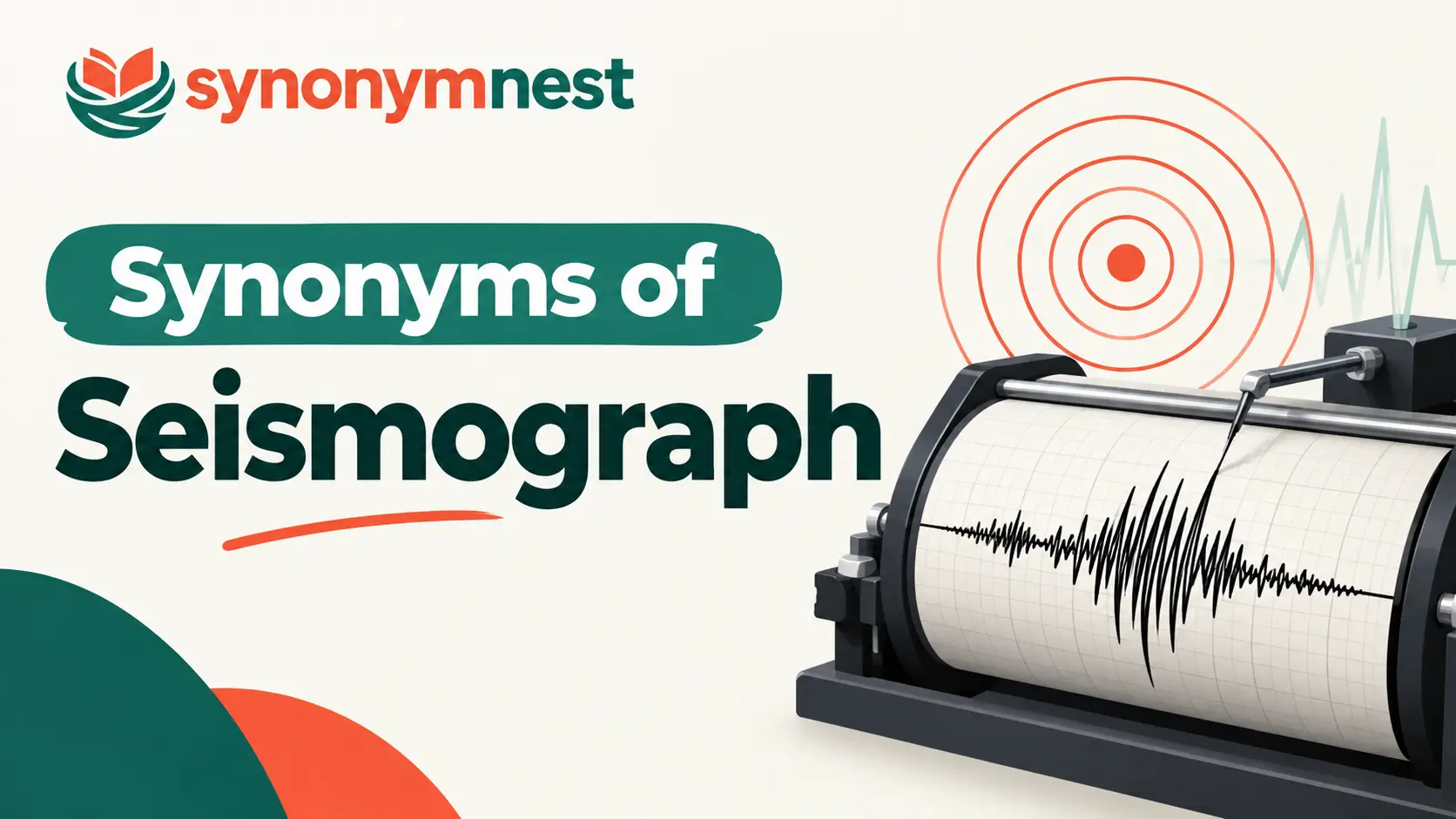
A seismograph is a scientific instrument that detects and records ground movements caused by earthquakes and other seismic events. Related terms include seismic recorder, earthquake recording instrument, and ground-motion recorder. A seismometer measures ground motion, while a seismogram is the recorded trace or data produced by a seismic recording system.
A seismograph plays an important role in earthquake research, geology, and scientific monitoring. It helps scientists record ground vibrations and study the waves produced by earthquakes. Understanding this word and its related terms can improve your scientific vocabulary and help you explain earthquake activity more clearly.
However, not every word associated with a seismograph is a true synonym. Some terms describe instruments that detect vibrations, while others refer to measuring devices, recorded data, or the scientific study of earthquakes. Knowing these differences helps you select the most accurate expression for your writing.
In this guide, you will discover useful synonyms and related terms for seismograph, their meanings, and examples of how they are used in sentences. You will also learn about pronunciation, word formation, etymology, common scientific distinctions, and frequently asked questions. Whether you are a student, teacher, researcher, or English learner, this guide will help you use the word correctly.
Meaning of Seismograph
A seismograph is an instrument or recording system used to detect and record movements of the ground. Scientists use its records to investigate earthquakes, underground vibrations, and other seismic activity.
For example, when an earthquake occurs, seismic waves travel through the Earth. Instruments at monitoring stations detect ground motion, and recording systems preserve information about that motion. Scientists examine these records to understand the event and study the Earth’s interior.
Definition
Seismograph (noun): A scientific instrument or system that detects and records ground motion, especially motion associated with earthquakes.
Examples
- The seismograph recorded the ground movements caused by the earthquake.
- Scientists examined the seismograph records after the tremor.
- The university installed a seismograph to monitor local seismic activity.
- Researchers used seismic recordings to study waves traveling through the Earth.
Why Is the Word Important?
The word seismograph is useful in geology, geography, physics, disaster research, and science education. It refers to equipment used to produce records that scientists can examine and interpret.
Writers should use the term when discussing earthquake recording systems. When referring specifically to a measuring sensor or the resulting record, seismometer or seismogram may be more accurate.
30 Synonyms and Related Terms for Seismograph
The following list includes established technical terms and descriptive alternatives. Some are close substitutes in suitable contexts, while others describe related equipment or processes. They should not all be treated as exact dictionary synonyms.
1. Seismic Recorder
Meaning: A device or system that records seismic activity or ground motion.
Examples:
- The seismic recorder captured the vibrations during the earthquake.
- Researchers reviewed the seismic recorder’s data.
Usage: This is one of the closest descriptive alternatives to seismograph, particularly when the emphasis is on recording.
2. Earthquake Recording Instrument
Meaning: An instrument used to record ground motion associated with earthquakes.
Examples:
- The earthquake recording instrument preserved important scientific data.
- Students learned how an earthquake recording instrument works.
Usage: This phrase is suitable for educational explanations, although it is a description rather than a standard one-word synonym.
3. Ground-Motion Recorder
Meaning: A recording device that documents movement of the ground.
Examples:
- The ground-motion recorder detected shaking near the fault.
- Engineers examined the ground-motion recorder’s measurements.
Usage: This phrase is useful when discussing ground movement rather than earthquakes alone.
4. Seismic Recording System
Meaning: A system that detects, collects, and records seismic signals.
Examples:
- The seismic recording system collected data throughout the night.
- Scientists upgraded the seismic recording system at the research station.
Usage: Use this phrase when the equipment includes sensors, electronics, and data-recording components.
5. Seismic Instrument
Meaning: A scientific instrument used to investigate seismic activity.
Examples:
- The seismic instrument detected small ground vibrations.
- Researchers calibrated the seismic instrument before collecting data.
Usage: This is a broader term. It can describe several kinds of scientific equipment, not just a seismograph.
6. Seismometer
Meaning: An instrument that detects and measures ground motion.
Examples:
- The seismometer detected vibrations from a distant earthquake.
- Scientists installed a sensitive seismometer near the monitoring station.
Usage: This is an important related scientific term. In modern technical contexts, a seismometer is generally the sensing instrument, while a seismograph refers to the recording instrument or system. Usage can overlap.
7. Seismic Sensor
Meaning: A sensor designed to detect ground vibrations or seismic waves.
Examples:
- The seismic sensor detected motion that people could not feel.
- Engineers placed a seismic sensor near the research site.
Usage: A seismic sensor is a component of many monitoring systems. It is not necessarily a complete recording instrument.
8. Earthquake Sensor
Meaning: A sensor designed to detect ground movements associated with earthquakes.
Examples:
- The earthquake sensor detected ground shaking.
- Technicians tested the earthquake sensor before installation.
Usage: This is an understandable descriptive phrase, but it does not identify one specific instrument design.
9. Ground-Motion Sensor
Meaning: A device that detects movement of the ground.
Examples:
- The ground-motion sensor measured vibrations near the bridge.
- Engineers installed a ground-motion sensor to monitor structural movement.
Usage: This term is especially relevant to earthquake engineering and structural monitoring.
10. Vibration Sensor
Meaning: A device that detects or measures vibrations.
Examples:
- The vibration sensor detected movement in the building.
- Engineers used a vibration sensor to investigate mechanical shaking.
Usage: A vibration sensor can detect many kinds of vibration, so it is broader than a seismograph.
11. Seismic Monitoring Instrument
Meaning: Equipment used to observe and measure seismic activity.
Examples:
- The seismic monitoring instrument collected information about local tremors.
- Scientists checked the seismic monitoring instrument regularly.
Usage: This phrase works well in research reports and educational writing.
12. Earthquake Monitoring Instrument
Meaning: Equipment used to monitor ground movements and earthquake-related activity.
Examples:
- The earthquake monitoring instrument provided useful observations.
- Researchers maintained the earthquake monitoring instrument throughout the study.
Usage: This is a descriptive alternative when the purpose of the equipment is monitoring.
13. Ground-Motion Recording Device
Meaning: A device that records movements of the ground over time.
Examples:
- The ground-motion recording device preserved the event’s data.
- The researchers inspected the ground-motion recording device after the earthquake.
Usage: This phrase emphasizes the recording function of the equipment.
14. Seismic Detection Device
Meaning: Equipment designed to detect seismic signals or ground movement.
Examples:
- The seismic detection device picked up vibrations from the surrounding area.
- Technicians tested the seismic detection device before beginning the experiment.
Usage: Detection does not necessarily mean that the equipment creates a permanent record.
15. Earth-Movement Sensor
Meaning: A sensor that detects movement of the ground or Earth.
Examples:
- The earth-movement sensor registered a small vibration.
- Scientists examined the earth-movement sensor’s readings.
Usage: This is a descriptive phrase rather than a standardized technical name.
16. Tremor-Recording Instrument
Meaning: Equipment used to record vibrations or shaking associated with a tremor.
Examples:
- The tremor-recording instrument captured the ground’s movement.
- Researchers reviewed the tremor-recording instrument’s output.
Usage: This expression can work in educational material, although seismic recorder is usually more concise.
17. Seismic Data Recorder
Meaning: A device or system that records seismic data.
Examples:
- The seismic data recorder stored readings from several sensors.
- Researchers transferred information from the seismic data recorder to a computer.
Usage: This term emphasizes the collection and storage of data rather than the sensing mechanism.
18. Seismic Logger
Meaning: A device or system that logs seismic measurements over time.
Examples:
- The seismic logger stored readings from the monitoring station.
- Scientists downloaded the seismic logger’s data for analysis.
Usage: A logger may be part of a larger seismic monitoring system.
19. Seismic Wave Detector
Meaning: A device that detects signals associated with seismic waves.
Examples:
- The seismic wave detector registered an incoming signal.
- Scientists compared readings from different seismic wave detectors.
Usage: This phrase describes detection rather than necessarily recording a complete seismogram.
20. Ground-Shaking Detector
Meaning: A device that detects shaking of the ground.
Examples:
- The ground-shaking detector registered movement during the event.
- Engineers tested the ground-shaking detector in a controlled environment.
Usage: This is a plain-English description suitable for general readers.
21. Earthquake Recording System
Meaning: A system that detects and records earthquake-related ground movements.
Examples:
- The earthquake recording system preserved the event’s measurements.
- Researchers improved the earthquake recording system at the laboratory.
Usage: This phrase is useful when referring to a complete recording setup.
22. Seismic Measurement Instrument
Meaning: An instrument used to measure aspects of seismic activity.
Examples:
- The seismic measurement instrument produced consistent readings.
- Scientists calibrated the seismic measurement instrument before the survey.
Usage: This is a broad description. Not every measuring instrument records data in the same way.
23. Seismic Monitoring Device
Meaning: A device used to observe seismic activity over time.
Examples:
- The seismic monitoring device remained active throughout the experiment.
- The research team checked the seismic monitoring device each morning.
Usage: This term focuses on ongoing observation rather than one particular recording method.
24. Earthquake Detection Instrument
Meaning: An instrument used to detect earthquake-related signals or ground movements.
Examples:
- The earthquake detection instrument registered a seismic signal.
- Technicians examined the earthquake detection instrument after testing.
Usage: This is a descriptive phrase that emphasizes detection.
25. Seismic Wave Recording System
Meaning: A system that records signals associated with seismic waves.
Examples:
- The seismic wave recording system captured data from the distant event.
- Scientists analyzed the output of the seismic wave recording system.
Usage: This phrase is suitable when the recording of seismic waves is the main concern.
26. Ground-Vibration Recorder
Meaning: A device or system that records vibrations in the ground.
Examples:
- The ground-vibration recorder documented movement near the construction site.
- Researchers compared the ground-vibration recorder’s results with other measurements.
Usage: This descriptive phrase can be useful in engineering and monitoring contexts.
27. Seismic Acquisition System
Meaning: Equipment used to collect seismic data, often in scientific surveys or exploration.
Examples:
- The seismic acquisition system collected measurements during the survey.
- Engineers checked the seismic acquisition system before fieldwork.
Usage: This is a specialized related term. Such systems may contain multiple sensors and recording components and are not necessarily synonyms for a seismograph.
28. Earthquake Data-Recording System
Meaning: A system used to collect and preserve earthquake-related measurements.
Examples:
- The earthquake data-recording system stored information for later analysis.
- Scientists reviewed the earthquake data-recording system’s output.
Usage: This phrase emphasizes data collection and preservation.
29. Seismic Monitoring Station Equipment
Meaning: Equipment installed at a station to observe and record seismic activity.
Examples:
- The seismic monitoring station equipment required routine maintenance.
- Researchers upgraded the seismic monitoring station equipment.
Usage: This is a broad phrase referring to equipment at a station, rather than a single instrument.
30. Earthquake Research Instrument
Meaning: A scientific instrument used to investigate earthquakes and related ground motion.
Examples:
- The earthquake research instrument helped scientists study seismic waves.
- Students observed the earthquake research instrument during a laboratory visit.
Usage: This general expression is useful for introductory explanations, but it is not a precise technical synonym.
How to Choose the Right Seismograph Synonym
The best word depends on what you want to describe.
- Use seismic recorder when emphasizing the recording function.
- Use seismometer when referring to the instrument that detects and measures ground motion.
- Use seismic sensor when referring to a sensing component.
- Use ground-motion recorder when the focus is on recording movement of the ground.
- Use seismogram when referring to the recorded trace or data.
- Use seismic monitoring system when discussing the wider arrangement of instruments and recording equipment.
Remember that the descriptive phrases in this article are not all established dictionary synonyms. In scientific writing, accuracy is more important than replacing a word simply to avoid repetition.
Seismograph vs. Seismometer vs. Seismogram
These three terms are closely related, but they have different meanings.
Seismograph: An instrument or system used to record ground motion.
Seismometer: A sensing instrument that detects and measures ground movement.
Seismogram: The recorded trace or data representing ground motion over time.
For example, a seismometer may detect ground movement, the recording system may preserve the measurements, and the resulting seismogram may be analyzed by scientists.
In modern digital systems, these terms can overlap in everyday usage. However, understanding their technical distinctions helps students and writers communicate more accurately.
Connotative Meaning of Seismograph
The word seismograph has a primarily neutral, scientific meaning. It names an instrument rather than expressing an emotion or judgment.
Its context may suggest different associations:
- Scientific context: Research, measurement, and discovery.
- Disaster context: Earthquakes, ground shaking, and emergency response.
- Educational context: Geology, physics, and learning about the Earth.
For example, “The seismograph recorded the earthquake” is a neutral statement. The word itself does not mean danger or destruction.
Etymology of Seismograph
The word seismograph combines elements derived from Greek.
- Seismo-: Relates to shaking or earthquakes.
- -graph: Relates to writing, drawing, or recording.
Together, the word refers to an instrument associated with recording seismic movement.
The word became established in scientific vocabulary as researchers developed instruments to investigate earthquakes and record ground motion. For historical writing, specific dates and claims about the earliest instruments should be checked against reliable historical sources.
Pronunciation of Seismograph
The standard pronunciation is approximately:
- US English: /ˈsaɪz.mə.ɡræf/
- UK English: /ˈsaɪz.mə.ɡrɑːf/
The word has three syllables:
seis-mo-graph
The first syllable receives the main stress. Practicing the word slowly can help English learners pronounce it more confidently.
Word Formation and Related Vocabulary
The word seismograph belongs to a family of scientific terms associated with earthquakes and seismic activity.
- Seismograph (noun): An instrument or system that records ground movement.
- Seismometer (noun): An instrument that detects and measures ground motion.
- Seismogram (noun): A record of ground motion.
- Seismic (adjective): Relating to earthquakes or vibrations within the Earth.
- Seismology (noun): The scientific study of earthquakes and seismic waves.
- Seismologist (noun): A scientist who studies earthquakes and related phenomena.
These terms are useful in science writing because each one serves a different purpose.
Common Uses of a Seismograph
A seismograph or modern seismic recording system can support several scientific activities.
Earthquake monitoring: Recording ground movements associated with seismic events.
Scientific research: Helping researchers study the timing, characteristics, and propagation of seismic waves.
Earth science education: Demonstrating how scientists observe movement within the Earth.
Engineering studies: Providing seismic data that may help researchers evaluate ground motion relevant to structures and infrastructure.
Geophysical investigations: Contributing to studies of the Earth’s interior and other underground processes.
A seismograph does not reliably predict the exact time and location of a future earthquake. Its principal role is to detect and record ground motion so that scientists can analyze seismic events.
Antonyms of Seismograph
Seismograph does not have a direct antonym because it names a scientific instrument. Words such as stillness, calmness, and stability describe conditions that may contrast with ground shaking, but they are not opposites of the instrument itself.
For example:
- Stillness: A state without noticeable movement.
- Stability: A condition of remaining steady.
- Calmness: A state without disturbance or agitation.
These words may be useful when describing ground conditions, but they should not be listed as true antonyms of seismograph.
Short Questions and Answers
1. What is a synonym for seismograph?
Seismic recorder is a useful close alternative when the focus is on recording ground motion. Other expressions, such as ground-motion recorder, are descriptive alternatives rather than universally established synonyms.
2. Is a seismometer the same as a seismograph?
The terms are closely related and sometimes overlap in modern usage. More precisely, a seismometer detects and measures ground motion, while a seismograph refers to a recording instrument or system.
3. What is a seismogram?
A seismogram is the recorded trace or data that represents ground motion over time. It is the record produced by a seismic recording system, not the instrument itself.
4. What is the scientific study of earthquakes called?
The scientific study of earthquakes and seismic waves is called seismology. A scientist who specializes in this field is called a seismologist.
5. Can a seismograph predict earthquakes?
A seismograph records ground motion and helps scientists analyze earthquakes. It does not reliably predict the exact time and location of a future earthquake.
6. What is the difference between an earthquake detector and a seismograph?
An earthquake detector is a broad description of equipment that detects earthquake-related signals. A seismograph specifically emphasizes recording ground motion.
7. Does seismograph have a direct antonym?
No. It names an instrument, so words such as stillness and stability are related to opposite ground conditions rather than being direct antonyms.
Conclusion
Learning the meaning of seismograph and its related terms can strengthen your English vocabulary and scientific understanding. Expressions such as seismic recorder and ground-motion recorder may work as descriptive alternatives, while seismometer and seismogram have distinct technical meanings.
The most important point is to choose words according to their meaning and context. Not every phrase associated with earthquake monitoring is an exact synonym. By understanding these distinctions, students, teachers, researchers, and writers can explain seismic instruments more clearly and accurately.
Continue practicing these terms in sentences, reading scientific material, and comparing related vocabulary. Over time, you will become more confident using earthquake-related terminology in both everyday explanations and formal scientific writing.