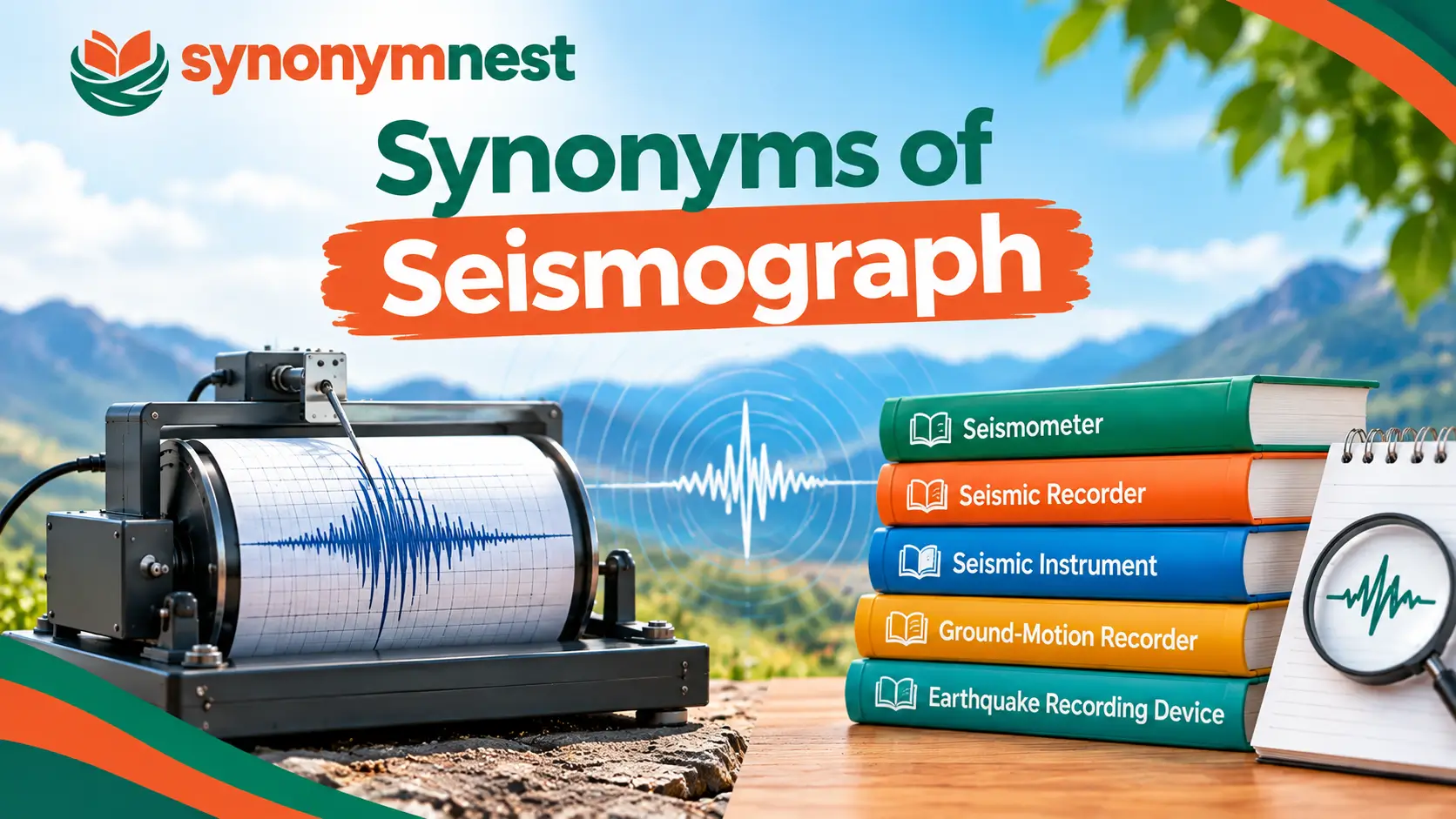
A seismograph is an instrument or recording system used to detect and record movement of the ground, especially movement caused by earthquakes. In modern usage, the word is closely associated with the seismometer, the sensing component that detects ground motion. A seismograph produces a record of that motion called a seismogram.
If you are looking for a synonym for seismograph, it is important to understand that not every term describing earthquake equipment is an exact synonym. Words such as seismometer, seismic recorder, and seismic instrument can be close alternatives, while terms such as seismic sensor, earthquake detector, and ground-motion sensor describe related tools or functions.
This guide explains 30 useful synonyms, close alternatives, and related terms for seismograph. It also covers the meaning, pronunciation, etymology, difference between a seismograph and seismometer, how these instruments work, examples, word forms, and frequently asked questions.
What Is a Synonym for Seismograph?
A close synonym for seismograph is seismometer, although the two words can have slightly different technical meanings. Other useful alternatives include seismic recorder, seismic instrument, ground-motion recorder, seismic recording system, and earthquake recording instrument. In everyday writing, the best choice depends on whether you mean the sensor, the recording system, or the complete station.
Meaning of Seismograph
A seismograph is an instrument used to record ground movement caused by earthquakes and other sources of seismic activity. Seismographs are placed at seismic stations and can work together in networks to help scientists study earthquakes.
Simple Definition
Seismograph (noun): An instrument or system that detects and records movement of the ground.
Example Sentences
- The seismograph recorded strong ground motion during the earthquake.
- Scientists examined the seismograph data after the tremor.
- The seismic station detected waves from a distant earthquake.
- The researcher studied the seismogram to identify the arriving seismic waves.
What Does a Seismograph Record?
A seismograph records ground motion over time. The resulting record is called a seismogram. Modern seismograms are generally digital rather than paper records. They can show the arrival and characteristics of different seismic waves, including P waves, S waves, and surface waves.
A seismogram may also contain vibrations that are not caused by earthquakes. Traffic, construction, ocean waves, machinery, and other disturbances can create signals that seismic instruments detect.
Seismograph vs. Seismometer
The terms seismograph and seismometer are often used interchangeably, but there is a useful technical distinction.
A seismometer is the sensing part of the instrument that detects ground movement. A seismograph traditionally refers to a seismometer combined with a recording system. USGS notes that the terms are also commonly used synonymously.
In simple terms:
- Seismometer: detects and measures ground motion.
- Seismograph: traditionally includes the sensor and recording system.
- Seismogram: the recorded result of the ground motion.
This distinction is useful when writing scientifically accurate content.
How Does a Seismograph Work?
A basic seismograph works using the principle of inertia. The instrument is firmly attached to the ground, while a suspended mass tends to remain relatively still when the ground moves.
When an earthquake shakes the ground, the frame of the instrument moves with the Earth. The suspended mass moves differently because of its inertia. The difference between the movement of the ground and the mass can then be measured and recorded.
Older seismographs could use a pen and rotating drum to create a visible record. Modern instruments are electronic. They convert the relative movement into an electrical signal that can be recorded digitally by a computer.
Modern seismic stations can use multiple components to record movement in different directions, including vertical movement and horizontal movement along different axes.
30 Synonyms and Related Terms for Seismograph
Not all of the following terms are exact dictionary synonyms. They are divided into close synonyms, functional alternatives, and related terms so that you can choose the most accurate word for your context.
1. Seismometer
Type: Noun
Meaning: A sensitive instrument that detects and measures ground motion.
Example:
The seismometer detected vibrations from a distant earthquake.
Best use: Scientific and technical writing.
2. Seismic Recorder
Type: Noun
Meaning: A device or system that records seismic ground motion.
Example:
The seismic recorder captured the earthquake waves.
Best use: When emphasizing recording.
3. Seismic Instrument
Type: Noun
Meaning: A broad term for an instrument used to detect or measure seismic activity.
Example:
Scientists installed a sensitive seismic instrument near the fault.
Best use: General scientific writing.
4. Ground-Motion Recorder
Type: Noun
Meaning: An instrument or system that records movement of the ground.
Example:
The ground-motion recorder detected strong shaking.
Best use: Technical explanations.
5. Seismic Recording System
Type: Noun
Meaning: A complete system used to detect and record seismic signals.
Example:
The seismic recording system transmitted data to the research center.
Best use: Modern monitoring systems.
6. Earthquake Recording Instrument
Type: Noun
Meaning: A general description of an instrument that records earthquake-related ground movement.
Example:
The earthquake recording instrument provided valuable data.
Best use: Educational writing.
7. Seismic Sensor
Type: Noun
Meaning: A sensor designed to detect seismic movement or vibrations.
Example:
The seismic sensor detected a small vibration underground.
Best use: When focusing on detection rather than recording.
8. Ground-Motion Sensor
Type: Noun
Meaning: A sensor that detects movement of the ground.
Example:
The ground-motion sensor measured the vibration caused by the earthquake.
Best use: Engineering and technical contexts.
9. Earthquake Detector
Type: Noun**
Meaning: A device or system designed to detect earthquake-related signals.
Example:
The earthquake detector registered the first seismic waves.
Best use: General and educational writing.
10. Seismic Detector
Type: Noun**
Meaning: A device used to detect seismic activity.
Example:
The seismic detector picked up vibrations from underground.
Best use: Detection-focused contexts.
11. Vibration Sensor
Type: Noun**
Meaning: A sensor that detects vibration or movement.
Example:
The vibration sensor recorded unusual ground movement.
Best use: General engineering contexts; it is broader than seismograph.
12. Ground Sensor
Type: Noun**
Meaning: A broad term for a sensor placed on or in the ground to monitor movement or conditions.
Example:
The ground sensor detected unusual vibrations.
Best use: General contexts, not as an exact technical synonym.
13. Seismic Monitoring Instrument
Type: Noun**
Meaning: An instrument used to monitor seismic activity over time.
Example:
The seismic monitoring instrument remained active throughout the night.
Best use: Earthquake monitoring.
14. Seismic Monitoring Device
Type: Noun**
Meaning: A device used to observe and track seismic signals.
Example:
The seismic monitoring device transmitted new readings.
Best use: General technical writing.
15. Ground-Motion Instrument
Type: Noun**
Meaning: An instrument designed to detect or measure movement of the ground.
Example:
Researchers used a ground-motion instrument to study the fault.
Best use: Scientific explanations.
16. Seismic Measurement Instrument
Type: Noun**
Meaning: An instrument used to measure characteristics of seismic movement.
Example:
The seismic measurement instrument recorded the strength of the ground motion.
Best use: Technical writing.
17. Earthquake Monitoring Instrument
Type: Noun**
Meaning: An instrument used to monitor earthquake activity.
Example:
The earthquake monitoring instrument detected signals from a distant event.
Best use: Educational and scientific contexts.
18. Seismic Data Recorder
Type: Noun**
Meaning: A system or device that records seismic data.
Example:
The seismic data recorder stored the signals for later analysis.
Best use: Data-focused writing.
19. Seismic Recording Device
Type: Noun
Meaning: A device used to record seismic motion.
Example:
The seismic recording device captured several minutes of ground motion.
Best use: General technical writing.
20. Earthquake Recording Device
Type: Noun
Meaning: A general term for equipment that records earthquake-related movement.
Example:
The earthquake recording device produced a detailed record of the shaking.
Best use: Simple explanations.
21. Seismic Detection Device
Type: Noun
Meaning: A device that detects seismic signals.
Example:
The seismic detection device identified the incoming waves.
Best use: Detection-focused writing.
22. Ground-Vibration Sensor
Type: Noun
Meaning: A sensor designed to detect vibrations in the ground.
Example:
The ground-vibration sensor detected movement near the construction site.
Best use: Engineering and monitoring contexts.
23. Earth-Motion Sensor
Type: Noun
Meaning: A sensor that detects movement of the Earth’s surface.
Example:
The earth-motion sensor detected very small vibrations.
Best use: Educational or descriptive writing.
24. Seismic Station Instrument
Type: Noun
Meaning: An instrument used as part of a seismic monitoring station.
Example:
The seismic station instrument sent data to the central monitoring network.
Best use: Network-monitoring contexts.
25. Earthquake Sensor
Type: Noun
Meaning: A broad term for a sensor used to detect earthquake-related movement.
Example:
The earthquake sensor detected the first ground vibrations.
Best use: General audiences.
26. Seismic Wave Detector
Type: Noun
Meaning: A device that detects seismic waves.
Example:
The seismic wave detector identified the arrival of the P wave.
Best use: Earthquake science.
27. Ground-Shaking Monitor
Type: Noun
Meaning: A device or system that monitors shaking of the ground.
Example:
The ground-shaking monitor recorded strong movement near the epicenter.
Best use: Plain-English explanations.
28. Earthquake Monitoring System
Type: Noun
Meaning: A broader system that uses seismic instruments and data networks to monitor earthquakes.
Example:
The earthquake monitoring system detected the event across several stations.
Best use: Network-level discussions.
29. Seismic Monitoring System
Type: Noun
Meaning: A system for detecting, recording, transmitting, and analyzing seismic activity.
Example:
The seismic monitoring system provided real-time data to researchers.
Best use: Modern seismic networks.
30. Earth-Movement Recorder
Type: Noun
Meaning: A descriptive term for equipment that records movement of the Earth.
Example:
The earth-movement recorder captured the vibration during the quake.
Best use: Simple explanatory writing.
Which Terms Are Closest to Seismograph?
If you need the most accurate alternatives, focus on these:
- Seismometer
- Seismic recorder
- Seismic instrument
- Ground-motion recorder
- Seismic recording system
- Earthquake recording instrument
The remaining terms are better understood as related or functional terms rather than exact synonyms. This distinction is important because a detector may only detect movement, while a recorder records it, and a complete monitoring system may include several instruments and communication components.
Categories of Seismograph Synonyms
Grouping related terms by function makes them easier to use.
Recording Terms
- Seismic recorder
- Ground-motion recorder
- Seismic data recorder
- Seismic recording device
- Earthquake recording device
Use these when you want to emphasize the recording of seismic activity.
Detection Terms
- Seismic sensor
- Seismic detector
- Earthquake detector
- Seismic detection device
- Seismic wave detector
These are useful when the focus is on detecting vibrations or seismic waves.
Measurement Terms
- Seismometer
- Seismic measurement instrument
- Ground-motion instrument
- Seismic instrument
These are appropriate when discussing scientific measurement.
Monitoring Terms
- Seismic monitoring instrument
- Earthquake monitoring instrument
- Seismic monitoring system
- Earthquake monitoring system
- Ground-shaking monitor
These terms are useful when discussing continuous observation and seismic networks.
Seismograph Examples in Sentences
Here are some natural examples:
- The seismograph recorded the earthquake within seconds of the shaking.
- Scientists examined the seismogram to study the seismic waves.
- A sensitive seismometer detected the distant earthquake.
- The seismic recorder stored the ground-motion data.
- Engineers installed a ground-motion sensor near the structure.
- The seismic monitoring system received data from several stations.
- Researchers used a seismic instrument to study the active fault.
What Is a Seismogram?
A seismogram is not a synonym for seismograph. It is the record produced by a seismograph or seismic recording system.
A seismogram shows ground motion as it changes with time. Modern seismograms are usually digital. Scientists can examine the recorded signal to identify seismic waves and investigate an earthquake’s characteristics.
This distinction is easy to remember:
Seismometer = sensor
Seismograph = instrument/system that records
Seismogram = recorded data
Seismograph and Earthquake Magnitude
A seismograph does not simply display a number that says how “strong” an earthquake is. Seismic data are analyzed to determine characteristics such as the earthquake’s location and magnitude.
Magnitude describes the size of the earthquake source and is not dependent on how strong the shaking feels at one particular location. Intensity, by contrast, describes the shaking and effects at a particular place, so it can vary from location to location.
The modern USGS reporting system uses moment magnitude for earthquake magnitude, while the Richter scale is an older method that is no longer used by USGS for large, distant earthquakes.
Can a Seismograph Predict Earthquakes?
A seismograph is primarily used to detect and record ground motion. It does not provide a reliable exact prediction of when and where a future earthquake will occur.
Scientists use seismic records to study earthquakes, identify patterns, locate events, and improve understanding of Earth’s interior and seismic hazards. Seismographic networks provide valuable real-time and historical data for this work.
Modern Seismographs
Modern seismographs are very different from the classic pen-and-drum instruments often shown in textbooks.
Electronic seismometers detect tiny ground movements and convert them into electrical signals. Computers then record and process these signals as digital data. Modern stations can measure movement in multiple directions and transmit information to monitoring networks.
A typical modern seismic station can include:
- A seismometer
- Data logger
- Timing system
- Power supply
- Communication equipment
- Computer or network connection
Some seismic stations are installed underground or in specially designed locations to reduce unwanted vibrations and improve measurements.
History of the Seismograph
The history of earthquake detection goes back much further than the modern electronic instruments used today.
USGS notes that the earliest known seismoscope was developed by the Chinese philosopher Chang Heng in A.D. 132. It could indicate that an earthquake had occurred, but it did not record the earthquake in the modern sense. The first seismograph was developed much later, in 1890.
Over time, earthquake instruments developed from mechanical systems into highly sensitive electronic instruments capable of recording tiny ground movements.
Etymology of Seismograph
The word seismograph comes from Greek roots associated with earthquakes and writing or recording.
- Seismo- relates to shaking or earthquakes.
- -graph relates to writing or recording.
This combination reflects the basic purpose of the instrument: recording earthquake or ground-shaking activity.
Pronunciation of Seismograph
Seismograph
- US: /ˈsaɪz.məˌɡræf/
- UK: /ˈsaɪz.mə.ɡrɑːf/
Syllables
seis-mo-graph
Word Forms Related to Seismograph
Several useful words belong to the same scientific word family:
- Seismograph — an instrument or recording system for seismic motion
- Seismometer — a sensor for detecting ground motion
- Seismogram — the recorded seismic signal
- Seismology — the scientific study of earthquakes and seismic waves
- Seismologist — a scientist who studies earthquakes and seismic activity
- Seismic — relating to earthquakes or vibrations of the Earth
Learning this word family can make scientific vocabulary easier to understand and use.
Related Words for Seismograph
If you are writing about earthquakes, these words may also be useful:
- Earthquake
- Seismic
- Seismic wave
- Ground motion
- Ground shaking
- Tremor
- Vibration
- Fault
- Epicenter
- Hypocenter
- Seismology
- Seismometer
- Seismogram
- Magnitude
- Intensity
- Seismic station
These are related terms, not necessarily synonyms for seismograph.
Seismograph Synonyms for Different Contexts
For Academic Writing
Use:
- Seismometer
- Seismic instrument
- Seismic recorder
- Ground-motion recorder
Example:
Researchers installed a seismic instrument to monitor the fault zone.
For Simple English
Use:
- Earthquake recording device
- Earthquake detector
- Ground-motion sensor
- Earthquake sensor
Example:
An earthquake sensor detects movement caused by seismic waves.
For Technical Writing
Use:
- Seismometer
- Seismic recording system
- Seismic monitoring system
- Ground-motion instrument
Example:
The seismic monitoring system transmitted measurements from several stations.
For General Content
Use:
- Seismograph
- Seismometer
- Seismic recorder
- Earthquake recording instrument
These terms are generally easier for readers to understand.
Common Mistakes When Using Seismograph Synonyms
One common mistake is treating every earthquake-related instrument as an exact synonym. A vibration sensor, for example, can detect vibrations in many environments and is not necessarily a seismograph.
Another mistake is confusing seismograph with seismogram. The first refers to the instrument or recording system, while the second refers to the resulting record.
A third mistake is saying that a seismograph directly “measures earthquake strength.” Seismic instruments record ground motion, and scientists analyze those records to determine earthquake characteristics such as magnitude.
Frequently Asked Questions
What is another word for seismograph?
Seismometer is the closest commonly used alternative. Other close terms include seismic recorder, seismic instrument, ground-motion recorder, and seismic recording system. However, these terms can have different technical meanings.
Is a seismometer the same as a seismograph?
They are closely related and are often used interchangeably. Technically, a seismometer is the sensing component, while a seismograph traditionally refers to the sensor together with its recording system.
What does a seismograph record?
A seismograph records ground motion over time. The resulting record is called a seismogram.
What is a seismogram?
A seismogram is the recorded representation of ground movement detected by a seismic instrument. It can show the arrival and characteristics of seismic waves.
Can a seismograph detect small earthquakes?
Yes. Sensitive seismic instruments can detect very small ground movements, including signals from distant earthquakes.
Does a seismograph predict earthquakes?
No. A seismograph detects and records ground movement. Scientists use seismic data to study earthquakes and improve understanding of seismic hazards, but the instrument does not reliably predict the exact time and location of a future earthquake.
What is the difference between magnitude and intensity?
Magnitude describes the size of an earthquake source, while intensity describes the shaking and effects at a particular location. Intensity can therefore vary from place to place during the same earthquake.
What is the difference between a seismograph and a seismogram?
A seismograph is the instrument or recording system. A seismogram is the record produced by that system.
Conclusion
A seismograph is an important instrument for detecting and recording ground motion caused by earthquakes and other seismic sources. The closest commonly used alternative is seismometer, although the two terms can have slightly different technical meanings. Other useful terms include seismic recorder, seismic instrument, ground-motion recorder, seismic recording system, and earthquake recording instrument.
It is also important to distinguish synonyms from related terms. A seismic sensor or earthquake detector may describe the detection function, while a seismogram is the actual recorded result. Understanding these differences helps you choose the right word for academic writing, science articles, school assignments, and general English.
Modern seismographs use sensitive electronic instruments and digital recording systems rather than relying only on the traditional pen-and-drum design. The data they collect help scientists locate earthquakes, study seismic waves, calculate earthquake magnitude, and better understand Earth’s structure and seismic hazards.