The word “good” is one of the most common words in the English language. We use it dozens of times a day — “I had a good day,” “She is a good teacher,” “This food is good.” But because it’s used so often, it can make your speaking and writing sound flat, repetitive, and unimpressive.
Learning strong, well-chosen synonyms for “good” instantly upgrades your English — whether you’re writing an essay, a resume, a business email, or just having a conversation. This guide doesn’t just give you a list — it tells you which word to use, when, and why, so you never sound unsure about word choice again.
Meaning of Good
Good (Adjective): Something that is pleasant, helpful, correct, kind, high in quality, or morally right.
Examples:
- She is a good friend.
- This food tastes good.
Connotative Meaning
- Positive tone: kind, pleasant, excellent, helpful
- Negative tone: can sound weak, vague, or lazy if overused in writing
- Neutral tone: basic, general description of quality
Etymology
“Good” comes from the Old English word gōd, meaning virtuous, desirable, or favorable. It is closely related to the German word gut, and both trace back to a common Proto-Germanic root meaning “fitting” or “suitable.”
Short History
- Old English (450–1100): Used mainly to describe moral goodness and character.
- Middle English (1100–1500): Meaning expanded to include “pleasant,” “suitable,” and “kind.”
- Modern English (1500–Present): Now used broadly for quality, behavior, skill, health, and general approval.
Pronunciation (US & UK – IPA)
- US: /ɡʊd/
- UK: /ɡʊd/
- Syllables: good (one syllable)
Word Formation
From the root “good,” English has built several related words:
- Goodness (noun) — moral quality
- Goodbye (interjection/noun) — farewell greeting
- Good-looking (adjective) — attractive
- Goods (noun, plural) — a completely different meaning: products or merchandise
Quick Reference: Which Synonym Fits Which Situation?
Before the full list, here’s a cheat sheet so you can pick the right word instantly instead of guessing.
| Situation | Best Synonyms to Use |
|---|---|
| Casual conversation / texting | Great, Nice, Fine, Cool (informal) |
| Business or professional writing | Excellent, Outstanding, Efficient, Reliable |
| Academic or essay writing | Beneficial, Favorable, Admirable, Commendable |
| Describing a person’s character | Trustworthy, Reliable, Kind, Respectable |
| Describing a skill or performance | Skillful, Talented, Brilliant, Capable |
| Resume / CV writing | Efficient, Reliable, Capable, Outstanding |
| IELTS / TOEFL writing tasks | Beneficial, Favorable, Advantageous, Commendable |
| Expressing strong excitement | Amazing, Fantastic, Terrific, Wonderful |
| Describing health or condition | Healthy, Fine, Sound |
| Formal praise/appreciation | Superb, Splendid, Marvelous, Admirable |
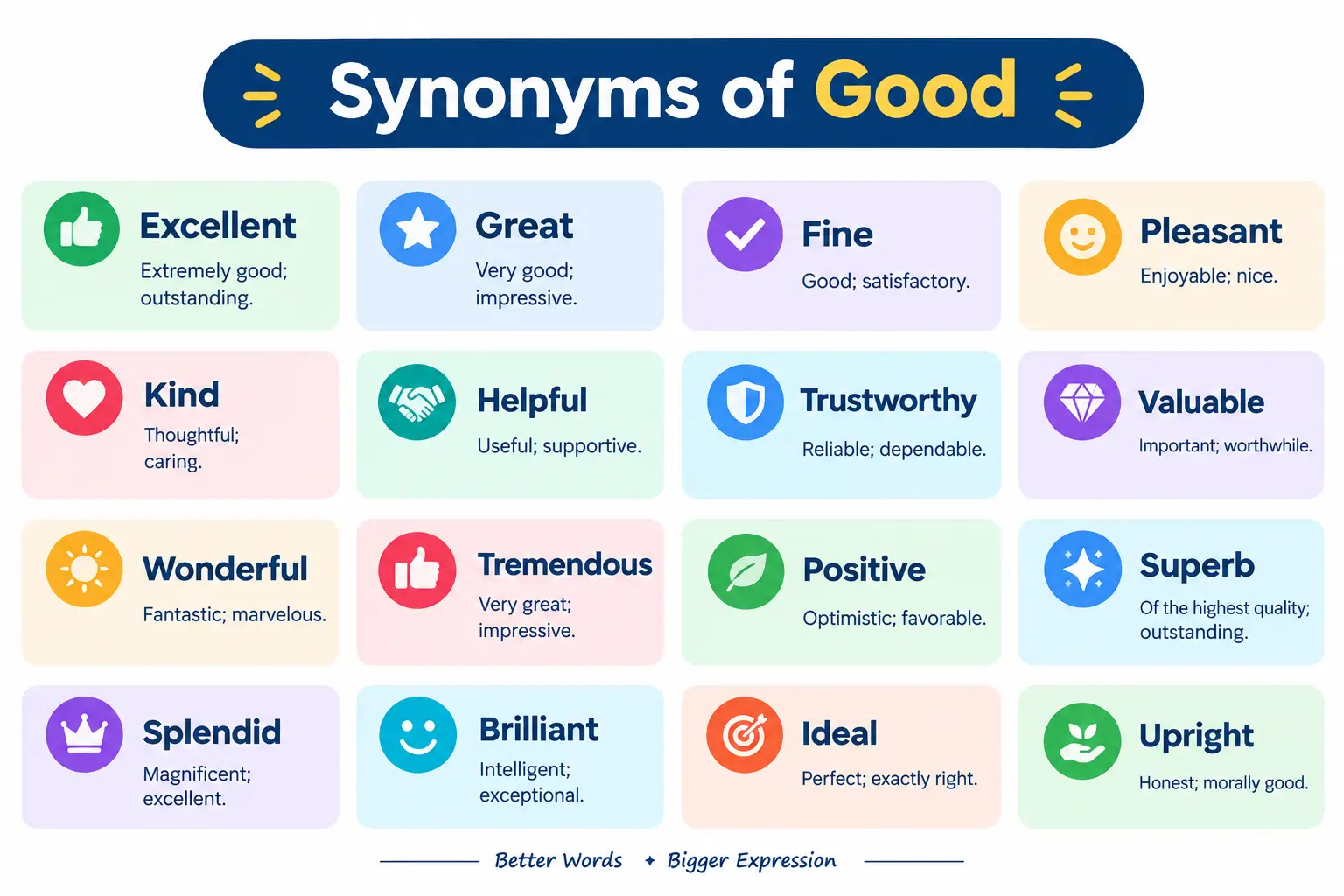
30 Powerful Synonyms of “Good”
Each entry includes meaning, pronunciation, formality level, and two example sentences.
1. Excellent
US: /ˈeksələnt/ · UK: /ˈeksələnt/ · Formality: Formal/Neutral Meaning: Extremely good; of very high quality.
- She did an excellent job on the report.
- The hotel’s service was excellent.
2. Great
US: /ɡreɪt/ · UK: /ɡreɪt/ · Formality: Informal/Neutral Meaning: Very good or impressive.
- We had a great time at the party.
- That is a great idea — let’s try it.
3. Fine
US: /faɪn/ · UK: /faɪn/ · Formality: Neutral Meaning: Acceptable or of good quality; also used for health.
- I feel fine today, thank you.
- The weather is fine for a walk.
4. Nice
US: /naɪs/ · UK: /naɪs/ · Formality: Informal Meaning: Pleasant, kind, or agreeable.
- She is a nice person to work with.
- That was a nice gift you gave her.
5. Wonderful
US: /ˈwʌndərfəl/ · UK: /ˈwʌndəfəl/ · Formality: Neutral/Warm Meaning: Extremely good; inspiring joy or admiration.
- We had a wonderful evening together.
- The view from the mountain was wonderful.
6. Fantastic
US: /fænˈtæstɪk/ · UK: /fænˈtæstɪk/ · Formality: Informal, enthusiastic Meaning: Extremely impressive or good.
- She gave a fantastic performance on stage.
- That sounds like a fantastic plan.
7. Amazing
US: /əˈmeɪzɪŋ/ · UK: /əˈmeɪzɪŋ/ · Formality: Informal, enthusiastic Meaning: Very surprising and good.
- The movie was absolutely amazing.
- You did an amazing job on this project.
8. Positive
US: /ˈpɑːzətɪv/ · UK: /ˈpɒzətɪv/ · Formality: Formal/Neutral Meaning: Helpful, optimistic, or favorable.
- She has a positive attitude toward challenges.
- The test results were positive.
9. Pleasant
US: /ˈplezənt/ · UK: /ˈplezənt/ · Formality: Neutral/Formal Meaning: Enjoyable or agreeable.
- It was a pleasant day for a picnic.
- He has a pleasant voice for radio.
10. Superb
US: /suːˈpɜːrb/ · UK: /suːˈpɜːb/ · Formality: Formal Meaning: Of the highest quality.
- The meal at the restaurant was superb.
- She gave a superb speech at the conference.
11. Outstanding
US: /aʊtˈstændɪŋ/ · UK: /aʊtˈstændɪŋ/ · Formality: Formal, professional Meaning: Clearly better than others; exceptional.
- He is an outstanding student in mathematics.
- Her work performance has been outstanding this year.
12. Brilliant
US: /ˈbrɪljənt/ · UK: /ˈbrɪljənt/ · Formality: Neutral/Informal (UK: also casual praise) Meaning: Extremely smart, skillful, or impressive.
- That is a brilliant idea for the campaign.
- She gave a brilliant answer during the interview.
13. Marvelous
US: /ˈmɑːrvələs/ · UK: /ˈmɑːvələs/ · Formality: Formal, slightly old-fashioned Meaning: Very pleasing; causing wonder.
- The show was absolutely marvelous.
- You look marvelous in that outfit.
14. Terrific
US: /təˈrɪfɪk/ · UK: /təˈrɪfɪk/ · Formality: Informal, energetic Meaning: Very good or exciting.
- She did a terrific job organizing the event.
- That was a terrific football match.
15. Splendid
US: /ˈsplɛndɪd/ · UK: /ˈsplendɪd/ · Formality: Formal, British-leaning Meaning: Very impressive; magnificent.
- They live in a splendid house by the coast.
- The performance was truly splendid.
16. Beneficial
US: /ˌbenəˈfɪʃəl/ · UK: /ˌbenɪˈfɪʃəl/ · Formality: Formal/Academic Meaning: Helpful or producing good results.
- Exercise is beneficial for your overall health.
- This course is beneficial for beginners learning English.
17. Favorable
US: /ˈfeɪvərəbl/ · UK: /ˈfeɪvərəbl/ · Formality: Formal/Business Meaning: Showing approval or giving an advantage.
- The weather conditions are favorable today.
- She received a favorable response from the manager.
18. Delightful
US: /dɪˈlaɪtfəl/ · UK: /dɪˈlaɪtfəl/ · Formality: Warm, descriptive Meaning: Giving great pleasure or joy.
- We had a delightful evening with old friends.
- The garden looks delightful in spring.
19. Admirable
US: /ˈædmərəbəl/ · UK: /ˈædmərəbəl/ · Formality: Formal Meaning: Deserving respect and approval.
- Her honesty is truly admirable.
- He did an admirable job under pressure.
20. Skillful
US: /ˈskɪlfəl/ · UK: /ˈskɪlfəl/ · Formality: Neutral/Formal Meaning: Having great ability or expertise.
- She is a skillful artist with a unique style.
- The surgeon was extremely skillful during the operation.
21. Talented
US: /ˈtæləntɪd/ · UK: /ˈtæləntɪd/ · Formality: Neutral Meaning: Naturally good at something.
- He is a talented musician who plays three instruments.
- The team is full of talented young players.
22. Reliable
US: /rɪˈlaɪəbəl/ · UK: /rɪˈlaɪəbəl/ · Formality: Formal/Professional Meaning: Can be trusted to perform consistently well.
- She is a reliable employee who never misses deadlines.
- This car has proven very reliable over the years.
23. Trustworthy
US: /ˈtrʌstwɜːrði/ · UK: /ˈtrʌstwɜːði/ · Formality: Neutral/Formal Meaning: Honest and deserving of trust.
- He is a trustworthy friend who keeps his promises.
- We need a trustworthy leader for this project.
24. Efficient
US: /ɪˈfɪʃənt/ · UK: /ɪˈfɪʃənt/ · Formality: Formal/Professional Meaning: Working well without wasting time or resources.
- She is an efficient worker who finishes tasks quickly.
- This new machine is far more efficient than the old one.
25. Capable
US: /ˈkeɪpəbəl/ · UK: /ˈkeɪpəbəl/ · Formality: Formal/Professional Meaning: Having the ability or skill to do something.
- She is fully capable of solving this problem.
- He is a capable manager with strong leadership skills.
26. Ideal
US: /aɪˈdiːəl/ · UK: /aɪˈdɪəl/ · Formality: Neutral/Formal Meaning: Perfect or most suitable for a purpose.
- This is an ideal location for a new school.
- The weather is ideal for a picnic today.
27. Appropriate
US: /əˈproʊpriət/ · UK: /əˈprəʊpriət/ · Formality: Formal Meaning: Right or suitable for a particular situation.
- Please wear appropriate clothing to the event.
- That was an appropriate response given the circumstances.
28. Healthy
US: /ˈhelθi/ · UK: /ˈhelθi/ · Formality: Neutral Meaning: In good physical or mental condition.
- She eats healthy food every day.
- He looks strong and healthy after his recovery.
29. Worthy
US: /ˈwɜːrði/ · UK: /ˈwɜːði/ · Formality: Formal Meaning: Deserving respect, attention, or effort.
- The cause is worthy of everyone’s support.
- She made a worthy effort despite the difficulties.
30. Respectable
US: /rɪˈspektəbəl/ · UK: /rɪˈspektəbəl/ · Formality: Formal Meaning: Considered good and proper by society; decent.
- He has built a respectable career in law.
- They live in a respectable, quiet neighborhood.
Comparative and Superlative Forms
Understanding how “good” changes grammatically helps you use it correctly in comparisons.
| Form | Word | Example |
|---|---|---|
| Positive | good | This is a good book. |
| Comparative | better | This book is better than that one. |
| Superlative | best | This is the best book I’ve read this year. |
| Adverb form | well | She sings well. |
Note: Unlike regular adjectives, “good” does not become “gooder” or “goodest” — it uses the irregular forms better and best.
Some synonyms also have adverb forms you can use to describe actions:
- Excellent → Excellently (“She performed excellently.”)
- Brilliant → Brilliantly (“He explained the topic brilliantly.”)
- Efficient → Efficiently (“The team worked efficiently.”)
- Skillful → Skillfully (“She painted the mural skillfully.”)
Common Idioms and Phrases Using “Good”
Idioms add color and natural fluency to your English. Here are commonly used expressions:
- Good as gold — very well-behaved (Used for: “The children were good as gold during the flight.”)
- Good riddance — expressing relief that something/someone unwanted is gone
- Good for nothing — describing someone useless or lazy
- In good faith — with honest intentions
- Good grief — an exclamation of surprise or frustration
- Make good on (a promise) — to fulfill or keep a commitment
- Good-natured — friendly and easygoing in personality
- For good — permanently (“He left the city for good.”)
- Good and proper — thoroughly, completely (informal, British usage)
- Have a good hand at something — to be naturally skilled at a task
Synonyms by Use-Case
For Resume and CV Writing
Use words that show measurable competence: Efficient, Reliable, Capable, Outstanding, Skillful, Proficient. Example: “Managed an efficient team of 12 employees, consistently delivering outstanding results.”
For Essay and Academic Writing
Use precise, formal alternatives: Beneficial, Favorable, Advantageous, Commendable, Admirable. Example: “Regular physical activity is highly beneficial for long-term mental health.”
For IELTS/TOEFL Writing Tasks
Examiners reward lexical variety. Instead of repeating “good,” alternate between: Favorable, Advantageous, Considerable, Positive, Effective.
For Everyday Conversation
Keep it natural and casual: Great, Nice, Fine, Cool, Awesome. Example: “That movie was great, we should watch the sequel.”
For Describing People’s Character
Use words tied to trust and personality: Trustworthy, Kind, Reliable, Respectable, Admirable.
Prototype Meaning
When people hear the word “good,” they typically picture something positive, helpful, kind, or of high quality. It functions as the most basic, general-purpose word of approval in English — which is exactly why it needs strong alternatives for more precise or vivid communication.
Prototype Categorization
- Quality: excellent, superb, outstanding
- Personality: kind, nice, trustworthy
- Performance: brilliant, talented, capable
- Health: healthy, fine
- General approval: great, amazing, wonderful
Organizing synonyms into categories like this helps writers instantly select the most accurate word for their specific context, rather than defaulting to “good” out of habit.
Antonyms of Good
- Bad
- Poor
- Terrible
- Harmful
- Negative
- Inadequate
- Unsatisfactory
Frequently Asked Questions
1. What does “good” mean? It means something positive, helpful, correct, or high in quality.
2. When should “good” be used instead of a synonym? Use “good” in casual, everyday conversation when you want a simple, general positive meaning without extra emphasis.
3. Is “good” a positive or negative word? It is a positive word, though it can sound weak or vague if overused in formal writing.
4. What is a formal synonym for “good”? Words like “excellent,” “outstanding,” “commendable,” and “beneficial” work well in formal or professional writing.
5. What is a one-word synonym for “good” often used in casual speech? “Great” and “nice” are the most common casual, one-word alternatives.
6. What is a strong synonym for “good” in a resume? “Efficient,” “capable,” “reliable,” and “outstanding” are strong choices for resumes and CVs.
7. Which synonym for “good” is best for academic essays? “Beneficial,” “favorable,” and “advantageous” fit academic and IELTS/TOEFL writing well.
8. Is “great” more formal or informal than “good”? “Great” is generally more informal and used in casual conversation, though it also appears in enthusiastic formal speech.
9. What is the superlative form of “good”? The superlative form is “best” (not “goodest”), and the comparative form is “better.”
10. How can I stop overusing the word “good” in my writing? Identify the specific meaning you want to express (quality, character, skill, or health) and pick a synonym from that category instead of defaulting to “good” every time.
Conclusion
Learning the word “good” alongside its 30 powerful synonyms significantly strengthens your vocabulary and communication skills. Instead of repeating the same word again and again, you now have precise alternatives for every context — casual conversation, professional writing, academic essays, and resumes.
Understanding formality levels, grammar patterns, comparative forms, and common idioms gives you a complete, practical command of this word family — not just a list to memorize. Practice using two or three of these synonyms daily in your speaking and writing, and you will notice a real improvement in how clear, confident, and professional your English sounds.