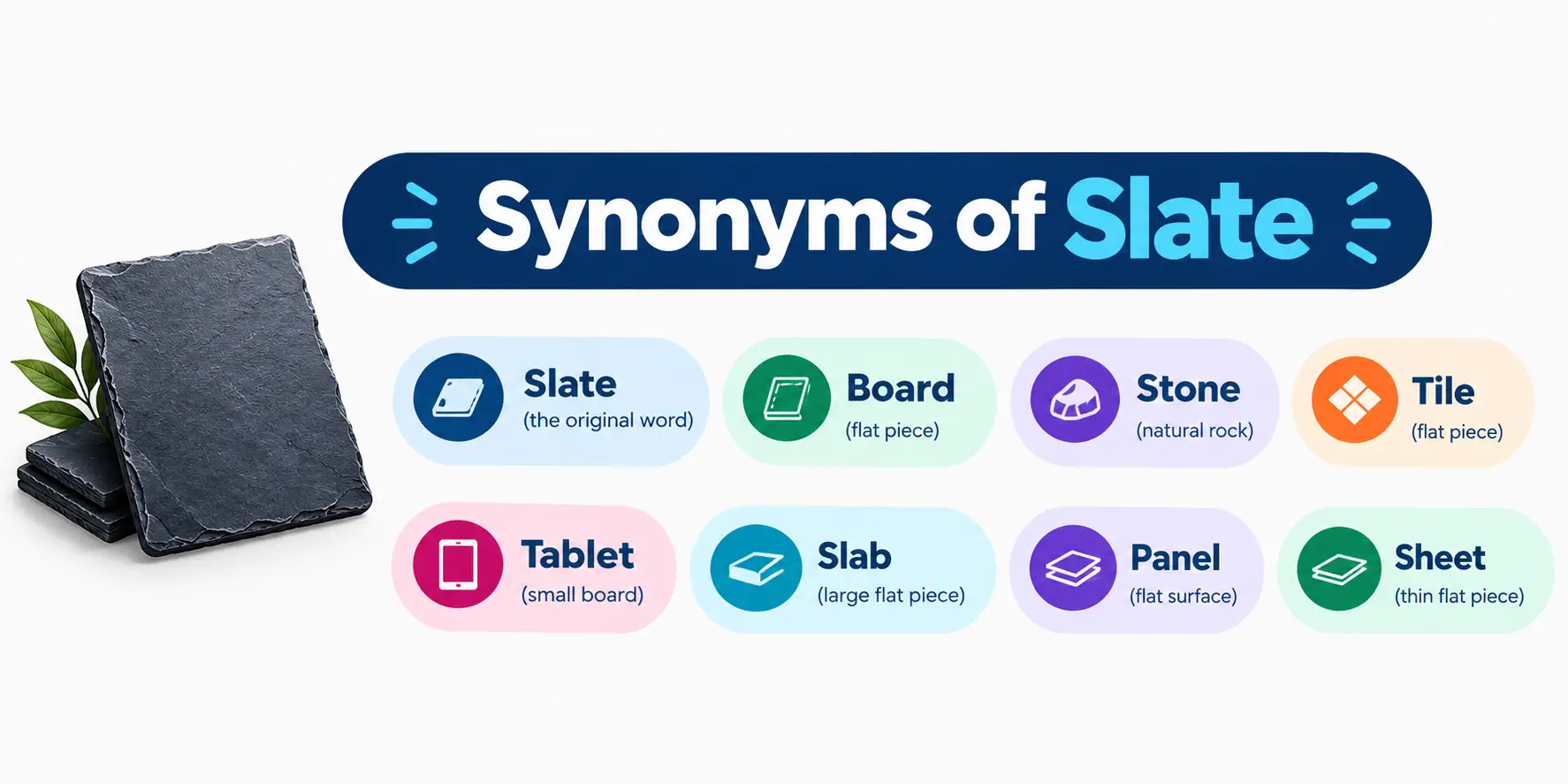
The word slate is unusual because it works as both a noun and a verb, and it carries three genuinely different meanings: a type of rock, a fresh start, and, as a verb, to schedule something or to criticize it harshly. Because these meanings are so different, a single flat list of “30 synonyms” doesn’t really work. Otherwise, you end up comparing a rock to a criticism, which helps no one.
To fix that, this guide groups synonyms by which sense of “slate” they replace. In addition, each entry comes with a short note on how it differs in tone or register, rather than just repeating the definition.
Meaning of Slate
As a noun, slate is a fine-grained rock that splits into thin, flat sheets, used for roofing, flooring, and, historically, writing boards. As an idiom, “a clean slate” means a fresh start, free of past mistakes.
Connotation
- Neutral: the rock/material sense, the scheduling sense
- Positive: “clean slate” (fresh start)
- Negative: the criticism sense
Etymology
“Slate” entered English in the 14th century from Old French esclate / esclat (“split, splinter”), from the verb esclater (“to split, shatter”).
Pronunciation
US: /sleɪt/ · UK: /sleɪt/ · 1 syllable
Part 1: Synonyms for Slate (the Rock / Material)
1. Shale (Noun) — /ʃeɪl/
This is a related but geologically distinct sedimentary rock, softer and more crumbly than slate. So, use it carefully: calling slate “shale” in a construction context is technically inaccurate.
- The hillside was layered with dark shale.
2. Schist (Noun) — /ʃɪst/
Similarly, this is a metamorphic rock that splits into sheets, though it’s often confused with slate despite being coarser-grained and shinier because of its mica content.
- The exposed cliff face was streaked with schist.
3. Flagstone (Noun) — /ˈflæɡstoʊn/
Meanwhile, flagstone refers to flat stone, which may or may not be slate, cut for paving. It’s the right word when the context is paths and patios rather than roofs.
- The garden path was laid with flagstone.
4. Slate Tile / Roofing Slate (Noun)
This is the precise term to use when the context is roofing specifically, making it more specific than “slate” alone.
- The cottage still has its original roofing slate.
5. Writing Slate / Chalkboard (Noun, historical)
This one refers to the schoolroom object rather than the material, so it’s appropriate only in a historical or nostalgic context.
- Children once practiced their letters on a writing slate.
(Note: this is the one category where “slate” itself is hard to replace one-for-one, since slate is a specific mineral.
Part 2: Synonyms for Slate (Verb — “to Schedule”)
6. Schedule
This is a neutral, formal choice, well suited to business or official writing.
- The meeting is scheduled for 3 p.m.
7. Line up
By contrast, this is slightly informal and suggests preparation in advance.
- They’ve lined up three speakers for the conference.
8. Pencil in
Here, the tone is informal and tentative, implying the plan could still change.
- Let’s pencil in Thursday and confirm later.
9. Earmark
Instead of an event, this word usually applies to budgets or resources set aside for a specific purpose.
- Funds have been earmarked for the new roof.
10. Book
For everyday, common usage, this word works well for appointments or venues.
- She booked the hall for Saturday.
11. Slot in
Again informally, this implies fitting something into an already-existing plan.
- Can we slot in a quick call tomorrow?
12. Arrange
As a neutral and versatile alternative, this fits almost any context.
- The trip has been arranged for next month.
13. Timetable (Verb, UK usage)
Particularly in British English, this word is common in institutional contexts such as schools or transport.
- Classes are timetabled from 9 a.m.
Part 3: Synonyms for Slate (Verb — “to Criticize Harshly”)
This is the meaning most vocabulary lists miss entirely, yet it’s arguably the most common use of “slate” in British journalism.
14. Pan
Typically, this word is informal and used for reviews of films, books, or restaurants.
- Critics panned the sequel.
15. Lambaste
More formally, this implies a forceful, angry criticism.
16. Excoriate
Even more intensely, this very formal or literary word suggests a scathing, almost brutal criticism.
- The report excoriated the company’s safety record.
17. Trash (informal)
- Fans trashed the ending online.
18. Blast
In journalism especially, this punchy word is common in headlines.
- The senator blasted the new policy.
19. Censure
For institutional reprimands, such as those from governments or professional bodies, this formal and official term fits best.
- The board voted to censure the director.
20. Lampoon
Unlike a direct attack, this word implies criticism through mockery or satire.
- The show lampooned the government’s handling of the crisis.
21. Condemn
Rather than focusing on quality, this strong word usually expresses moral disapproval of wrongdoing.
22. Rip into (informal)
In speech or casual writing, this vivid, conversational phrase works well.
- The coach ripped into the team at halftime.
23. Savage (verb)
Finally, this informal-literary word implies a review was especially harsh and memorable.
- The album was savaged by reviewers.
Part 4: Synonyms for “Clean Slate” (the Idiom)
24. Fresh start
This is the most direct, plain-English equivalent.
- Moving cities gave her a fresh start.
25. Blank page / blank slate
- He treated the new job like a blank page.
26. New beginning
With a slightly more emotional or personal register, this phrase suits life milestones.
- Their wedding felt like a new beginning.
27. Do-over (informal, American)
- Can I get a do-over on that answer?
28. Tabula rasa (formal/academic)
- Locke described the mind at birth as a tabula rasa.
29. Wipe the slate clean
When “clean slate” alone feels too short, this fuller idiomatic phrase works better.
- The settlement let both companies wipe the slate clean.
30. Second chance
Unlike “clean slate,” this phrase focuses on opportunity rather than erasing the past.
- The judge gave him a second chance.
Antonyms of Slate (by Meaning)
| Sense | Antonyms |
|---|---|
| Clean slate (fresh start) | baggage, history, track record, tainted past |
| Schedule (verb) | cancel, postpone, scrap, call off |
| Criticize (verb) | praise, applaud, commend, laud |
| Rock/material | (no true antonym — it’s a physical material) |
Quick FAQ
Does “slate” always mean the same thing? No, it has three unrelated core meanings, material, scheduling, and criticism, plus the idiom “clean slate.” Therefore, always check context before picking a synonym.
Is “slate” formal or informal? It depends on the sense: the material and scheduling uses are neutral to formal, while the criticism sense shows up more often in informal British journalism than in formal writing.
What’s the biggest mistake people make with this word? Often, people treat “shale,” “schist,” “board,” and “panel” as interchangeable with slate. However, these words are related but geologically or functionally distinct, so using them carelessly can be factually wrong, not just stylistically different.
Which synonym should I use for slate meaning “criticize”? In general, match the register to the context: use pan or trash for informal reviews, lambaste or excoriate for formal writing, and censure for official or institutional contexts.
Conclusion
In short, “slate” is really three or four words wearing one spelling. Because of that, choosing the right synonym depends entirely on which sense you mean, whether it’s the rock, the schedule, the harsh review, or the fresh start. So, match register and context rather than reaching for the nearest word that “sounds similar,” and your writing will read as precise rather than repetitive.