The word tangent is used when someone suddenly shifts away from the main topic of a conversation, lecture, or piece of writing. Picture a teacher explaining a math formula and then pausing to tell a story about a famous mathematician — that shift is a tangent.
Because this idea comes up so often in speech and writing, having a strong set of synonyms helps you avoid repeating the same word and lets you express how someone went off-topic — briefly, humorously, at length, or by accident.
This article covers the meaning, pronunciation, etymology, connotation, and 25 real, commonly used synonyms of “tangent,” each with genuine, dictionary-supported usage.
Meaning of “Tangent”
Tangent (Noun): A topic or line of thought that departs from the main subject.
Examples:
- His comment went off on a tangent about his childhood.
- During the meeting, she took a tangent that distracted everyone.
Connotation
- Positive: Can make a discussion livelier, funnier, or more memorable.
- Negative: Can distract, confuse, or waste time.
- Neutral: Simply describes a shift away from the main subject, without judgment.
Etymology
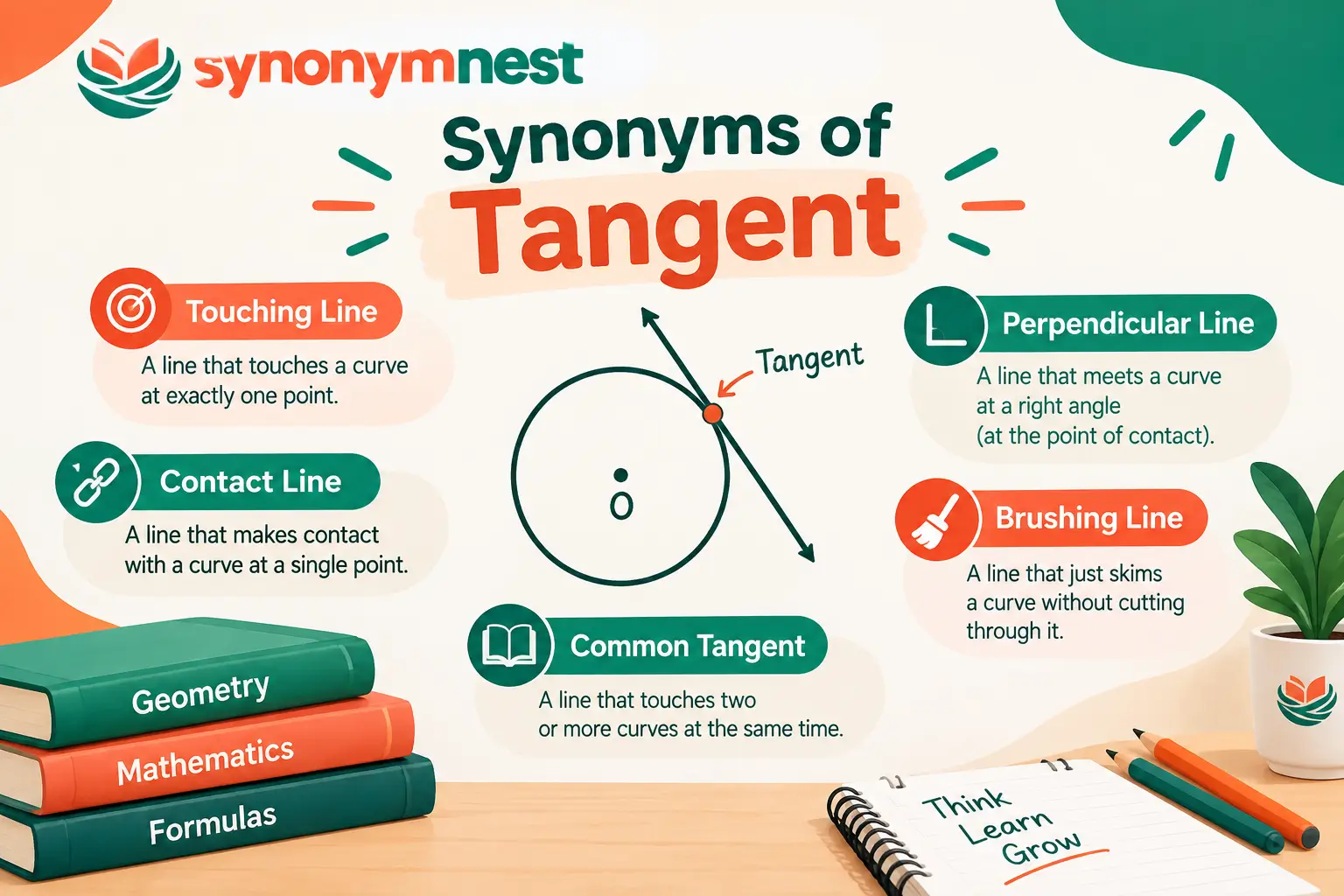
“Tangent” comes from the Latin word tangere, meaning “to touch.” It entered English through mathematics first — a tangent line “touches” a curve at a single point without crossing it. The figurative meaning (“going off on a tangent,” i.e., leaving the main subject) developed from this geometric image: someone touches on a related idea and veers away from the main line of thought. This figurative sense became common in English usage from the 18th century onward and is now the dominant everyday meaning.
Pronunciation
- US: /ˈtæn.dʒənt/
- UK: /ˈtæn.dʒənt/
- Syllables: tan-gent
Word Family
- Root: tang- (from Latin tangere, “to touch”)
- Adjective: tangential
- Adverb: tangentially
- Related phrase: “go off on a tangent” / “go off at a tangent” (UK)
25 Synonyms of “Tangent”
1. Digression (Noun)
US /dɪˈɡrɛʃ.ən/ · UK /dɪˈɡrɛʃ.ən/ Meaning: A temporary departure from the main topic, usually in speech or writing.
- The professor’s digression made the lecture more interesting.
- He included a humorous digression about last year’s conference.
2. Aside (Noun)
US /əˈsaɪd/ · UK /əˈsaɪd/ Meaning: A brief remark that strays from the main discussion, often added as a passing comment.
- She made an aside about her vacation plans.
- The actor whispered an aside to the audience.
3. Deviation (Noun)
US /ˌdiː.viˈeɪ.ʃən/ · UK /ˌdiː.viˈeɪ.ʃən/ Meaning: A departure from an established course, plan, or topic.
- His speech included a deviation into personal stories.
- The lecture contained a small deviation from the agenda.
4. Excursion (Noun)
US /ɪkˈskɝː.ʒən/ · UK /ɪkˈskɜː.ʃən/ Meaning: A brief, often exploratory departure from the main subject (used more in formal or literary contexts).
- The author’s excursion into history was informative.
- The presentation included a short excursion on art techniques.
5. Sidetrack (Verb/Noun)
US /ˈsaɪd.træk/ · UK /ˈsaɪd.træk/ Meaning: To divert attention away from the main subject, often unintentionally.
- The discussion was sidetracked by unrelated issues.
- He went off on a sidetrack about his childhood.
6. Divergence (Noun)
US /daɪˈvɝː.dʒəns/ · UK /daɪˈvɜː.dʒəns/ Meaning: A moving apart or away from the main topic or path, often used in more analytical contexts.
- There was a divergence from the original theme.
- His talk included a divergence into politics.
7. Detour (Noun)
US /ˈdiː.tʊr/ · UK /ˈdiː.tʊə/ Meaning: An indirect route away from the main point, usually temporary and intentional.
- He took a detour to explain an interesting fact.
- The lecture included a brief detour about scientific discoveries.
8. Excursus (Noun)
US /ɪkˈskɝː.səs/ · UK /ɪkˈskɜː.səs/ Meaning: A detailed, formal digression, typically found in academic or literary writing.
- The book included an excursus on medieval literature.
- The teacher added a brief excursus about cultural history.
9. Diversion (Noun)
US /daɪˈvɝː.ʒən/ · UK /daɪˈvɜː.ʒən/ Meaning: Something that shifts attention away from the main point, often used to entertain or distract.
- His anecdote served as a welcome diversion.
- The speaker’s story acted as a diversion in the meeting.
10. Ramble (Verb/Noun)
US /ˈræm.bəl/ · UK /ˈræm.bəl/ Meaning: To talk or write in a wandering, unfocused way, often at length.
- She began to ramble about unrelated events.
- His speech was a long ramble covering various topics.
11. Meander (Verb/Noun)
US /miˈæn.dɚ/ · UK /miˈæn.də/ Meaning: To wander slowly and aimlessly from one topic to another.
- The lecturer tended to meander during class.
- His story meandered through past experiences before reaching the point.
12. Departure (Noun)
US /dɪˈpɑːr.tʃɚ/ · UK /dɪˈpɑː.tʃə/ Meaning: A notable move away from the main subject, plan, or usual approach.
- There was a sudden departure from the agenda.
- His departure from the topic confused some listeners.
13. Drift (Noun/Verb)
US /drɪft/ · UK /drɪft/ Meaning: A slow, gradual movement away from the topic, often without anyone noticing at first.
- The discussion started to drift into unrelated areas.
- The meeting began to drift off-topic after an hour.
14. Veer (Verb)
US /vɪr/ · UK /vɪə/ Meaning: A sudden change of direction away from the main point.
- The speaker veered from the prepared text.
- Her argument took a quick veer into anecdotal territory.
15. Wander (Verb)
US /ˈwɑːn.dɚ/ · UK /ˈwɒn.də/ Meaning: To move aimlessly from one topic to another without a clear direction.
- His talk began to wander after ten minutes.
- The discussion wandered into unrelated anecdotes.
16. Offshoot (Noun)
US /ˈɔːf.ʃuːt/ · UK /ˈɒf.ʃuːt/ Meaning: A secondary topic or idea that branches off from the main one.
- The lecture had several interesting offshoots.
- One offshoot of the discussion focused on politics.
17. Side note (Noun)
US /saɪd noʊt/ · UK /saɪd nəʊt/ Meaning: A brief, often minor comment added outside the main topic.
- As a side note, he mentioned his recent trip.
- The author included a side note on the historical background.
18. Peripheral remark (Noun phrase)
US /pəˈrɪf.ər.əl rɪˈmɑːrk/ · UK /pəˈrɪf.ər.əl rɪˈmɑːk/ Meaning: A comment that is not central or essential to the main topic.
- A peripheral remark provided extra context.
- She made a peripheral remark about her childhood.
19. Non sequitur (Noun)
US /nɑːn ˈsɛk.wɪ.tɚ/ · UK /nɒn ˈsɛk.wɪ.tə/ Meaning: A statement that does not logically follow from what came before — a more abrupt, often jarring kind of tangent.
- His comment about lunch was a total non sequitur in the middle of the budget discussion.
- The film’s dialogue was full of comic non sequiturs.
20. Red herring (Noun)
US /rɛd ˈhɛr.ɪŋ/ · UK /rɛd ˈhɛr.ɪŋ/ Meaning: A distracting point introduced (sometimes deliberately) that pulls attention away from the real issue.
- The lawyer’s question was a red herring meant to confuse the jury.
- Don’t let that detail become a red herring in our discussion.
21. Segue (Noun/Verb)
US /ˈsɛɡ.weɪ/ · UK /ˈsɛɡ.weɪ/ Meaning: A smooth, often deliberate transition to a different (sometimes unrelated) topic.
- He used the joke as a segue into his main argument.
- Her segue from weather to weddings caught everyone off guard.
22. Excursion into (fixed phrase, still worth noting separately from #4 due to common use)
Meaning: Commonly used as “an excursion into [topic]” to describe a focused tangent on a specific subject.
- The article took an excursion into the history of jazz before returning to its main point.
23. Off-topic remark (Noun phrase)
US /ɔːf ˈtɑː.pɪk rɪˈmɑːrk/ · UK /ɒf ˈtɒp.ɪk rɪˈmɑːk/ Meaning: A general, plain-language way to describe any comment unrelated to the main topic.
- He made an off-topic remark during the presentation.
- The discussion included several off-topic remarks.
24. Aside comment (Noun phrase)
Meaning: A slightly more casual variant of “aside,” commonly used in spoken English.
- She threw in an aside comment about the traffic before starting her presentation.
25. Tangential point (Noun phrase)
US /tænˈdʒɛn.ʃəl pɔɪnt/ · UK /tænˈdʒɛn.ʃəl pɔɪnt/ Meaning: A point that is only loosely or indirectly connected to the main topic.
- He raised a tangential point that, while interesting, didn’t move the discussion forward.
Prototype Categorization
- Brief, casual remarks: aside, side note, off-topic remark, aside comment
- Longer or more formal digressions: digression, excursus, excursion, deviation
- Movement-based imagery (wandering, drifting): ramble, meander, wander, drift, veer
- Structural/rhetorical terms: non sequitur, red herring, segue, tangential point
- General departure from a plan or path: departure, divergence, detour, sidetrack, offshoot
Antonyms: focus, directness, main point, central idea, relevance
Quick Q&A
What does “tangent” mean? A departure from the main topic of discussion.
When should you use it? Use it (or its synonyms) to describe someone shifting away from the central subject in speech, writing, or argument.
Is “tangent” positive or negative? It depends on context — a tangent can add humor or insight, or it can distract and derail a conversation.
How is it different from similar words?
- Digression implies a temporary, often self-aware departure.
- Aside is typically brief and conversational.
- Non sequitur implies a jarring, illogical jump rather than a gradual drift.
- Red herring usually implies the distraction is intentional or misleading.
- Segue implies a smooth, controlled transition rather than an accidental one.
Conclusion
Understanding “tangent” and its real synonyms — from casual terms like aside and side note to more formal ones like excursus and digression — helps you describe departures from a topic with more precision. Choosing the right word depends on tone (formal vs. casual), length (brief remark vs. extended detour), and intent (accidental drift vs. deliberate diversion). Practicing with these terms will make your writing and speech more accurate and expressive.