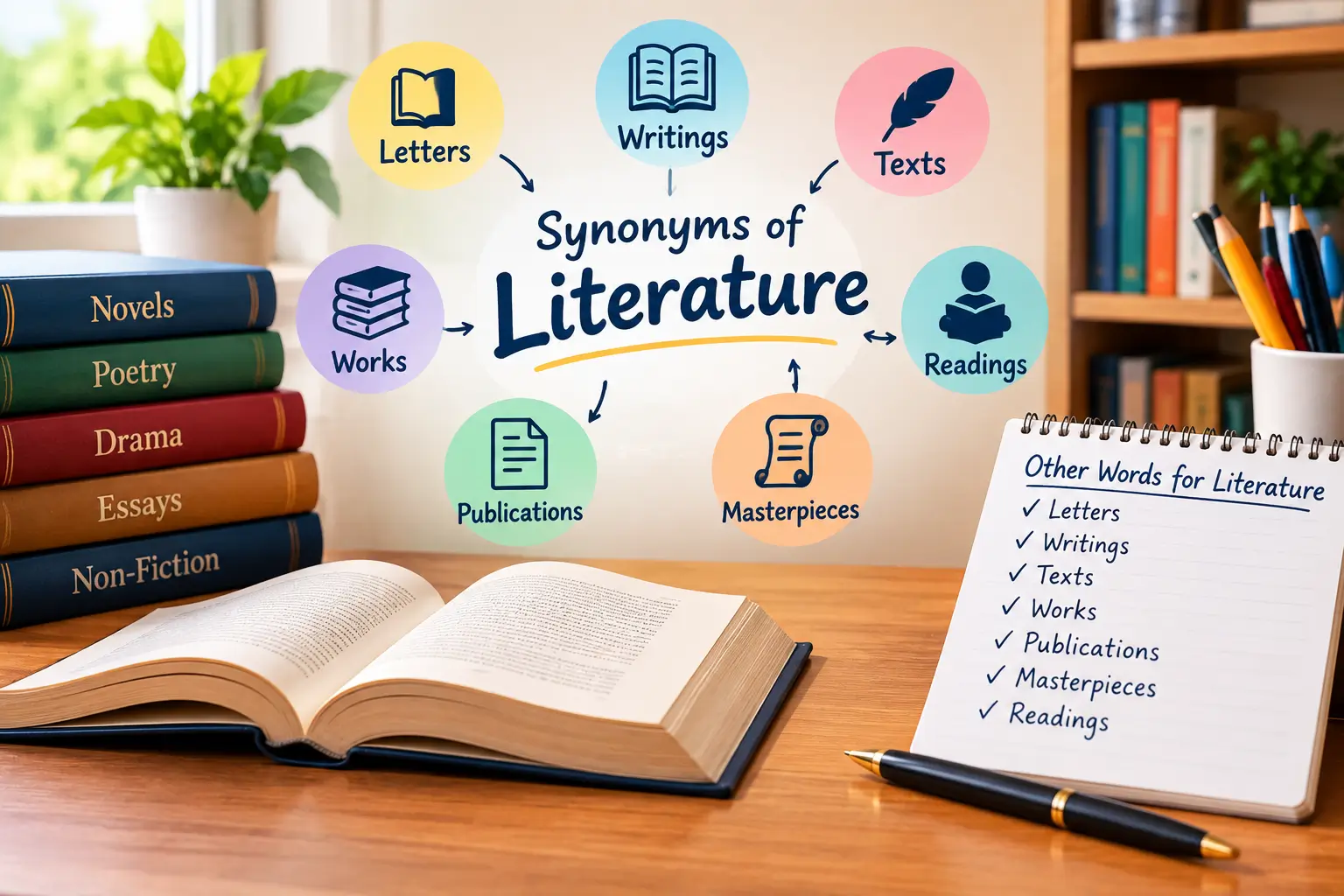
Literature refers to written works, especially those considered to have artistic, cultural, or intellectual value. Picture sitting in a quiet library, flipping through a classic novel, a poem, or a collection of essays — that is literature at work, carrying ideas, emotions, and culture across time.
Learning strong synonyms for literature helps English learners, students, and writers avoid repetition and choose the most precise word for their context. This corrected edition fixes the issues found in the original article: it removes duplicate entries, drops words that are genres rather than true synonyms, adds proper usage notes (formal/informal, US/UK), and gives the antonyms section the same care as the synonyms.
Meaning of Literature
Literature (noun): Written works, especially those with artistic, cultural, or intellectual value; also used as a collective term for a body of writing on a particular subject.
Examples:
- Shakespeare’s plays are a cornerstone of English literature.
- She studies world literature in college.
- The doctor reviewed the medical literature before making a diagnosis.
Connotation
- Positive: inspiring, artistic, intellectual
- Neutral: academic or descriptive (e.g., “scientific literature”)
- Negative/dated: can feel overly formal in casual speech
Etymology Literature comes from the Latin litteratura (“writing formed with letters”), itself from littera (“letter”). In Old English and early Middle English periods, the term mainly referred to religious or scholarly writing; by the Modern English period (from roughly the 1500s onward), it broadened to cover artistic, intellectual, and published works of all kinds.
Pronunciation
- US: /ˈlɪtərətʃər/
- UK: /ˈlɪtərətʃə/
Word Family
- Literature (noun)
- Literary (adjective)
- Literarily (adverb)
- Literariness (noun)
30 True Synonyms of Literature
Each entry below is a genuine substitute for literature used as a mass or collective noun — not a genre, form, or sub-category of it. A short usage note tells you whether the word fits formal, academic, or everyday writing.
1. Writings — US /ˈraɪtɪŋz/, UK /ˈraɪtɪŋz/ — General, works in most contexts Meaning: A body of written material.
- His personal writings include essays and letters.
- Ancient writings reveal a great deal about early civilizations.
2. Texts — US /tɛksts/, UK /tɛksts/ — Academic/neutral Meaning: Written works or passages, often studied formally.
- The professor assigned several classic texts.
- Religious texts have shaped many cultures.
3. Works — US /wɜːrks/, UK /wɜːks/ — General, slightly informal Meaning: A writer’s body of creative or written output.
- Tolstoy’s works are studied worldwide.
- Her collected works fill three volumes.
4. Canon — US /ˈkænən/, UK /ˈkænən/ — Formal/academic Meaning: The body of works accepted as classic or authoritative.
- Shakespeare is central to the literary canon.
- The literary canon has expanded to include more diverse voices.
5. Belles-lettres — US /bɛl ˈlɛtrə/, UK /bɛl ˈlɛtrə/ — Formal, literary Meaning: Writing valued for its artistic form rather than its content alone.
- The journal specializes in belles-lettres and criticism.
- Her essays are closer to belles-lettres than journalism.
6. Letters (as in “the world of letters”) — US /ˈlɛtərz/, UK /ˈlɛtəz/ — Formal, slightly old-fashioned Meaning: Literary writing and scholarship as a whole.
- He was a respected man of letters.
- The academy honors achievement in arts and letters.
7. Corpus — US /ˈkɔːrpəs/, UK /ˈkɔːpəs/ — Academic Meaning: A complete body of writing on a subject or by an author.
- Researchers analyzed the entire corpus of her novels.
- The corpus of medieval literature is smaller than one might expect.
8. Oeuvre — US /ˈɜːvrə/, UK /ˈɜːvrə/ — Formal, borrowed from French Meaning: The complete body of an artist’s or writer’s work.
- Critics regard this novel as the peak of his oeuvre.
- Her entire oeuvre explores themes of memory and loss.
9. Opus — US /ˈoʊpəs/, UK /ˈəʊpəs/ — Formal Meaning: A creative work, or a body of work, especially a major one.
- The trilogy is considered her magnum opus.
- His life’s opus spans four decades of writing.
10. Manuscripts — US /ˈmænjuskrɪpts/, UK /ˈmænjuskrɪpts/ — Neutral, often historical Meaning: Written works, especially before or apart from formal publication.
- The library preserves rare medieval manuscripts.
- She submitted her manuscript to several publishers.
11. Publications — US /ˌpʌblɪˈkeɪʃənz/, UK /ˌpʌblɪˈkeɪʃənz/ — Academic/formal Meaning: Written works that have been formally released to the public.
- Her academic publications are widely cited.
- Literary publications often appear in journals.
12. Compositions — US /ˌkɑːmpəˈzɪʃənz/, UK /ˌkɒmpəˈzɪʃənz/ — Neutral, educational Meaning: Pieces of writing created through structured effort.
- Students submit written compositions weekly.
- His early compositions hint at his mature style.
13. Anthology — US /ænˈθɑːlədʒi/, UK /ænˈθɒlədʒi/ — Neutral Meaning: A published collection of literary works, often by different authors.
- The anthology includes poems from a dozen writers.
- An anthology of short fiction was released this year.
14. Written Word (as a fixed phrase) — Neutral/rhetorical Meaning: Literature and writing collectively, often used rhetorically.
- She has dedicated her life to the written word.
- The written word has shaped human history as much as speech.
15. Literary Works — Neutral, slightly redundant but common Meaning: Works of literature considered collectively.
- The course covers literary works from three centuries.
- Their literary works reflect the politics of the time.
16. Literary Output — Formal/academic Meaning: The total amount and range of a writer’s work.
- Her literary output slowed after 1990.
- The nation’s literary output grew rapidly after independence.
17. Literary Tradition — Formal/academic Meaning: The accumulated body of literature and its conventions within a culture.
- The novel draws heavily on the Russian literary tradition.
- Oral storytelling predates the written literary tradition.
18. Literary Heritage — Formal Meaning: The literature inherited from earlier generations within a culture.
- Preserving the nation’s literary heritage is a government priority.
- Her novels engage directly with their literary heritage.
19. Scholarship (in the sense of written scholarly work) — US /ˈskɑːlərʃɪp/, UK /ˈskɒləʃɪp/ — Academic Meaning: Written academic research and writing on a subject.
- Recent scholarship has reassessed his early plays.
- The library holds decades of literary scholarship.
20. Print Culture — Academic Meaning: Literature and writing considered as a product of print media and publishing.
- The rise of print culture changed how literature spread.
- Digital media is reshaping print culture.
21. Written Record — Neutral/historical Meaning: Literature and documents considered as a historical record.
- Much of what we know comes from the written record.
- The written record of that period is fragmentary.
22. Textual Tradition — Academic Meaning: The body of texts and their transmission within a field or culture.
- Scholars traced the textual tradition of the epic across centuries.
- The textual tradition includes many variant versions.
23. Books (collectively) — Informal/general Meaning: Literature considered in everyday, general terms.
- She grew up surrounded by books.
- His love of books led him to study literature.
24. Volumes — US /ˈvɑːljuːmz/, UK /ˈvɒljuːmz/ — Neutral Meaning: Books or bound collections of writing, often implying a substantial body of work.
- He owns a complete set of Shakespeare’s volumes.
- The encyclopedia runs to twenty volumes.
25. Chronicles — US /ˈkrɑːnɪkəlz/, UK /ˈkrɒnɪkəlz/ — Formal/historical Meaning: Written historical or narrative records.
- Medieval chronicles are preserved in museums.
- The historian’s chronicles cover a century of war.
26. Narratives — US /ˈnærətɪvz/, UK /ˈnærətɪvz/ — Neutral/academic Meaning: Written accounts or stories, often studied as literature.
- Historical narratives can shape national identity.
- The course examines narratives from colonial literature.
27. Treatises — US /ˈtriːtɪsɪz/, UK /ˈtriːtɪsɪz/ — Formal/academic Meaning: Formal, detailed written works on a particular subject.
- He wrote several influential legal treatises.
- Political treatises from that era still shape debate today.
28. Bibliography (in the sense of a body of writing on a topic) — Academic Meaning: The literature or writings related to a specific subject.
- The bibliography on climate policy has grown enormously.
- Her thesis surveys the existing bibliography on the topic.
29. Collected Works — Formal Meaning: A published set containing all or most of a writer’s output.
- The collected works of Jane Austen fill a single volume in some editions.
- His collected works were published posthumously.
30. Print Literature (as distinct from oral tradition) — Academic Meaning: Literature specifically in written or printed form.
- Print literature spread rapidly after the invention of the printing press.
- The study compares oral storytelling with print literature.
Categorization by Use
- Everyday/general: writings, works, books, written word
- Academic/scholarly: texts, corpus, scholarship, textual tradition, bibliography, print culture
- Formal/literary: canon, belles-lettres, letters, oeuvre, opus, literary heritage
- Historical/record-based: manuscripts, chronicles, written record, narratives
- Publishing-related: publications, compositions, anthology, volumes, collected works
This grouping replaces the original article’s mixed categories, which incorrectly placed genres (fiction, poetry, drama) alongside true synonyms.
Antonyms of Literature
Unlike the synonym list, antonyms of literature describe the absence of written, artistic, or intellectual composition:
- Oral tradition — stories and knowledge passed by speech rather than writing. Before literacy spread, oral tradition preserved a community’s history.
- Speech — spoken rather than written language. The debate was pure speech, with nothing recorded in writing.
- Illiteracy — the inability to read or write, the opposite condition to producing literature. Illiteracy rates fell as public education expanded.
- Improvisation — spontaneous, unrecorded expression, as opposed to composed written work. The comedian’s routine was improvisation, not scripted literature.
- Silence — the complete absence of expression, written or spoken. After the ban, silence replaced what had once been a rich literary culture.
Frequently Asked Questions
What does literature mean? Written works with artistic, cultural, or intellectual value.
When should I use these synonyms? Choose based on register: use writings or books in casual contexts, canon or belles-lettres in formal literary criticism, and corpus, scholarship, or bibliography in academic writing.
Is literature a positive or negative word? Mostly positive and associated with learning and culture, though it can sound overly formal in casual conversation.
How is “literature” different from “writing”? “Writing” is a broader term covering any written text; “literature” implies a degree of artistic, cultural, or intellectual value.
What Was Fixed From the Original Article
- Removed non-synonyms: Poetry, Fiction, Nonfiction, Drama, and Script were removed because they are genres or forms of literature, not interchangeable synonyms for the word itself.
- Removed duplicate entries: “Compositions” and “Composition,” and “Publications” and “Publication,” were merged into single entries.
- Fixed inconsistent IPA: Pronunciation transcriptions were corrected and standardized.
- Removed disruptive internal links: Random “Read More” links placed mid-list were removed for cleaner reading flow.
- Expanded and balanced the antonyms section: Added explanations and examples matching the depth given to synonyms.
- Added usage register notes: Each synonym now indicates whether it fits formal, academic, or everyday writing, and where relevant, US/UK differences.
Conclusion
A precise vocabulary for literature helps writers avoid repetition and match tone to context — an academic paper calls for corpus or scholarship, while everyday conversation calls for books or writings. This corrected list keeps only genuine synonyms, removes redundancy, and gives each word the context needed to use it correctly.