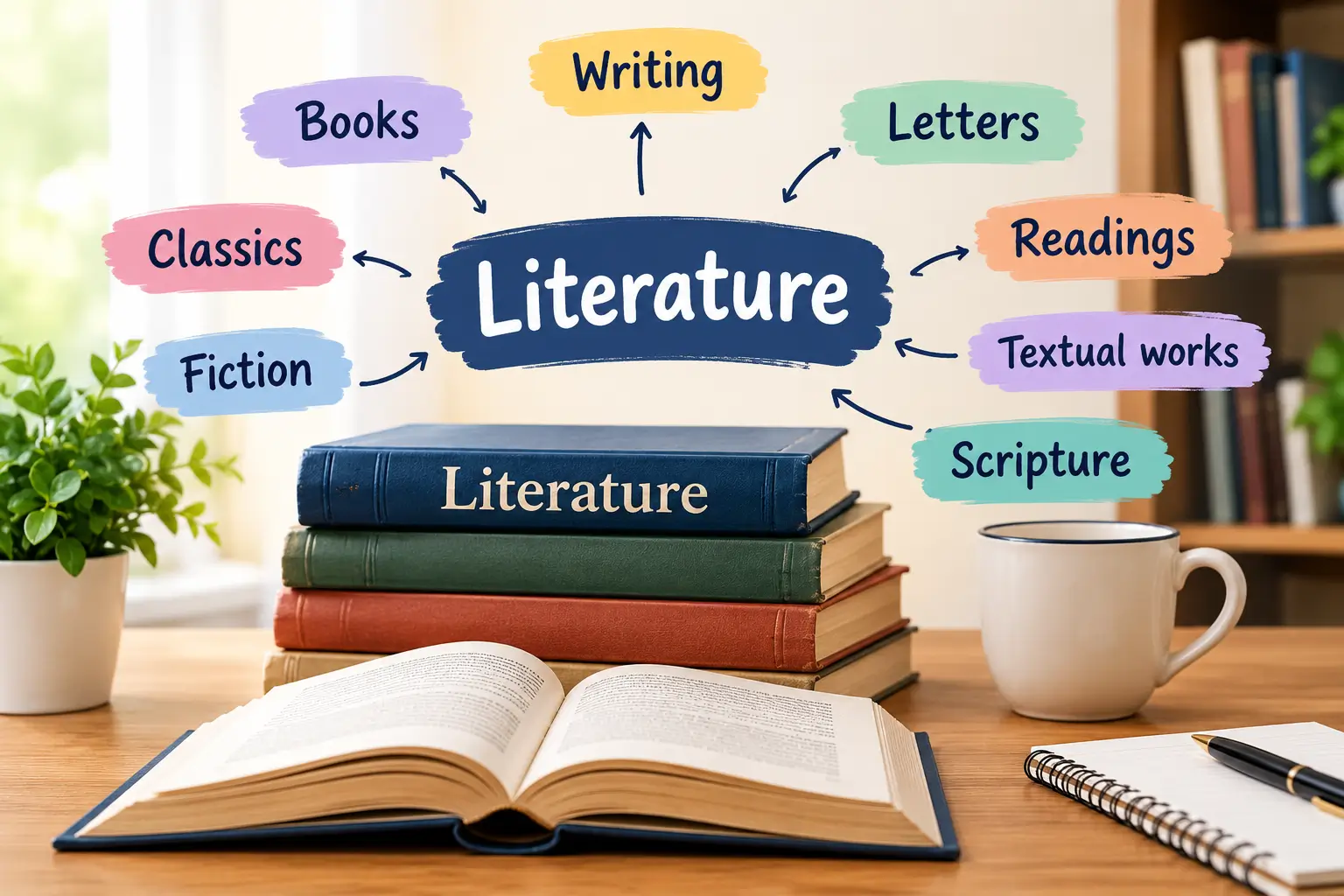
Literature refers to written works, especially those considered to have artistic, cultural, or intellectual value. Imagine sitting in a cozy library, flipping through a classic novel, a poem, or a short story — that is literature at work, communicating ideas, emotions, and culture across time.
The term is widely used in schools, universities, and cultural discussions because literature shapes our understanding of human experience.
Learning synonyms of literature is essential for English learners and content writers. It helps avoid repetition, enriches writing, and allows precise expression depending on context. This article separates genuine, interchangeable synonyms from related literary forms — words often mistaken for synonyms but that actually name a type of literature rather than replace the word itself.
Meaning of Literature
Definition (Noun): Written works, especially those with artistic, cultural, or intellectual value.
Examples:
- Shakespeare’s plays are a cornerstone of English literature.
- She studies world literature in college.
Connotative Meaning
- Positive tone: inspiring, artistic, intellectual
- Negative tone: can feel old-fashioned or overly formal
- Neutral tone: academic or descriptive context
Etymology
Literature comes from the Latin litteratura, meaning “writing formed with letters,” itself derived from littera (“letter”).
- Old English (450–1100): Limited usage, mostly tied to religious and scholarly texts.
- Middle English (1100–1500): Broadened to include poetry, prose, and other written works.
- Modern English (1500–present): Refers broadly to artistic, intellectual, or published works.
Note: literature entered English as a whole borrowed word rather than being built piece-by-piece from an English root and suffix, so it’s more accurate to describe it as a direct Latin loanword than to split it into “liter + ature.”
Pronunciation (US & UK – IPA)
- US: /ˈlɪtərətʃər/
- UK: /ˈlɪtrətʃə/ (often reduced to /ˈlɪtrɪtʃə/ in fast speech)
Syllables: lit-er-a-ture
Word Formation
- Literature (noun)
- Literary (adjective)
- Literarily (adverb)
- Literariness (noun)
Part 1: True Synonyms of Literature
These words can genuinely replace “literature” in most sentences without changing the core meaning — they refer to the whole body of written work, not a specific type.
1. Writings (Noun) — US /ˈraɪtɪŋz/ | UK /ˈraɪtɪŋz/
Meaning: Texts that have been written or recorded.
- His personal writings include essays and letters.
- Ancient writings reveal historical events.
2. Texts (Noun) — US /tɛksts/ | UK /tɛksts/
Meaning: Written works or passages, considered collectively.
- The professor assigned classic texts.
- Religious texts often influence culture.
3. Publications (Noun) — US /ˌpʌblɪˈkeɪʃənz/ | UK /ˌpʌblɪˈkeɪʃənz/
Meaning: Printed or digital works released publicly.
- Her publications include novels and articles.
- Academic publications are peer-reviewed.
4. Compositions (Noun) — US /ˌkɑːmpəˈzɪʃənz/ | UK /ˌkɒmpəˈzɪʃənz/
Meaning: Works created through writing or structured arrangement.
- He submitted several essay compositions.
- Her compositions are studied for their structure and style.
5. Works (Noun) — US /wɜːrks/ | UK /wɜːks/
Meaning: Written or creative pieces, taken as a body.
- Tolstoy’s works are studied worldwide.
- Her collected works span four decades.
6. Canon (Noun) — US /ˈkænən/ | UK /ˈkænən/
Meaning: The accepted body of important literary works.
- Shakespeare is part of the Western canon.
- The canon evolves as new voices are recognized.
7. Anthology (Noun) — US /ænˈθɑːlədʒi/ | UK /ænˈθɒlədʒi/
Meaning: A published collection of selected literary works.
- The anthology includes poems from multiple authors.
- An anthology of short stories was published last year.
8. Corpus (Noun) — US /ˈkɔːrpəs/ | UK /ˈkɔːpəs/
Meaning: The complete body of written work by an author, period, or tradition.
- Scholars study Austen’s entire corpus.
- The corpus of medieval literature is still being catalogued.
9. Oeuvre (Noun) — US /ˈɜːrvrə/ | UK /ˈɜːvrə/
Meaning: The complete body of an author’s creative work.
- Her oeuvre reflects decades of social commentary.
- Critics regard his oeuvre as a single, evolving project.
10. Belles-lettres (Noun) — US /ˌbɛl ˈlɛtrə/ | UK /ˌbɛl ˈlɛtrə/
Meaning: Writing valued for its artistic and aesthetic qualities.
- The course focuses on belles-lettres rather than technical writing.
- Belles-lettres includes essays prized for style as much as substance.
11. Letters (Noun, in “man/woman of letters” sense) — US /ˈlɛtərz/ | UK /ˈlɛtəz/
Meaning: Literary or scholarly writing as a field.
- He devoted his life to letters.
- She was celebrated as a woman of letters.
12. Volume (Noun) — US /ˈvɑːljuːm/ | UK /ˈvɒljuːm/
Meaning: A published book, often as part of a larger body of work.
- He owns a complete volume of Shakespeare’s plays.
- Each volume covers a different literary period.
13. Writing (Noun, uncountable) — US /ˈraɪtɪŋ/ | UK /ˈraɪtɪŋ/
Meaning: The general practice or product of written expression.
- Her writing is elegant and precise.
- Creative writing courses build these skills.
14. Bibliography (Noun, in the “body of texts on a subject” sense) — US /ˌbɪblɪˈɑːɡrəfi/ | UK /ˌbɪblɪˈɒɡrəfi/
Meaning: The literature or published material relating to a particular subject.
- The bibliography on postcolonial theory is vast.
- Researchers must review the existing bibliography first.
Part 2: Related Literary Forms (Not Direct Synonyms)
These words describe specific types or genres of literature. They cannot always replace “literature” in a sentence — you can say “she studies world literature,” but “she studies world fable” doesn’t carry the same meaning. Use them when you mean a particular form, not the whole field.
| Word | Meaning | Example |
|---|---|---|
| Prose | Ordinary written language, not verse | Her prose is clear and engaging. |
| Poetry | Literary work written in verse | Romantic poetry is timeless. |
| Fiction | Literature based on imagination | She writes historical fiction. |
| Nonfiction | Literature based on fact | Biographies are nonfiction. |
| Drama | Literature written for performance | Greek drama still influences theatre. |
| Essays | Short written works on a topic | Her essays are widely quoted. |
| Treatises | Detailed formal writing on a subject | He wrote several legal treatises. |
| Novels | Long fictional narratives | Classic novels remain widely read. |
| Stories | Written narratives, short or long | Children love bedtime stories. |
| Chronicles | Detailed factual records of events | Medieval chronicles are preserved in archives. |
| Narrative | An account or story, in any form | The film follows a simple narrative. |
| Allegory | A symbolic story with hidden meaning | The novel is an allegory for freedom. |
| Fable | A short story teaching a moral lesson | Aesop’s fables are timeless. |
| Myth | A traditional story explaining culture or nature | Greek myths still shape storytelling. |
| Legend | A traditional story handed down over time | Arthurian legends inspired countless writers. |
| Epic | A long narrative poem of heroic events | Homer’s epics are foundational texts. |
| Tale | A told or written narrative | The novel is a compelling tale. |
| Script | Written text prepared for performance | The play’s script was published this year. |
Antonyms
Literature doesn’t have a clean, single-word antonym — its opposite is really a contrast in form, not a fixed word. The closest contrasts are:
- Oral tradition / oral literature — stories and knowledge passed by speech rather than writing
- Illiteracy — the absence of the ability to read or write, contrasted with literature’s dependence on the written word
- Speech / improvisation — unrecorded, spontaneous spoken expression, as opposed to fixed written text
These are useful contrasts for discussion, but none function as a true one-word opposite of “literature.”
Short Questions and Answers
What does literature mean? Written works with artistic, cultural, or intellectual value.
When should I use “literature” versus a genre word like “fiction” or “poetry”? Use “literature” for the whole field or body of written work. Use genre words (fiction, poetry, drama) when referring to a specific type within that field.
Is literature a positive or negative word? Mostly positive — associated with learning, culture, and artistic merit.
How is “literature” different from “writing”? “Writing” is broader and includes anything written, regardless of artistic value. “Literature” implies a level of craft, cultural significance, or intellectual weight.
Conclusion
Learning accurate synonyms of literature — and knowing which words are true substitutes versus which are genre-specific terms — strengthens both vocabulary and precision in writing. Choosing the right word for the right context avoids repetition and helps readers understand exactly what kind of literary work is being discussed, whether that’s the entire field, a specific author’s body of work, or one particular form like poetry or drama.